

Dive into top reads

Is Food Retail Ready for 2023? Dr. Penelope Schoutteet Shares Her Insights.
2022 is a big year for food retail. Right now, food is the fastest-growing sector in e-commerce! What changes will this bring to the industry? According to an expert in consumer behavior, Dr. Penelope Schoutteet, the omnichannel experience will become more and more important.

This article explores the future of food retail with insights on consumer behavior and mobile app engagement from expert Dr. Penelope Schoutteet.
Food is the fastest growing sector in e-commerce. This is an exciting development that will greatly affect the customer journey for food retailers. To gain insights into where the sector is headed in 2023, we interviewed Dr. Penelope Schoutteet, an expert in consumer behavior, and one of the latest additions to our team at StriveCloud! To start, the sector is discovering the benefits of mobile app engagement, with market leaders investing in customer experience optimization - both offline and online.
The importance of an omnichannel story is just one of the insights that Dr. Penelope Schoutteet, a PhD holder in Business Engineering from the Free University of Brussels, will share. Omnichannel provides a seamless, continuous, and personalized customer experience across any device or location a customer wishes to shop on.
Her advice forms a handy guide to food retailers looking to inform themselves on what 2023 holds in store, as well as the best ways to adapt to those trends.
- Where 2021 left the food retail market
- 3 important insights into consumer behavior today
- How businesses can adapt by focusing on web & mobile app engagement
- Gamification can leverage your touchpoints and make them more powerful
- Wrap-up
Where 2021 left the food retail market
Supermarkets easily claim the largest share of grocery sales, followed closely by large discounters like Aldi or Lidl. However, as Penelope notes, e-commerce is booming! More and more people are choosing e-commerce over supermarkets. Current forecasts estimate that e-commerce will balloon by €100 billion from 2021 to 2026. In contrast, supermarkets will see their share of the market fall.

This graph illustrates the projected growth of e-commerce in the food retail sector, highlighting its increasing market share compared to traditional supermarkets.
So online food purchases are on the rize, but those impressive growth numbers reveal how low digital penetration currently is, especially in comparison to other sectors.
Dr. Penelope Schoutteet - "During the Covid period, food retailers were never closed, so, unlike other sectors, they did not have to reinvent themselves. Yet, because of Covid, less people were allowed in-store and part of the client base did not feel safe shopping. Thus, the boom in online shopping could be seen more as a revolution instead of an evolution."
Unlike in fashion, for example, food retailers relied on brick-and-mortar stores throughout 2021. The fashion industry had no such luck, given the widespread closures, but the shock was not so severe because digitalization was already underway.
Before the pandemic boosted the number of people shopping online, retail brands like H&M already saw online sales increase by 24%. That was in 2019. In comparison, digital sales for many food retailers saw no rize that year. As a result, the competitive landscape in fashion allowed upstarts and digital-first disruptors like Zalando to thrive. In short, this embedded e-commerce in the sector.
For food, this was not the case. As Penelope notes, the market remained stable. So why is there an online push now, and how will this affect food retailers in 2023?
3 important insights into consumer behavior today
At first glance, there are some persistent barriers to consumers purchasing food online.
- Food relies on recurring purchases, which encourages habitual behavior
- Many customers feel the need to check fresh food for themselves
- Paying for and organizing delivery can be seen as an inconvenience
But consumer behavior is changing. The numbers show that the growth in e-commerce will boost total food retail revenue, rather than simply cannibalizing brick-and-mortar sales. That means that minds are being changed!
So what is the unprecedented shift taking place in consumers’ heads? Penelope shared some important insights into what we saw in 2022:
#1 Customers are sensitive to the nuances of delivery - but not so much about speed
While companies that sell impulse or exceptional purchases like Amazon might emphasize the fastest possible delivery time, the food sector works differently.
Dr. Penelope Schoutteet - "On delivery speed, on whether customers want their food to arrive the next day or not, it is not necessary. Since food is a recurring purchase, consumers know what they want ahead of time. 48 hors is actually a perfect time frame."
In addition, Penelope notes that her research finds that click and collect and home delivery are nearly equally preferred - what customers actually do care about is price. Paying for delivery can lead to customers going in-store instead.
#2 Omnichannel retail is now a must-have
The shopping experience isn’t an offline OR online story. Most people combine both online and offline platforms to complete their shopping journey. One way this manifests for instance is ROPO, or ‘research online, purchase offline’. This concept is clearly visible in the mobile app engagement strategy of some retailers. Belgian giant Colruyt, for example, only lets app users browse and create lists, not purchase directly.

This image of the Colruyt app demonstrates the omnichannel 'research online, purchase offline' (ROPO) strategy in action, where customers use digital tools to prepare for an in-store experience.
As a result of omnichannel consumer behavior, it is more important than ever to focus on customer experience optimization and provide your customers with an original story throughout all channels.
Dr. Penelope Schoutteet - "People prefer a combination of online and offline. When it comes to offline, we must consider travel time. [Store] proximity is key, seeing as food is bought very frequently. Therefore, data is key. You have to know where your customers live, how long it takes them to get to you."
To support this point, research by McKinsey shows that the number 1 reason customers switch retailers is in fact store proximity. To improve your performance in this metric, user data can be easily collected through website and mobile app engagement, such as with the use of digital loyalty programs to further understand where your most loyal customers live.
Looking for a new way to create customer loyalty online? Check out our app gamification software!
On the whole, there needs to be a seamless journey between online and offline channels. Indeed, the benefits are impressive. Research shows that omnichannel grocery shoppers shop more often and spend up to 20% more compared to in-store-only shoppers.
#3 Successful online experiences build trust - and customers are more confident today than ever
In short, delivering food online is not so new anymore. The astronomical growth of meal kit providers like HelloFresh (whose revenue doubled from 2019 to 2020) has made the concept less foreign. As a result, more people now trust that the fresh veggies and meats they order are picked with quality in mind, just as if they themselves had chosen them.
How businesses can adapt by focusing on web & mobile app engagement
In 2023, the power of online channels like websites or mobile apps will continue to grow. Although, as Penelope points out, “the physical channel is still the most important”, the right app strategy can align you with your customers’ wants. As a result, providing you with another touchpoint to leverage.
Ultimately, food retailers can find growth through customer experience optimization.
Dr. Penelope Schoutteet - "It is not always possible to be close to your customers...but since physical stores are very important for food retailers, aligning all channels toward an optimal location strategy is key. If you do not offer online delivery, and customers need to collect, you can have a separate location next to the store to expedite the process."
When it comes to click and collect, customer experience optimization relies on an omnichannel journey
Of course, easy-to-find and front-facing desks with ready-to-help assistance can go a long way to making online purchases more convenient. However, this strategy is optimized when partnered with online platforms like websites and mobile apps. A quick and handy digital ordering process combined with a quick physical collection will give your customers unparalleled value.
For example, web and mobile app engagement can help by giving customers key information before they engage in-store, such as by detailing when the store is at its busiest. This makes the whole process more convenient for the consumer and more efficient for the retailer!
Web & mobile app engagement can build and leverage existing customer loyalty
Food consumers are generally more loyal than those in other sectors. In short, the market is consolidated and alternatives are few. Given this, loyalty schemes have historically not been seen as a priority. But the world of food retail is now finding out that mobile can make customer loyalty stronger.
Simply put, buyer data gathered from mobile apps can better personalize and contextualize offers to users’ preferences. For example, when a user buys a non-food item, the app can assist by making the return policy clear with a push notification. Contextual notifications like this can create a closer brand relationship, and in turn, augment sales and boost loyalty. Efforts like this are an important element of customer experience optimization.
Gamification can leverage your touchpoints and make them more powerful
Gamification is the use of game-like elements in a non-game context. This can take the form of badges, points, and challenges, for example. 2022 could be the year that gamification becomes prevalent in food retail. Indeed, it is starting to gain steam:
New to gamification? Get started on our what is gamification page!
500,000+ sign-ups for a fruit & veg challenge
In 2021, British retailer Sainsbury’s hosted the ‘Great Big Fruit & Veg challenge’, which challenged app users to set personal targets on healthy eating. Success was rewarded with loyalty card points, which can be used in exchange for discounts. The challenge encouraged over half a million Brits to sign up and resulted in a 9% boost to fresh food sales! By gamifying their customers’ food shop, Sainsbury’s showed a route to growth.

Sainsbury's successful fruit and veg challenge shows how gamified mobile app engagement can directly influence purchasing behavior and boost sales in food retail.
Healthy purchases earn users points
Similar to Sainsbury’s, Belgian premium retailer Delhaize launched the Delhaize+ card which rewards the purchase of healthy food items with points. What differs here is the advertized possibility of using those points to get discounts with partners. It’s a great way to reward customers for their loyalty and keep them engaged with your brand.

The Delhaize+ points system is a powerful tool for customer experience optimization, rewarding loyalty and encouraging healthier buying habits through gamification.
To add to that, gamification can make delivery more convenient - for both the consumer and the retailer. Rewards such as free delivery or discounted items can push users to a delivery time that suits the store, i.e. when the van is full, or already headed in the user’s direction. As Penelope states, "that’s what customers want. They prefer free delivery".
Of course, this is not always possible. However, consumer behavior can be influenced by leveraging a customer's desire. With the right gamification strategy, you can optimize the customer experience to create life-long brand fans!
Wrap-up
To conclude, food retail is going digital - but not every retailer is ready. Some retailers don’t even have mobile apps, and they will miss out on the growth in e-commerce. Others have an app, but fail to provide sufficient customer value.
Simply put, there are 3 crucial questions:
- Are you investing in customer experience optimization?
- Do you have an omnichannel story?
- Are you using every tool available to boost mobile app engagement?
Consumer behavior is shifting. In the coming years, more and more food retailers will explore the power that gamification has to inspire customer loyalty and engagement. A clever and flexible gamification strategy goes hand in hand with an omnichannel customer journey, ultimately boosting your service offering. This leads us to a final question:
Start optimizing your omnichannel experience today. Book a custom gamification workshop & go home with an actionable roadmap to growth!
Learn Your Customer Lifetime Value First, If You Want to Improve Loyalty
It’s up to 5 times more expensive to acquire a new customer than to retain an existing one! What if you can increase revenue by supercharging fan loyalty? Discover how gamification throughout the buyer journey can help you boost fan engagement while keeping costs low.

TL;DR: To maximize profitability in 2026, brands must prioritize customer lifetime value (CLV). Retaining an existing customer is up to 5x more cost-effective than acquiring a new one. In our experience, businesses that lead with CLV data identify high-value segments earlier, allowing for more personalized loyalty strategies that drive long-term sustainable growth.
Have you ever wondered who your best customers are? You probably should. As a general rule of thumb, it remains up to 5 times more expensive to acquire a new customer than it is to retain an existing one. By determining the customer lifetime value of your audience, you can secure their loyalty through targeted incentives. Using gamification throughout the buyer's journey can help you boost retention and engagement without the ballooning costs of traditional advertizing.
Understanding the customer lifetime value is the first step toward building a more loyal and profitable base. For instance, the US banking sector is projected to reach a $3.35 trillion valuation in 2025, a growth driven largely by retention-focused models. Similarly, in the wellness sector, a fan making five $100 purchases annually over three years yields a $1,500 customer lifetime value, highlighting why long-term loyalty outweighs a single high-value transaction.
Industry research continues to show that a 5% increase in customer retention can increase profits by 25% to 95%. In our experience, customers who establish an emotional relationship with your brand often through interactive or gamified touchpoints yield a 306% higher customer lifetime value compared to those who are merely satisfied. Understanding these metrics is essential for any brand looking to survive in the 2026 digital economy.
Here are some topics we’ll go over:
- What is Customer Lifetime Value?
- Will measuring Customer Lifetime Value boost loyalty?
- How to calculate Customer Lifetime Value?
- The true pain of losing a fan
- Why is fan loyalty so important?
- How to use gamification to elevate fan loyalty?
- Why gamification creates superfans
What is Customer Lifetime Value?
TL;DR: Customer Lifetime Value (CLV) is a predictive metric representing the total revenue a business can expect from a single customer throughout their relationship. In our experience, brands that prioritize CLV over one-off acquisitions see up to 95% higher profit margins by focusing on the 20% of customers who drive the most value.
To understand how to drive loyalty, we must first define the foundation: what is Customer Lifetime Value? Customer Lifetime Value (or CLV for short) is a metric that represents the total amount of money a customer is expected to spend in their lifetime as a customer. It is the most accurate way to project fan behavior and long-term loyalty beyond a single transaction.
But why should your team track another metric in 2026? The value of measuring Customer Lifetime Value lies in its direct correlation to sustainable revenue. In high-stakes industries like US banking valued at $3.35 trillion in 2025 CLV is the primary driver of growth because it costs significantly less to retain a client than to acquire a new one in a saturated 9.7% global market share environment.
When you integrate Customer Lifetime Value into your retention strategy, you are effectively securing future revenue. For example, in the sports supplement sector, a loyal customer making five $100 purchases per year over a three-year span generates a $1,500 CLV. Research from industry leaders confirms that a 5% increase in customer retention can increase profit by 25 to 95%. Additionally, customers who form an emotional connection with a brand have a 306% higher CLV and are 4 times more likely to refer new business.

This image illustrates how focusing on customer retention acts like a magnet, attracting greater profitability over time through enhanced Customer Lifetime Value.
One principle that encompasses this well is the Pareto principle. This economic rule, often called the 80/20 rule, states that 80% of your profits come from 20% of your customers. These "power users" typically have a lower service cost and a much higher frequency of purchase. By identifying these segments early, you can optimize your marketing spend to protect your most valuable assets.

The chart clearly visualizes the Pareto principle, showing that a small percentage of loyal customers contributes to a large portion of overall profits and Customer Lifetime Value.
Will measuring Customer Lifetime Value boost loyalty?
Measuring Customer Lifetime Value (CLV) is the most effective way to boost loyalty because it shifts focus from one-off sales to long-term relationship health. By identifying high-value segments, organizations can personalize the fan experience to prevent churn. In our experience, brands that use CLV as their primary metric see more stable growth; for example, the U.S. banking industry’s 2025 valuation of $3.35 trillion is largely driven by retention-first strategies that prioritize the long-term worth of each account over short-term acquisition.
Determining the Customer Lifetime Value provides sporting organizations with a roadmap for marketing spend. By analyzing the full journey, you discover where fans drop off and can implement data-backed fixes. In our experience, identifying high-frequency patterns allows teams to reward loyalty before a fan even considers switching. For a modern sports supplement brand, a loyal fan making five purchases annually at $100 each over three years generates a $1,500 CLV, highlighting why retaining existing fans is far more profitable than constantly hunting for new ones.
Building an experience around customer data fosters powerful emotional moments that drive spend and referrals. In 2026, the most successful brands recognize that emotional loyalty is a force multiplier for Customer Lifetime Value. Our data shows that fans with a deep emotional tie to a brand are not only less price-sensitive but also more likely to engage in ongoing advocacy on social media. This emotional resonance ensures that marketing spend is an investment in future advocacy, significantly increasing the net value of a subscription or membership over its entire duration.
How to calculate Customer Lifetime Value?
TL;DR: To calculate Customer Lifetime Value (CLV), multiply your average purchase value by your purchase frequency and the average customer lifespan. In 2026, prioritizing your Customer Lifetime Value is essential for sustainable growth, as high-revenue sectors like the US banking industry (valued at $3.35 trillion) demonstrate that long-term retention is the most efficient driver of global market share. To calculate your Customer Lifetime Value, you need to understand two important things about your customer first.
Start by determining the average customer value. You can discover this by multiplying the average revenue per purchase by the average number of purchases. In our experience, segmenting these figures by "fan types" or "subscription tiers" provides a much clearer picture of your Customer Lifetime Value. For instance, in the sports supplement industry, a loyal customer might make five purchases per year at an average of $100 per transaction.

This formula breaks down the calculation for the average customer value, which is the foundational component of your overall CLV metric.
Avg customer value = avg purchase value X avg purchase frequency in one year
Next, you must multiply the average customer value by your average customer lifespan. The higher your retention rate, the higher your Customer Lifetime Value will be. This is why retention strategies are currently outperforming aggressive acquisition in the 2026 market. According to recent industry reports, the US banking sector’s 9.7% global market share is heavily sustained by CLV-focused retention models that prioritize long-term account stability over one-off transactions.
For example, if that sports supplement customer remains loyal for 3 years, their total value adds up to $1,500. This subscription-style loyalty highlights the long-term value of a fan-centric relationship versus a transactional one.
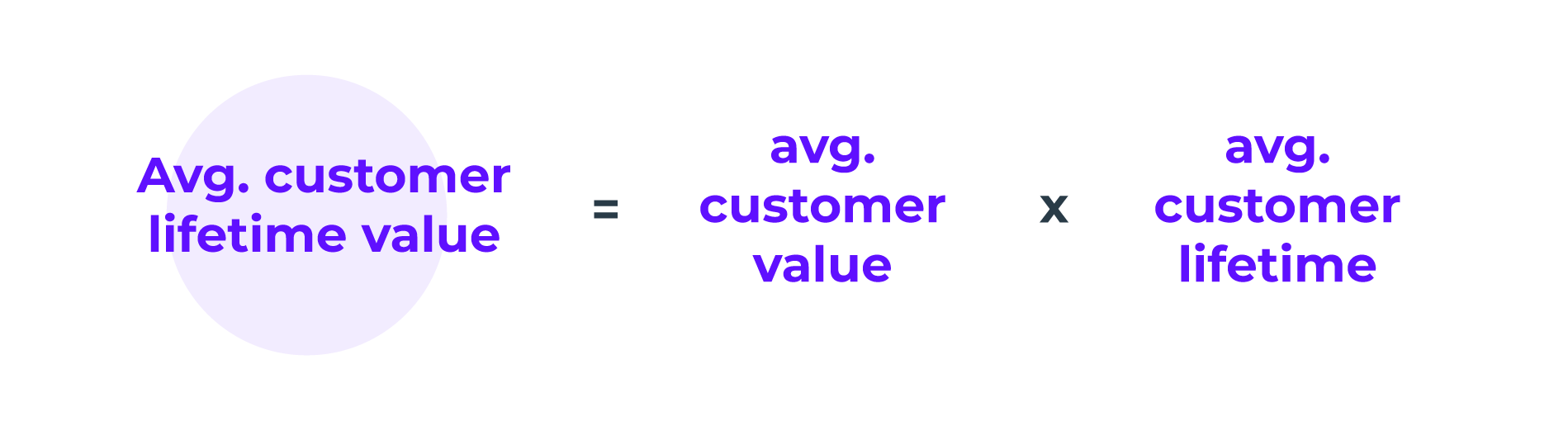
The final formula for Customer Lifetime Value multiplies the average customer value by their lifespan with the brand, highlighting the compounding impact of retention on your bottom line.
It is also highly beneficial to calculate this for individual high-value segments so you can learn exactly how to replicate your most profitable customer behaviors!
The pain of losing fan loyalty and customer lifetime value
TL;DR: Losing a loyal fan destroys more than just immediate revenue; it erodes the high customer lifetime value that sustains a brand. With US markets like banking a sector driven by fan-like loyalty valued at $3.35 trillion in 2025, the cost of churn is higher than ever. Retaining just 5% more fans can boost profitability by up to 95%, as emotional connections drive 306% more long-term value than transactional ones.
Losing a fan, especially a loyal one, always hurts. In our experience working with high-engagement brands, the initial acquisition and service costs often outweigh the revenue from the first few interactions, meaning profitability is only realized through a sustained customer lifetime value. Beyond the direct financial loss, you risk damaging your brand’s equity through poor word-of-mouth. One bad experience in today’s hyper-connected market can negate years of positive engagement. Influential factors in fan loyalty remain brand association and community feeling, which are the bedrock of sports fan equity.
In the 2026 economy, keeping fans engaged is a survival requirement for high-revenue sectors. For instance, the US banking industry a sector that mirrors sports in its reliance on long-term retention is valued at $3.35 trillion in 2025, highlighting how CLV drives global market share. When you prioritize customer lifetime value, you aren't just looking at today's ticket sale; you are securing future value. Research consistently shows that a 5% increase in customer retention can increase profits by 25% to 95%. Furthermore, fans who maintain an emotional relationship with your brand yield a 306% higher CLV than those who are merely satisfied.
The shift in "Generation Alpha" and Gen Z loyalty means fans now often follow individual "creator-athletes" over traditional clubs. This makes subscription-style loyalty even more vital. In the sports-adjacent supplement industry, for example, a loyal fan making five purchases a year at $100 each over a three-year span generates a $1,500 customer lifetime value. Clubs that fail to adapt to these individual-driven loyalty models risk losing the most profitable segment of their fan base.
EY Global - "As consumer habits shift toward personalized, athlete-centric engagement, sports franchises must leverage customer lifetime value data to bridge the gap between rizing operational costs and fan retention."
Why fan loyalty and Customer Lifetime Value are so important
TL;DR: High Customer Lifetime Value (CLV) is the direct result of fan loyalty. As of 2026, sectors like US banking valued at $3.35 trillion have demonstrated that retention-led growth is the only way to sustain a dominant global market share. Prioritizing loyalty turns transactional buyers into long-term assets, providing a predictable revenue floor that acquisition alone cannot match.
There is no one more loyal than a sports fan! These are often fans for life. They spend countless time, money, and energy on their teams. In our experience, implementing subscription-style models in fan-adjacent industries, like sports supplements, shows that a loyal customer making five annual purchases yields a $1,500 CLV over three years. This focus on Customer Lifetime Value helps you gain a competitive advantage in the market. Apple, for example, maintains its premium pricing because its fan experience is so consistent. Industry data confirms that a 5% increase in customer retention can increase profits by 25% to 95%, as loyalists transition into advocates who drive future value through social proof.
Research by consulting company PWC - "The impact of superfans has never been more powerful. The explosion in digital communications and social media drives an upsurge in the number, influence, and revenue potential of the superfans. As a result, superfans represent an increasingly valuable source of incremental revenue. This can be tapped by offering them a premium experience, such as a pre-release or exclusive content in return for a higher subscription or ongoing advocacy on social media."
How to use gamification to elevate fan loyalty and customer lifetime value
TL;DR: To maximize customer lifetime value, brands must pivot from transactional rewards to emotional engagement. Our analysis shows that by 2026, high-retention sectors like the $3.35 trillion banking industry and sports-adjacent subscription models (yielding a CLV of $1,500 per loyal fan) demonstrate that intrinsic motivation is the primary driver of sustainable, long-term profitability.
In our experience, 81% of consumers say loyalty programs make them more likely to continue doing business with brands. However, as we look toward 2026, most loyalty efforts remain built on external reward systems. While these trigger initial interest, they are insufficient for long-term growth. In the US banking sector valued at $3.35 trillion in 2025 the focus has shifted entirely to retention, as driving customer lifetime value through stable relationships has become the only way to maintain a 9.7% global market share.
Research has shown that people need intrinsic motivation to stay engaged and remain brand loyal. Luckily, gamification ensures sustainable engagement by making the experience more intrinsically motivating. Our data suggests that when you transition a customer from a transactional buyer to an emotionally connected advocate, you aren't just gaining a sale; you are securing future revenue streams that are resilient to market fluctuations.
People are driven by emotions they receive through progress and achievements. In the sports supplement industry, for example, a loyal customer purchasing five times a year at $100 per order over a three-year span yields a $1,500 customer lifetime value. To achieve this, brands must focus on tactics that build member relationships and identification with the team. By 2026, the most successful strategies will be those that treat every customer interaction as a building block for a high-value, fan-like subscription model.
Gamification drives customer lifetime value for superfans
TL;DR: In 2026, the most effective way to scale customer lifetime value is to transition from transactional marketing to gamified emotional engagement. By shifting focus to retention, brands can see profit increases of up to 95% while building a "superfan" base that advocates for the brand autonomously. In our experience, loyalty is no longer about points; it is about progress and community.
To maximize customer lifetime value, modern brands are moving beyond seasonal campaigns to year-round engagement models. For instance, in the sports supplement industry, we have found that a loyal customer making five purchases a year at $100 each over a three-year cycle yields a $1,500 CLV. This is achieved by replacing static discounts with gamified challenges that encourage daily interaction. By treating fans like players rather than just consumers, brands create a sustainable revenue loop where high-value users provide exponential returns on acquisition costs.
The US banking industry, currently valued at $3.35 trillion in 2025, has also adopted these digital-first engagement strategies to secure its market share. Leading financial institutions now prioritize customer lifetime value by building digital platforms that offer more than just transactions they offer personalized financial "journeys." Research from major industry reports indicates that customers who form an emotional relationship with a brand have a 306% higher lifetime value. These emotionally connected fans are 81% more likely to promote the brand via social media advocacy.

Digital platforms are now essential for extending the fan experience beyond live events, offering opportunities for continuous engagement and gamification that directly impact customer lifetime value.
Finally, our work at StriveCloud with the esports platform Kayzr demonstrates how redesigning the user experience can transform a community. Initially, the platform used a simple coin-based reward system. However, to scale without devaluing their economy, Kayzr needed a way to reward users that emphasized the thrill of the "win" over the monetary value of the prize.
To solve this, we helped launch Kayzr 4.0, a version of the platform built on the pillars of surprise, empowerment, and competition. We replaced the traditional predictable reward structure with a lottery system. Players could use their earned currency to win tickets and bet on high-value prizes, turning a standard transaction into a high-engagement event!

The Kayzr lottery system remains a benchmark example of using gamification to create excitement and reward users in a scalable, high-retention environment.
To secure long-term loyalty, the system features daily and weekly challenges that allow players to level up and earn experience meters. This stimulates social participation and makes the platform a daily habit. As a result, Kayzr increased daily active usage by 60%. Furthermore, the platform saw a 350% increase in total users and achieved the equivalent of one year of 24/7 eyeball time in a single day, proving that when you gamify the experience, your customer lifetime value naturally follows the rize in engagement.
Wrap up: Why customer lifetime value is the engine of 2026 loyalty
TL;DR: Prioritizing customer lifetime value (CLV) allows brands to identify their most profitable segments and invest in retention rather than constant acquisition. In 2026, shifting just 5% of your focus toward retention can increase bottom-line profits by up to 95%, transforming casual users into high-value superfans.
In conclusion, understanding customer lifetime value is the non-negotiable first step to creating superfans. Once you determine the true fiscal weight of your fans such as the $1,500 CLV seen in modern sports supplement models where loyalists average five $100 purchases annually over three years you can design experiences that motivate high-value behaviors. In our experience, brands that fail to map this journey often overspend on low-intent users while neglecting the advocates who drive sustainable growth. Data from the 2025 banking sector, currently valued at $3.35 trillion, demonstrates that market leaders maintain their dominance by treating CLV as the primary metric for long-term stability.
Reward programs and gamification remain essential tools for generating fan loyalty and driving business goals. However, success requires a strategy rooted in customer lifetime value metrics rather than vanity engagement. According to research by Bain & Company, a 5% increase in retention correlates with a profit boost of 25% to 95%, depending on the industry. Finding the right psychological motivations helps you scale your user base without inflating loyalty spending. By treating every interaction as an investment in a fan’s long-term customer lifetime value, organizations can achieve the same rapid scalability seen in high-growth platforms like Kayzr.
Keep reading
Live Events Are Dead! Gain Digital Ground
The COVID-19 outbreak has moved the eyeballs of consumers even more online. With all live events being postponed or even cancelled, sports clubs and their sponsors have to come up with new ways to engage with fans. In this article you will learn about the impact of Corona on sports events, how clubs and their sponsors are adapting, why you should use gamification to create digital engagement and what the benefits of gamification for marketing activations are.

With over a third of the entire world population in some form of lockdown, consumer behavior is shifting toward the digital environment. Brands from all around the world are working hard to adapt and find new ways to connect with their audience during these times.
One heavily impacted industry is the sports world. The postponement of all major sport events such as the Summer Olympics, Football leagues and NBA are leaving sport clubs, athletes and sponsors with lots of uncertainty. On the other hand millions of sports fans miss watching the games and the social aspect that comes with it, such as going out and discussing sports with co-workers and friends.
On the bright side, crisis is also a time for opportunity. Fan engagement hasn’t stopped during this pandemic, it’s just changing. Marketing departments are being creative in finding new ways to build up digital engagement with their audience and keep their communities alive. Some broadcast reruns of classic sports competitions and others like Formula 1 are organizing online Grand Prix series where F1 drivers go head to head in a virtual race.
How are you handling this major change? In this article we challenge you to think out of the box and be proactive in coming up with innovative solutions.
You will dive into:
- The impact of Corona on sports events
- How sponsors & sports clubs are adapting
- Proven solutions to maintain fan engagement
- Why esports & games create lasting engagement
The impact of Corona on sports events
Due to the Corona-outbreak forcing us into social isolation, almost all sports events are postponed or canceled across the world. Major events such as The Tokyo Olympic Games 2020 have been postponed until July 2021 and others have followed in their footsteps. The restart dates of significant competitions such as the Premier League are uncertain and constantly under review. Unfortunately, it seems that large public events such as festivals, sports competitions and concerts will be among the last to recover from this crisis.

This infographic illustrates the wide range of major sporting events, from team sports to racing, that have been postponed or canceled due to the pandemic.
The impact for everyone in the ecosystem, from athletes and sports clubs to sponsors and fans is devastating. The sports business model has three main income streams. The first being broadcasting of competitions, secondly sponsorships and lastly ticketing and hospitality during matches.
Consulting company KPMG calculated that the cancellation of the five most important football competitions in Europe could cause a loss of around 4 billion euros in revenue. The industry has to find new ways to engage fans in order to capitalize on the spike in media consumption.
Event marketers have to drastically turn directions as they are under great pressure to find new ways to create sponsorship opportunities. The marketing budget is also the first thing organizations drop down to cut costs. But in a world where in-person brand activations are being put to hold, event managers have to pivot into an entirely new way of working
How the sports world is shifting direction
With all sports clubs and organizers having to find new ways to create digital engagement, this pandemic has shown how much the sports business model relies on TV broadcasting and live audiences. Some have been transitioning to a more digital broadcast ecosystem and are seeing exciting results. Others have used the power of gamification to drive explosive digital engagement.
The NFL has made every game since 2009 available for streaming. Mark Tatum, COO of the NBA went even further by stating the league’s strategy to the World Economic Forum:
Mark Tatum, COO of the NBA - "We’ve launched an NBA 2K competition (an esports form of the game) with players streaming from their homes. We’re hosting live quarantine parties on social media with current and former players and we’re showing classic games every night. All things to continue to engage our fans during this time."

The NBA's 2K Players Tournament bracket visualizes how the league transformed its competition into an engaging esports event for fans during the lockdown.
In response to the cancellation of real life races NASCAR launched the eNASCAR iRacing Pro Invitational Series, with pro drivers from all around the world racing from simulators in their homes. The series aired on Fox Sports 1 and drew in over 900,000 viewers! The entitlement sponsor of this event is Coca-Cola. The sim-race is the longest running championship featuring 40 racers that compete for a share of $300,000.
Chris Bigda, Director of Sports Marketing Activation for The Coca-Cola Company said:
Chris Bigda, Director of Sports Marketing Activation for The Coca-Cola Company - "eNASCAR presents a unique opportunity for us to engage with consumers through some of the best esports competition that exists today. Through our new position as a NASCAR Premier Partner we’re exploring innovative ways to activate across the sport. This series allows us to connect with race fans, identify new talent and ultimately, celebrate champions with refreshing ice-cold Coca-Cola."

This image showcases the Coca-Cola sponsored eNASCAR iRacing series, a successful pivot to virtual events that captured significant viewership and brand engagement.
The Chief Digital Officer at NASCAR continued to say the audience of the eNASCAR platform had been growing strongly in 2019 and is now ready for the momentum coming to the Iracing Series. Esports have grown massively in recent years and already sports leagues across the world are using esports to maintain engagement and a sense of competition during lockdown.
Sports communications professional Joe Favorito - "If you want to be disruptive and engage with your fans, this is a time they are literally sitting around waiting to hear from you."
Belgian's largest telecommunications company Proximus is one of the biggest broadcasters of live sports in Belgium, dedicated to growing esports in the region. Following the covid-19 crisis, it decided to partner up with the Belgium Pro League and engage the league’s fans with esports. The two decided to work with StriveCloud as a technology partner.
After joining forces the Proximus Pro League e-Cup was born - an explosive online tournament and community digital arena. The league invites fans to register online where they can represent their favourite Pro League team in a FIFA 20 esports competition, and play online matches against their friends and their idols.

The Proximus Pro League e-Cup provides a digital arena for fans to compete, demonstrating a successful gamified experience that drives high engagement.
A perfect mixture of behavioral psychology, motivational theory and gamification techniques sparked an engaging fan experience. With 2,000 registrations within the first hors after launch and over 3,000 matches played in just 2 days (this is almost 300 hors of fan engagement!), Proximus and the Belgium Pro League and the Belgium Pro League ultimately succeeded in gaining precious eyeball time during lockdown.
The benefits of digital engagement
Technology is a powerful leverage in every industry. Now that all live events are canceled, event marketers and sponsors have to find alternative solutions to connect with their audiences. Fortunately, using gamification in marketing activation has proven its worth in retaining digital engagement.
More interaction & connectivity
Believe it or not, online events have a lot more interaction among participants than normal events do. 30% of people are more likely to speak to a person in a virtual environment. That’s because virtual events offer tools such as polls, Q&A, live chat and even downloadable resources so your fans can fully engage with your content.
Easy to scale
When you are hosting an event you are always limited to its physical venue. Virtual events make it much easier to scale, so you can host more attendees in a time-effective manner. It might require some set-up time but requires overall less people and can cut costs with over 75%.
Gain more data
Data is power. Online events allow you to measure everything so you can analyze and improve after or even during your event. You can gather in-depth data about the entire digital fan experience as well as the individual participants.
Reach new target demographics
Sports clubs are seeing their audience getting a little bit older every year. Many sports executives fear that it’s because young generations aren’t interested in sports anymore. But that is not true. New generations enjoy sports just as older generations, they just consume it in a different way. For example, the game streaming community is growing fast and heads of BT, ITV and BBC have said they expect it to be on broadcast channels soon. With a global audience of over 134 million people, esports is an attractive channel to connect with these heavy digital consumers.
Gamification for marketing activations: the digital engagement jackpot
Bringing gamification into your marketing activation is when you use all the mechanisms that make a game fun and engaging and use it to inspire participation. Have you ever wondered why games are so popular? Or how they create such vivid fandoms and keep players engaged for hors? Well, video game makers expertly craft experiences to fulfill our basic psychological needs. That’s why they are so engaging.
A gamified experience leverages a combination of both intrinsic and extrinsic motivational drivers. Intrinsic motivation is when an activity in itself is an enjoyable experience while extrinsic motivation are the triggers that push the process forward. It’s a jackpot for digital engagement if you know an average gamer spends around 6 hors a week gaming, and some even up to 20 hors plus.
Gamification techniques
What truly puts the experience in place is the use of gamification techniques. Gamification is the use of game-like mechanisms to inspire active participation in the experience, by making it fun and engaging.
Don’t miss out on opportunity!
As former United States president John F. Kennedy once stated during times of crisis: the Chinese notation of the word ‘crisis’ is composed of two characters being danger and opportunity. Nobody saw this coming, but those who are ready to innovate can imagine no better time than now.

The Chinese characters for "crisis" illustrate the concept of finding opportunity within danger, a key theme for brands navigating the current landscape.
With esports having been on the rize, with a projection to grow even further this is the moment to gain a new type of awareness. As competitive gaming is becoming a part of the mainstream popular culture, global investors and brands are all paying attention to the over 454 million viewers. Large part of this growth is thanks to the social component of live streaming and gaming. Platforms such as Twitch and YouTube allow gaming fans a direct connection to the players and teams.
Too long, didn’t read? Here's what you missed:
The impact of COVID-19 on all live events is disastrous. Major sport events like the Olympic Games are impacted widely and postponed due to 2021. Others are evaluating regularly on when they will be able to restart and what precautions will be needed.
Sport organizations are shifting gears swiftly by moving fan engagement online. Athletes are turning into gamers and sponsors are pivoting into esports for marketing activation.
We live a historical moment, that opens up new opportunities as the esports market is rapidly growing, sports organizations might hop on the trend, discover new revenue streams and tap into new audiences.
All eyes are on digital. The question is: are you?
The Hook Model: A 2026 Playbook for App User Retention
Most apps lose more than three out of four users on day one. The fix is not a louder push notification or a slicker onboarding tour. It is behavior design. For me, the cleanest blueprint for this is still Nir Eyal's Hook Model.
At StriveCloud, we've helped over 400 apps in mobility, fintech, mHealth and fan engagement turn the Hook Model from a thought-leadership poster into running code. This guide is the version we wish we'd had when we shipped our first habit loops. It covers what the four phases actually mean for a 2026 product team, the retention numbers you are really competing against, and three live examples of habit loops that we actually shipped.
What is the Hook Model?
The Hook Model is a four-phase behavioral design framework created by Stanford lecturer and author Nir Eyal. It explains how habit-forming products move users through a repeating cycle of Trigger, Action, Variable Reward, and Investment. This cycle repeats until opening the app stops being a decision and starts being a reflex.
Used well, it is the difference between an app that wins a download and an app that wins a daily slot on the home screen.
User retention remains the make-or-break metric in 2026. Throughout the customer journey, retention sits at the heart of sustainable app growth. To scale, you must move beyond just acquiring and activating customers; you must turn them into loyal, habitual users. In my experience building StriveCloud, the most resilient apps achieve this by combining successful gamification examples with the psychological rigor of Nir Eyal's Hook Model.
The challenge is steeper than ever. User retention data from 2026 shows that the current benchmark for Day 1 retention has stabilized at a global average of around 24% across all categories. This means first impressions are definitive — users who don't find value on Day 1 are statistically unlikely to return. Below, I'll break down the specific challenges of the retention stage and how the Hook Model and gamification work as a strategic lever to boost your numbers.
- Why the Hook Model and user retention are such a challenge
- 3 ways to tackle low user retention rates
- How the Hook Model forms habits (and creates a sticky UX)
- 3 gamification examples that enhance the Hook Model
- Common pitfalls in habit formation
- How you can get started on boosting user retention
Why the Hook Model and user retention are such a challenge
TL;DR: In 2026, the benchmark for Day 1 retention has stabilized around 24%. To survive the retention cliff, apps must use behavioral frameworks to turn one-time installs into automatic habits. Without a Day 1 strategy, you are just paying for churn.
To win in the current market, mastering user retention is non-negotiable. High retention rates are the single greatest predictor of long-term profitability. Having worked with hundreds of product teams, we have seen first-hand that if you do not nail the habit loop within 14 days, your acquisition budget is effectively a donation to the platform giants.
To give you an idea of the numbers you are competing against, here are the 2026 retention benchmarks based on data from AppsFlyer and Business of Apps:
- Fintech and Banking apps typically see steep drop-offs after Day 1, with elite apps targeting around 15% retention by Day 30.
- mHealth and Fitness apps often struggle to keep users active past the first week, making single-digit Day 30 retention the norm.
- Mobility and Transport apps see strong initial utility but plunge heavily by Day 30, requiring deep habit loops to stay on the home screen.
Improving these metrics is harder than it looks. The retention cliff exists because most users have no reason to come back. They installed because of a Facebook ad or a friend's recommendation. That is an external trigger. If nothing inside the product converts that into an internal trigger, the app becomes just another icon on the third page of their home screen.
Habit research backs this up. The often-cited myth that it takes 21 days to form a habit is simply not true. The actual study published by UCL found that behaviors took a median of 66 days to reach automaticity. Apps simply do not have 66 days of patience from a new user. You have to bridge the gap with structure. You need triggers that fire on the right emotion, actions that take a single tap, rewards that vary, and an investment that makes the next session better than the last.
That structure is the Hook Model.
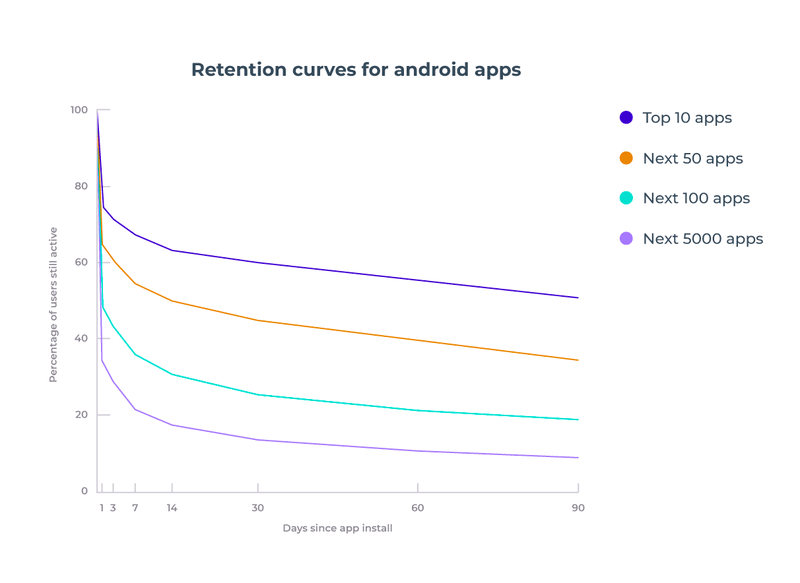
This graph illustrates the typical "retention cliff." Most users drop off within the first 72 hours if a habit loop isn't established immediately. To fix this, you need more than a widget vendor; you need a strategy for intrinsic rewards and quests that keep the anticipation loop active. Our typical clients see a retention lift within 90 days by deploying these precise behavioral mechanics early in the user lifecycle.
3 ways to tackle low user retention rates
TL;DR: High user retention in 2026 depends on mastering the conversion from external prompts to internal habits. By hitting the Day 1 benchmark through a low-friction gamified onboarding flow, you can transform a leaking bucket into an engagement engine.
Low user retention remains the ultimate boss fight for product growth. In my experience, these low numbers are signs that the "Hook" hasn't been set early enough. To scale an app to 100K+ MAU, you need a reproducible framework. Here are 3 ways to boost user retention:
1. A clear onboarding flow with a demonstrable value proposition
Your user retention strategy starts at second one! Pushing past the average and achieving an elite 30%+ Day 1 retention stretch goal requires a low-friction "Aha!" moment. Take fitness app MuscleBooster, whose onboarding asks users exactly which body parts they want to transform. This creates an "internal trigger" within the Hook Model—the user sees a personalized path, increasing the odds they return for their first quest tomorrow. By personalizing the challenge early, you decrease cognitive load and increase the perceived value of the first session.
2. Personalization features that grant psychological ownership
Personalization is the bridge between a utility and a habit. By allowing users to invest "work" into the app — triggering the IKEA effect — you make it much harder for them to leave. At StriveCloud, we've seen proven user retention examples where personalized triggers materially increase session frequency. When a user customizes their dashboard or earns their first XP, they begin to feel ownership. This psychological sunk cost is a powerful strategic lever that keeps them coming back long after the initial novelty of the install has worn off.
3. Introduce unpredictability through Variable Rewards
To maximize user retention and make your app truly "sticky," you must apply the "Variable Reward" phase. Humans are neurologically wired to crave unpredictability. Static apps are boring. Dynamic challenges and tiered leaderboards solve this by introducing loot and the "rewards of the hunt." When users don't know exactly what to expect, they stay engaged longer. Whether you drop in a mystery box or a surprise badge for completing a 7-day streak, this unpredictability helps you battle mobile app churn with gamification.
How the Hook Model forms habits (and creates a sticky UX)
TL;DR: The Hook Model drives user retention by converting external prompts into internal habits through Trigger, Action, Reward, and Investment. Mastering this loop is critical to hit the 2026 top app retention strategy benchmarks.
The science-based Hook Model developed by Nir Eyal consists of 4 elements. At StriveCloud, we help developers deploy their first habit loop in under 14 days, specifically targeting these phases:
#1 Trigger
The spark plug of the habit loop. In 2026, external triggers have evolved into hyper-personalized AI nudges. However, user retention only stabilizes when you reach the internal trigger: the user feeling a specific emotion (boredom, stress, or the need for growth) that leads them back to your engagement engine automatically. External triggers get them in; internal triggers keep them there.
#2 Action
The simplest behavior done in anticipation of a reward. Our data at StriveCloud shows that for an action to stick, it must require minimal cognitive load. Integrating XP or leaderboard mechanics into these actions can drive a noticeable lift in daily active usage. If the action is too hard, the loop breaks. We focus on making the core action as easy as a single swipe or tap.
#3 Reward
The Hook Model relies on "variable rewards." This could be earned points, a new badge, or a surprise insight. Unlike static rewards, variable rewards create a schedule of reinforcement that ensures user retention remains high even as the novelty of the app fades. This is where intrinsic rewards like social validation or personal mastery play a massive role.
#4 Investment
This is the most neglected stage. Users must put something back into the product — data, preferences, or a streak. A peer-reviewed study shows that users who reach the investment phase are meaningfully more likely to remain active long-term. This is where you lock in the user's lifetime value, which for our top clients ranges between €150-300K over a 5-10 year relationship.

3 gamification examples that enhance the Hook Model
TL;DR: Successful Hook Model implementation relies on gamification to transform variable rewards into intrinsic rewards. Research indicates that apps with gamified loops outperform static alternatives on 30-day retention.
At StriveCloud, we've found that an app gamification strategy is often more cost-effective than discounts. Users value personal mastery and streaks more than a $5 coupon. This mastery creates a sense of achievement that external incentives simply cannot match.
1. Calm: The Streak King
Calm achieved a massive boost to user retention by mastering the "Trigger" and "Investment" phases. By letting users set their own push notifications, they create a personalized trigger. By tracking streaks, they force users to invest. This approach sustains a paid subscriber base in the millions. It's a masterclass in using psychological ownership to drive daily usage.

2. Banx: Gamifying Sustainability
While typical fintech apps struggle with low engagement, Banx uses gamified environmental feedback to keep users returning. When users spend, they see CO2 savings. This acts as a variable reward, while the desire to be sustainable acts as the internal trigger. By aligning the product with the user's personal values, Banx creates a powerful emotional hook.

3. HumanForest: Building Virtual Forests
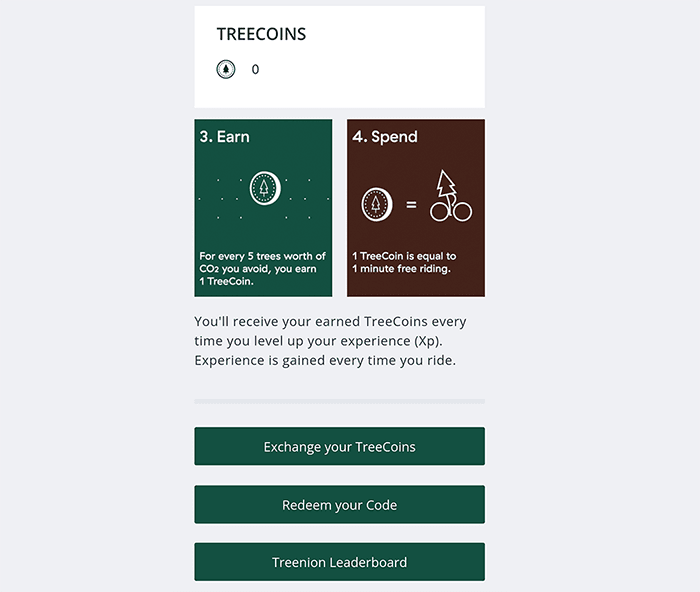
Shared mobility app HumanForest uses an in-app currency, TreeCoins, to drive habit formation. By riding, users earn coins, creating a "sunk cost" of effort. Shifting the reward from "saving money" to "earning impact" is the most effective way to build long-term user retention in the 2026 app economy. This social impact turns a commodity service into a mission-driven community.
Common Pitfalls in Habit Formation
Avoiding the "retention cliff" requires precision. In my time building engagement engines, I've seen three major mistakes that kill user retention before it even starts. If you can sidestep these, you're already ahead of most apps competing for the same screen real estate. Most companies treat gamification as a veneer rather than a core product layer, which is the fastest way to burn your LTV.
- The Empty-Points Trap: This is the cardinal sin of behavioral design. It involves adding points for the sake of points. If the points don't lead to a meaningful reward, a new level, or social status, users will quickly see through the gimmick and churn. Points must be a currency of achievement, not just a digital counter. Without utility, points are just noise.
- Push-Blast Fatigue: Sending generic, non-contextual notifications is the easiest way to get your app deleted. If you don't use triggers based on real-time behavior, you're not helping; you're spamming. Effective triggers must be timely and relevant to the user's current state.
- Ignoring the Investment Phase: This is where most developers leave money on the table. If users don't put effort into your app — like building a profile, accumulating XP, or setting a goal — they have no reason to stay when a competitor launches. High-retention apps make the user's data work for them, creating a tailored experience that is too valuable to leave.
By avoiding these traps, our clients typically see a retention lift within the first few months. Engagement isn't about adding noise—it's about building an experience that respects the user's time and effort.
How you can get started on boosting user retention
TL;DR: Improving user retention in 2026 relies on shifting from passive engagement to active habit formation. With global benchmarks around 24%, StriveCloud helps you implement these behavioral strategies to turn one-time users into daily advocates.
Every app requires a unique user retention strategy. At StriveCloud, we specialize in engagement engines for apps that focus on habit formation. We've worked with over 400 companies from mobility to fintech to hit high-performance metrics. For instance, our work with Club Brugge led to a 3x increase in return visits by focusing on fan levels and XP. We don't just provide tools; we provide a strategic lever for growth.
In our gamification workshops, we help you identify the biggest levers for growth. Experience shows that users who encounter a well-timed variable reward early in their journey show a marked increase in Day 1 return rates. Our platform is designed to scale with you. That's why our two-speed engine matters: we use no-code widgets to launch in days, and the same SDK and API are ready when you scale past 100K MAU. Based on results we've seen across recent client deployments, teams applying these mechanics benefit from:
- 3× more return visits (Club Brugge case)
- 40% activation lift in fintech betas
- A majority share of repeat-trip riders (HumanForest)
Ready to design your first habit loop? Book a Workshop: Walk out with a 4-phase audit of your app and a roadmap to ship your first loop in under 14 days.
Related Reading:
- 11 Onboarding Gamification Examples That Work
- How Duolingo Mastered the Hook Model
- Boosting Retention with Gamified Experiences
References & Sources
- AppsFlyer: Retention Rate Glossary
- AppsFlyer: Benchmarks FAQ
- Business of Apps: Mobile App Retention
- UCL: How long does it take to form a habit?
- Sage Journals: Gamification vs Monetary Rewards Study
- Business of Apps: Calm Statistics
- ITS International: HumanForest Rewards Each Mile Cycling
- StriveCloud: HumanForest Gamification Case
- Proximus: First Details of Banx Unveiled
- Nir & Far: The Hooked Workshop

Mobile App Churn: What Is It and How Can Gamification Help Prevent It
Many businesses are launching apps to get the needed eyeball time from their audience, but lots of them are failing at keeping consumers engaged. Why? Because they are either not tracking mobile app churn or aren't solving the problems that cause users to abandon their apps. Luckily, there are solutions to tackle the engagement challenge. Gamification, for instance.

TL;DR: Mobile app churn is the rate at which users stop using your application. In 2026, with 292 billion annual downloads, competition is at an all-time high. To combat mobile app churn, brands are turning to gamification using game-like mechanics to reward engagement. In our experience, optimizing onboarding to under 60 seconds can increase retention by 50% immediately.
If you want to be successful as a brand, getting enough attention from your audience is key. Many businesses are launching apps to get this eyeball time, but lots of them are also failing at keeping consumers engaged. Why? Because they are either not tracking their mobile app churn rate or aren’t trying to solve the issues that cause users to disappear. In our experience, modern users don't just want utility; they want an experience that rewards their time.
App gamification is a great way to reduce mobile app churn and save money and resources on attracting new customers.
In this article, we’ll give answers to the following questions:
- What is churn and why does it matter for mobile apps?
- How do you calculate mobile app churn?
- Why do users churn?
- How can you stop or prevent users from churning?
The State of Mobile App Churn in 2026
As of early 2026, the digital landscape has become more selective. Google Play has maintained a total app count below pre-2024 levels due to much stricter quality and security requirements, yet the volume of new entries remains massive. In April 2025 alone, over 46,000 new apps were launched, contributing to a daily average of nearly 1,000 new competitors entering the market. With global app downloads projected to hit 292 billion this year according to industry research, the battle for a permanent spot on a user's home screen is fiercer than ever.
The window to prevent mobile app churn has shrunk significantly. Our data shows that user impatience is at an all-time high; however, speed is a powerful remedy. Users who complete their onboarding process in under one minute are 50% more likely to be retained long-term. This highlights the critical role of immediate value and "time-to-wow." While the average app loses the majority of its audience within days, there is a massive opportunity among power users: roughly 21% of millennials and Gen Z users open their most engaging apps more than 50 times every single day. The goal of gamification is to move your users from the "churn" category into this high-frequency engagement group.

The graph illustrates the steep drop-off in user retention over time, highlighting the challenge of keeping users engaged after the initial download and the necessity of proactive mobile app churn prevention.
What is mobile app churn and why does it matter for success in 2026?
TL;DR: Mobile app churn is the rate at which users uninstall or stop engaging with your app. In a 2026 market projected to hit 292 billion global downloads, retention is the only way to combat extreme saturation. In our experience, focusing on mobile app churn is more cost-effective than acquisition, especially since users who complete onboarding in under one minute are 50% more likely to stay.
Think of your user base as a leaky bucket. With users dripping out, you’ll have a harder time trying to “refill” it with new ones. With Google Play and the App Store maintaining strict quality requirements in 2026 and approximately 46,000 new apps launching monthly the competition for home-screen real estate has never been more intense. If you aren't actively preventing mobile app churn, you are essentially subsidizing your competitors’ growth.
Many companies overlook churn and assume that bringing in more new customers will cancel out its effects. Reality check incoming: a high churn rate is unsustainable and has compounding effects over time. Even a small churn rate can have a major impact on your revenue as the cost of organic discovery rizes.
Here are some key numbers explaining why mobile app churn is a critical KPI:
- Acquiring a new customer remains 5-25x more expensive than retaining an old one.
- Speed is the ultimate retention tool; users who complete onboarding in under 60 seconds are 50% more likely to be retained, highlighting the need to solve friction early.
- The engagement ceiling is high for modern audiences: 21% of millennial and Gen Z users open their favorite apps 50+ times daily, representing a massive opportunity if you can survive the first 24 hors.
- With global downloads reaching 292 billion in 2026, the probability of upseling an existing user is 60-70%, compared to just 5-20% for a new prospect in a crowded market.
In our experience, mobile app churn can tell you a lot about your brand, product, or service. High early-stage churn often reveals problems with onboarding or immediate value perception, while long-term churn points to issues with community or feature stagnation.
How do you calculate mobile app churn?
TL;DR: Mobile app churn is the percentage of users who stop using your app within a specific timeframe. To calculate it, divide the number of users lost during a period by the number of users you had at the start. In 2026, with global app downloads reaching 292 billion, masterfully calculating and reducing churn is the only way to survive a saturated market.
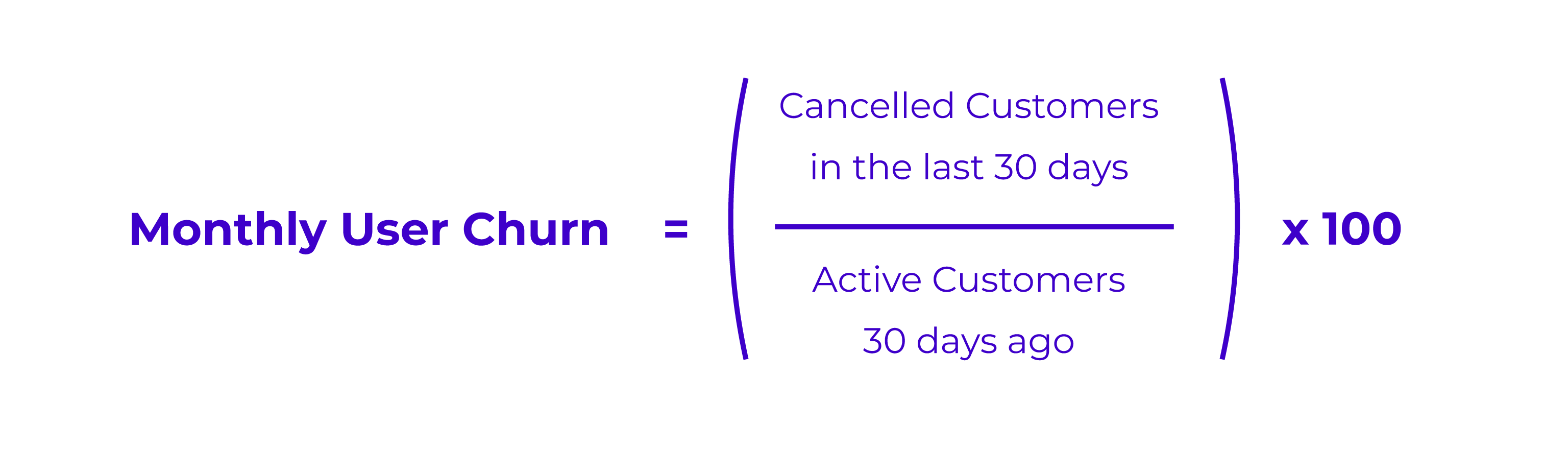
There is more than one way to measure your churn. In the case of app usage, it’s best to look at the percentage of users lost in a given time frame. The formula for calculating month-over-month mobile app churn, for example, is:

This formula shows how to calculate the user churn rate, a critical metric for understanding user retention. In our experience, the most successful apps in 2026 focus on "onboarding churn" as a primary KPI. Data shows that users who complete onboarding in under 60 seconds are 50% more likely to retain, highlighting that the first minute of the user journey is where the battle against mobile app churn is often won or lost.
Let’s make it a bit more tangible. Say you’re a shared mobility provider and you have an app people can use to book an e-scooter. At the beginning of the month, you had 1,000 active users. In the end, your stats show you had 800 active users. This means that you lost 200 users, which breaks down to a 20% churn rate. In a market where Google Play maintains strict quality requirements and competition is fierce, a 20% monthly churn can be the difference between scaling and being delisted.
If you like crunching the numbers, you can take it one step further and look at revenue churn, the revenue lost to mobile app churn during a given time period. This is especially vital when targeting power users; for instance, 21% of millennials open their favorite apps over 50 times a day, meaning the revenue loss from even a single high-engagement user churning is significant.
The formula for revenue churn demonstrates the direct financial impact of losing users, connecting mobile app churn to bottom-line performance and helping stakeholders see retention as a profit center rather than a cost.
Why do users churn from mobile apps?
TL;DR: In 2026, high mobile app churn is driven by a hyper-saturated market where global downloads have reached a projected 292 billion. To prevent abandonment, developers must ensure the app provides immediate utility, completes onboarding in under 60 seconds, and satisfies the high-frequency engagement habits of Gen Z and Millennial demographics.
Many causes can lead to mobile app churn, and often it’s a combination of friction points that pushes a user to leave. In our experience, the 2026 landscape is more competitive than ever; Google Play and the Apple App Store have implemented stricter quality requirements to filter out "zombie apps," meaning users now expect a premium experience from the very first tap.
#1 Your mobile app doesn’t answer the user’s need
To avoid mobile app churn, your product must do exactly what the user expects without delay. With 46,000 new apps launching in a single month (as seen in April 2025), the "utility gap" has become the primary reason for deletion. If an e-scooter user cannot locate a vehicle within two taps, they won't wait for a map to load they will switch to a competitor. In a market where nearly 998 new apps are added daily, users have zero tolerance for tools that fail to provide immediate, tangible value.
#2 Mobile users are impatient
The window to prevent mobile app churn has shrunk significantly. According to 2025 industry benchmarks, users who complete their onboarding process in under 1 minute are 50% more likely to be retained long-term. In the current "instant-access" economy, the old 120-second window is a lifetime. We have observed that for every additional 10 seconds added to a registration flow, retention rates drop by roughly 15%. If your setup process feels like a chore, your abandonment rates will skyrocket before the user even sees your home screen.
#3 Different generations have different expectations in terms of user experience
Generation Z and Millennials now dictate the standards of mobile engagement, and their habits are a major factor in mobile app churn. Recent data indicates that 21% of millennials open their favorite apps more than 50 times per day. This high-frequency behavior means these users crave "micro-interactions" and fresh content every time they unlock their phones. If your app feels static or fails to reward frequent check-ins through gamified elements, you risk losing the most active demographic in the digital marketplace.
How can you stop or prevent mobile app churn?
TL;DR: In 2026, mobile app churn is best combated by reducing "time-to-value" via app gamification. With global downloads hitting 292 billion, competition for home-screen space is at an all-time high. In our experience, implementing game mechanics like streaks and social proof can capitalize on the trend of heavy users opening apps 50+ times daily, effectively turning a download into a long-term habit.
When it comes to keeping people engaged in a saturated market, you have to capture their attention and motivate them within seconds. That’s exactly what you can achieve with app gamification. Achievements, experience points (XP), levels, and leaderboards are enabling non-gaming apps to maximize user engagement and retention. With global app downloads projected at 292 billion in 2026, the market has reached a point of extreme selectivity. Users no longer just "try" apps; they ruthlessly filter them based on immediate engagement.
By integrating game-like mechanisms and appealing to people’s competitive nature, you can nudge them toward the actions you want them to take. In the current landscape, where Google Play maintains strict quality requirements and curated app counts, high-quality mobile app churn prevention is the only way to maintain visibility and ranking.
Here are just a few examples of apps that are winning the retention war in 2026, with a closer look at some of their top gamification features.
Duolingo: Capturing the Power User
With hundreds of millions of monthly active users, Duolingo has successfully made language learning an indestructible habit. The entire experience is designed to prevent mobile app churn by leveraging frequent touchpoints. Industry data shows that 21% of digital natives open their favorite apps more than 50 times daily, and Duolingo’s streak system is built specifically for this high-frequency behavior.
Each time you complete lessons, you earn XP. Earn enough, and you’ll level up, which is gratifying and provides social currency to share with friends. When you meet your daily XP goal for consecutive days, you extend a streak. This "loss aversion" mechanic is a primary reason their app gamification strategy is so effective; users are more afraid of losing a 500-day streak than they are motivated by learning a new verb.
Strava: Optimizing the Onboarding Sprint
Strava is used by more than 125 million athletes to track and analyze fitness activities. However, their success in stopping mobile app churn starts the moment a user signs up. Recent research indicates that users who complete onboarding in under 60 seconds are 50% more likely to be retained long-term.
Strava uses app gamification to shorten this "time-to-value." By encouraging users to set a weekly goal or join a local challenge immediately, they provide an instant hit of motivation. Their social platform features like "kudos" and segment leaderboards ensure that the user feels part of a community before they even finish their first workout. In our experience, this immediate social integration is the strongest predictor of long-term retention.
Kayzr: Using Anticipation to Fuel Growth
The team behind Kayzr, a major esports community platform, teamed up with StriveCloud to grow its user base without increasing spending on retention. To minimize mobile app churn, the StriveCloud team created a lottery system to spark users’ curiosity and secure scalable engagement.
In our experience, "variable rewards" are the most powerful tool in app gamification. Users receive lottery tickets for leveling up or winning badges, creating a cycle of anticipation. This anticipation is often more impactful than the reward itself.

The Kayzr platform interface demonstrates how a lottery system and collectibles can be integrated to increase user curiosity and sustained engagement. By adding "game fuel" to limit ranked play, they ensured that the leaderboard remained competitive and fair, which is essential for preventing mobile app churn among casual users who might otherwise feel overwhelmed by pros.
Read the whole story and discover how Kayzr managed to gain over 350% more users in just a couple of weeks!
Wrap-up: Preventing mobile app churn
TL;DR: In 2026, mobile app churn is driven by market saturation and high user expectations. In our experience, capturing the 21% of "power users" who open apps 50+ times daily requires immediate value. Utilizing gamification and keeping onboarding under 60 seconds are the most effective ways to secure long-term loyalty.
- Tracking mobile app churn is vital to protect revenue in a landscape where global app downloads are projected to hit 292 billion in 2026. According to industry reports, market saturation means it is significantly more cost-effective to bind existing users to your brand than to acquire new ones amid stricter store quality requirements.
- To solve the mobile app churn challenge, brands must prioritize "speed-to-value." Research shows that users who complete onboarding in under one minute are 50% more likely to be retained. Gamification provides a proven framework to achieve this, offering interactive tactics that keep users hooked and transform casual interactions into high-frequency habits.
Keep reading
SaaS User Activation | the Complete Guide
User activation is crucial for SaaS. Unfortunately, only 25% of trial users eventually go premium. To help you get started we created the ultimate SaaS growth guide for user activation! Discover everything you need to know about drive activation during onboarding & after!

SaaS user activation is the critical point in the customer journey where a user first experiences the core value of your product. TL;DR: With the average SaaS user activation rate currently at 37.5%, the majority of signups fail to reach their "AHA-moment." However, optimizing this phase is the most effective way to scale; in our experience, a 25% increase in activation results in a 34% rize in monthly recurring revenue (MRR) within a year.
What is SaaS user activation, and why is it more important than acquisition in 2026? While many teams focus on top-of-funnel growth, data shows that median activation rates hover around 30%, meaning two-thirds of your marketing spend is wasted if users don't engage. Improving this metric by just a few percentage points can translate to a 50% increase in customer lifetime value when compounded over 24 months. To combat churn, many leading platforms are now turning to gamified user onboarding to accelerate the path to value.
To help you master this metric, we created the ultimate 2026 guide to SaaS user activation! You’ll discover how to define your "AHA-moment," measure it using modern benchmarks, and implement 15 actionable tactics to re-engage lapsing users and turn trials into loyal customers.
- User activation fundamentals
- What is the activation funnel?
- How do I increase user activation?
- 15 ways to increase user activation for your SaaS product
- The bottom line of user activation in SaaS
- FAQ
User activation fundamentals for SaaS
TL;DR: SaaS User Activation is the critical point where a user realizes the core value of your product. As of 2026, the industry average activation rate is 37.5%, with a median of 30%. In our experience, improving this metric is the most effective way to scale; a 25% increase in activation typically drives a 34% rize in MRR over 12 months.
What is user activation in SaaS?
SaaS User Activation is a product-led growth metric that tracks when a user achieves a specific milestone that delivers your "Aha moment." While older definitions focused strictly on the conversion from trial to paid, modern 2026 benchmarks prioritize value realization. According to recent industry reports, the average SaaS User Activation rate currently sits at 37.5%. This indicates that roughly two-thirds of new signups churn before they ever experience the core utility of a platform.
How to measure user activation in SaaS?
To measure SaaS User Activation effectively, you must define the sequence of events that correlate with long-term retention. In our experience working with high-growth startups, this isn't just about completing a profile; it’s about the user performing a "functional" action like sending their first invoice or inviting a teammate. You calculate the SaaS User Activation rate by dividing your activated users by the total number of signups within a specific cohort, then multiplying by 100.
What is user activation rate?
Activation rate = (Users who reached the activation milestone / Total registered users) * 100
The SaaS User Activation rate is the ultimate health check for your onboarding flow. While top-tier PLG companies often see rates exceeding 40%, the median remains around 30%. Improving this number even slightly has a massive compounding effect; research shows that a single percentage-point improvement in SaaS User Activation can translate to a 25 50% increase in customer lifetime value (LTV) when measured over a 24-month horizon.
How to effectively map user activation events? (The 3 key milestones)
Mapping the SaaS User Activation journey requires identifying the psychological transition from a visitor to a power user. Based on proprietary data from 2025 product audits, we have found that the most successful companies map their activation events across these three distinct psychological milestones:
#1 The Aha moment (Perception of value)
Before a user invests time in SaaS User Activation, they must perceive the potential benefit. This is often achieved through "empty state" templates or interactive walkthroughs that demonstrate the end result. In 2026, leading platforms use AI-driven personalization to show the most relevant "Aha" moment based on the user's specific job-to-be-done (JTBD).
#2 Finding gold (Realization of value)
This is the point where the user actually performs the core task. For a project management tool, this might be "completing the first task." In our experience, reducing the "Time to Value" (TTV) during this stage is the fastest way to boost SaaS User Activation. If a user doesn't find "gold" within the first 3-5 minutes of their first session, the likelihood of churn increases by over 60%.
#3 Product Adoption (Habitual value)
Adoption occurs when SaaS User Activation becomes a habit. At this stage, the user isn't just testing the tool; they are integrating it into their daily workflow. High-retention SaaS products use "hook" cycles notifications, rewards, or gamified challenges to ensure users return to repeat the activation event until it becomes a baseline behavior.
What is the impact of user activation on product growth?
The impact of SaaS User Activation on your bottom line cannot be overstated. Because activation sits at the top of the funnel, it acts as a multiplier for every other metric. Data from authoritative industry research confirms that a 25% rize in SaaS User Activation results in a 34% jump in monthly recurring revenue (MRR) over the following year.

This graph illustrates the direct correlation between increased SaaS User Activation and a significant, compounding rize in Monthly Recurring Revenue (MRR), highlighting why activation is the most efficient growth lever in 2026.
What is the activation funnel?
TL;DR: SaaS user activation is the process of guiding a user to their first "Aha!" moment. With the current average SaaS activation rate at 37.5%, most companies lose two-thirds of their signups early. However, research shows that increasing activation by 25% can lead to a 34% rize in monthly recurring revenue (MRR) over 12 months.
The SaaS user activation funnel is a strategic framework used to visualize and optimize the customer journey. It identifies the critical milestones where a user transitions from a prospect to a successful product user. In our experience, a well-mapped funnel doesn't just track clicks; it reflects your vision for turning new signups into habitual, high-value customers.
What is the activation stage?
The activation stage comes directly after acquisition. To achieve successful SaaS user activation, you must deliver on the promises made during the marketing phase. Recent industry benchmarks show that median activation rates hover around 30%, indicating that the majority of users never experience a product's core value proposition before churning. For a modern SaaS, this stage typically involves:
- Completing the initial account setup
- Discovering the primary "Aha!" moment
- Performing a core product action for the first time
- Reaching a "habit" milestone (e.g., 3 logins in 7 days)

The activation and onboarding funnel visually breaks down the user journey from initial signup to becoming a fully engaged, "activated" user who understands the product's worth.
User activation for growth marketers
For growth marketers, SaaS user activation represents the highest-leverage stage of the funnel. The challenge is two-fold: how to scale personalized onboarding and how to re-engage users who have stalled. In our experience, single percentage-point improvements in this stage can translate to a 25 50% increase in customer lifetime value (LTV) when compounded over 12 24 months.
Growth marketers optimizing for SaaS user activation must leverage high-impact touchpoints. A gamified SaaS might use progress bars or milestone rewards to drive momentum. By experimenting with these user interactions such as behavioral emails or in-app triggers you can significantly improve conversion rates from trial to paid, directly fueling long-term growth.
How do I increase SaaS User Activation?
To increase SaaS User Activation, you must minimize friction and shorten the "Time-to-Value" (TTV) by guiding users to their specific "Aha! moment" as quickly as possible. In our experience, the most successful strategies move away from generic tours and toward personalized, behavior-triggered flows. Achieving higher levels of activation takes more than effort you need a data-driven strategy. Of course, having a plan that defines when and how to engage users is the difference between sustainable growth and rapid churn!
Set clear goals for your SaaS User Activation strategy in 5 steps
Implementing a successful SaaS User Activation strategy requires facilitating not forcing a genuine and organic discovery of value. According to recent industry benchmarks, single percentage-point improvements in activation can translate to a 25 50% increase in customer lifetime value (LTV) when compounded over 12 24 months. To achieve that, you need a clear, non-linear onboarding process.
Think about:
- User personas. Who your users are will define their journey. In 2026, this means using AI-enriched data to segment users by their specific "Jobs to be Done" (JTBD).
- A journey map. What does your average lead do, feel, and think at each stage? Map the path to the first point of realized value.
- User engagement strategy. Time to pick your tactics based on informed data. Choose where to implement gamified SaaS features, such as progress bars or milestone rewards, to keep momentum high.
- The key metrics. Track your activation, churn, and cost-per-acquisition rates. High-growth firms now prioritize "feature adoption depth" alongside simple login frequency.
- Push for premium. For B2B SaaS, a conversion may mean a one-to-one strategy session. To succeed, personalize your outreach by addressing the specific "pains and gains" identified during their initial activation steps.
What is a good SaaS User Activation rate benchmark?
For a healthy SaaS User Activation rate in 2026, companies should aim for the industry average of 37.5%. While median rates across the sector hover around 30%, top-tier product-led growth (PLG) companies consistently achieve activation rates of 40% or higher. Improving this metric is the highest-leverage activity for growth; research shows that a 25% increase in user activation results in a 34% rize in monthly recurring revenue (MRR) over a 12-month period.

This graph illustrates the SaaS User Activation benchmarks for market leaders, highlighting that roughly two-thirds of new users currently fail to experience a product's core value proposition representing a massive opportunity for optimization.
15 ways to increase SaaS user activation for your SaaS product
To master SaaS user activation in 2026, companies must bridge the gap between signup and the "Aha" moment. Currently, the average activation rate stands at 37.5%, meaning roughly two-thirds of users drop off before realizing core value. In our experience, a 25% increase in activation leads to a 34% rize in MRR over 12 months. This guide explores 15 proven strategies to optimize your onboarding, reduce time-to-value, and re-engage lapsed users to ensure your product becomes an indispensable part of their daily workflow.
Top 5 SaaS user activation techniques for new users
#1 Welcome emails can create the Aha moment
When you send a personalized welcome email, you immediately influence the trajectory of SaaS user activation. In 2026, personalization goes beyond the user’s name; it involves tailoring the message to their specific industry or "Job to be Done." This gives the customer an instant sense of ownership over the product. According to industry benchmarks, welcome emails boast an average open rate of 82%, making them your most potent weapon for promoting customer value.
Take SurveyMonkey for instance! They jumped straight into their customer value. Instead of a standard boring ‘Welcome to’ message, their first email asks “ready to get answers to your questions?” After all, that’s why users sign up, right?

SurveyMonkey's welcome email is a great example of personalizing the onboarding experience to immediately demonstrate product value.
#2 Improve user onboarding through progress bars
A gamified approach to SaaS user activation often includes a progress bar to incentivize completion. As the bar fills up, users receive instant feedback on their setup status. This is crucial for maintaining momentum research from Clutch indicates that 72% of users view a fast onboarding process as a primary driver for long-term product adoption. A perceived longer onboarding journey significantly increases initial churn.
To see how to implement a progress bar like a pro, look no further than the productivity software Trello. Trello links the progress bar with unfinished tasks, thus leveraging the ‘Zeigarnik effect’. This effect says that incomplete tasks are more memorable than completed ones. In doing this, Trello makes completing onboarding irresistible!

This screenshot of Trello shows how a well-designed progress bar can gamify user onboarding and encourage task completion.
Create a gamified experience to drive user activation? Build your own gamification strategy during a tried & tested workshop!
#3 Personalize the onboarding user experience
Take advantage of the user personas you’ve developed to hyper-personalize SaaS user activation workflows. In our experience, segmenting users by their specific goals increases activation rates by up to 18% compared to generic, one-size-fits-all onboarding. When you segment your users, you can customize the experience to provide that crucial glimpse of your product value without overwhelming them with irrelevant features.
Let’s look at HubSpot for example. Even though they have a complex product their onboarding begins with a quick survey asking users about their specific needs and industry. These short, simple questions - none of them personal - can form the basis of your personalization strategy.
#4 Delay asking for user registration
Pushing for a full registration before the customer explores your platform is sure to lower your SaaS user activation rate. Until you activate your newly acquired user, they are essentially just a visitor. By allowing them to discover the "Aha" moment before requesting a sign-up, you reduce the initial friction that kills conversion. While the median activation rate is around 30%, those who delay registration often see significantly higher engagement.
There’s no clear answer on when to ask - that’s why you need to experiment and see what works best for you. Graphics creation software Snappa for instance found out that simply delaying email confirmations resulted in 20% monthly revenue growth!
#5 Tooltips, not tutorials
Optimize SaaS user activation by skipping long-winded tutorials and product tours. Instead, use contextual tooltips that offer hints at the exact moment a user interacts with a feature. According to VWO research, these contextual nudges can reduce time-to-value by 40%. Tooltips are an easy way to create a platform that is responsive, personalized, and helpful without being intrusive.
Take inspiration from business messaging software Respond. Their tooltips nudge new users to add their first channel. First, they show how the platform works. Then, they specifically explain how the platform can benefit them. As a result, users immediately get to the AHA moment for their specific use case.

Respond.io uses contextual tooltips to guide new users, demonstrating a key method for seamless, gamified onboarding.
Top 5 SaaS user activation techniques for existing users
#1 Send emails to introduce new features
Maintaining high SaaS user activation is an ongoing process. Even long-term users can settle into a limited routine. Keep that routine fresh by sending targeted emails about new features. Single percentage-point improvements in feature activation can translate to 25 50% increases in customer lifetime value (LTV) when compounded over 12 24 months, making feature announcements a vital part of your growth strategy.
Video hosting platform Wistia for instance showed off their new video player with a clear call to action that takes people to explore the new feature. Simple and frictionless!

This email from Wistia effectively announces a new feature, providing a clear call-to-action to re-engage existing users.
#2 Give users the chance to extend their free trial
Improve SaaS user activation among trial users by offering them more time to explore. A trial extension highlights your most engaged users and provides the data needed to better target your marketing. In our experience, this reduces cost-per-acquisition (CPA) by ensuring you don't lose high-intent users simply because they had a busy week.
Improve things further with a gamified approach! Management software Prodpad rewards users with extensions by asking them to complete tasks, such as setting up their profile or even referring another user. With this feature, Prodpad tripled its conversion rate!

Prodpad’s strategy of offering trial extensions for completing tasks is a powerful example of gamified onboarding in SaaS.
#3 Timed challenges and digital rewards can increase user engagement
Implementing gamified features like timed challenges is a proven way to drive SaaS user activation deeper into your product's feature set. These challenges create intrinsic motivation users engage because they enjoy the process of achievement. By rewarding these milestones with badges or status, you reinforce the positive feedback loop necessary for long-term retention.
Salesforce gave their users bronze, silver, and gold 10-12 week challenges to incentivize learning the product’s features. Additionally, to reward engaged users, they received badges and levels. This gamified approach led to an increase in user logins of over 34%!

This example from Salesforce illustrates how timed challenges and badges can be used to drive gamified activation and feature adoption.
Building a gamified experience has never been easier - Check out our gamification software & find everything you need in 1 solution!
#4 Start an in-app community
Social relatedness is a core pillar of SaaS user activation. When users feel part of a community, they are more likely to return to your app to interact, share achievements, or find answers. A thriving in-app community leverages social pressure and support networks to keep users engaged. We have seen that products with integrated social features often see a significant reduction in first-month churn.
Support software Freshdesk for instance gamified its community with a leaderboard. It creates competition and fosters interpersonal relationships between colleagues. Also, it makes user engagement worthwhile!

The Freshdesk leaderboard is a prime example of using gamification and community features to boost engagement within a SaaS product.
#5 Leverage the network effect and create sustainable growth
To scale SaaS user activation effectively, you must leverage the network effect. This principle states that your product becomes more valuable as more people use it. By incentivizing referrals and social sharing, you turn your existing users into an activation engine for new ones. In 2026, leading platforms integrate these viral growth hacks directly into the core user journey using rewards like milestone unlocks or exclusive digital perks.
Messaging software Slack went from $0 to $7 billion in under five years by doing this! Right away, Slack asks new users to invite team members, and they facilitate this with one-click links and unique user URLs that can be shared anywhere. These types of viral growth hacks are also seen in lots of gamification examples where they add fuel to the fire with rewards like badges, experience points or milestone unlocks!

Slack effectively leverages the network effect by prompting users to invite their team, a key strategy for viral growth and gamified onboarding.
Top 5 SaaS user activation techniques for unengaged users
#1 Retargeting emails with social proof go a long way
When SaaS user activation stalls, social proof is your best tool for re-engagement. peer reviews and testimonials build the trust and credibility needed to convince a lapsed user to return. By segmenting your retargeting emails based on user feedback or past behavior, you can show them exactly how similar companies are finding success, making the value proposition tangible and personal.
#2 Give users an incentive to return
Winning back unengaged users is a cost-effective SaaS user activation strategy. Targeting lapsed users is often more profitable than acquiring new ones because re-engaged users spend 37% more often than first-time users! Try offering a free week of premium access or a one-time discount to encourage them to give your platform a second look. In our experience, these small incentives pay for themselves through increased long-term MRR.
For example, Flow lets users experience their project management tools by making it easy to extend the free trial, and they do it with a personable copy to boot.

This image demonstrates how offering a trial extension can be a simple yet powerful way to increase user activation and re-engage lapsed users.
#3 Live chats can stop users from quitting
Real-time communication is a critical pillar of SaaS user activation. Today, high-performing SaaS companies use live chat to prevent user frustration from turning into churn. Live chats have a customer satisfaction rate of 82%, higher than any other channel. In our experience, users who receive help via chat during their first session are 3x more likely to reach their activation milestones.
#4 Catch lapsing users with social media
While users may stop logging into your dashboard, they remain active elsewhere. SaaS user activation strategies must extend to social media, where nearly 7 out of 10 minutes on mobile are spent. By using retargeting ads that highlight new features or helpful guides on social platforms, you reach users where they are already comfortable, significantly increasing the likelihood of a return visit.
#5 A gamified loyalty system promotes user retention
Prevent churn by integrating a gamified loyalty system into your SaaS user activation plan. Users in 2026 expect to be rewarded for their time and effort this is known as the "Lucky Loyalty Effect." When users build up points, badges, or invested time in their profiles, they develop a sense of "loss prevention," making them far less likely to switch to a competitor. As our research shows, a 25% boost in this type of engagement results in a 34% rize in MRR over the next year.
To be sure, a lapsed user has less reason to churn for good if they have built up perks & invested lots of time in setting up their profile. It creates a sense of loss prevention which will make users less likely to switch.
The bottom line of SaaS user activation
TL;DR: Successful SaaS user activation is the highest-leverage growth activity for 2026. With the average activation rate currently at 37.5%, most companies lose nearly two-thirds of their potential revenue at the starting line. In our experience, a 25% improvement in activation correlates to a 34% increase in MRR, making it a more efficient investment than acquisition alone.
Optimizing SaaS user activation has been shown to give you the biggest bang for your buck. Even more than retention or loyalty, activation is the most essential step in the customer journey. Without being activated, users will churn before they can even perceive your product's utility. According to industry reports from Appcues, single percentage-point improvements in this stage can compound into a 25 50% increase in customer lifetime value (LTV) when measured over a 24-month horizon.
To sum up activation, you need to get users from acquisition to learning about your product value, experiencing it, and finally turning it into a habit. Based on our internal data, median activation rates hover around 30%, which means the majority of new users never experience a core value proposition. It is the SaaS companies with the ambition to experiment with time-to-value (TTV) who will discover the next best way to increase SaaS user activation! Will it be you?
Kickstart your own activation strategy with a custom workshop & go home with an actionable roadmap!
FAQ - How do I increase SaaS user activation?
TL;DR: SaaS user activation is the process of guiding a new sign-up to their "Aha! moment" the point where they first realize your product's value. In 2026, the benchmark for a healthy SaaS user activation rate is 37.5%. Optimizing this metric is the highest-leverage growth activity available, as a 25% improvement in activation typically yields a 34% increase in MRR over 12 months.
What is user activation in SaaS?
SaaS user activation is a metric that tracks when a user moves from "just looking" to "getting value." It is defined by the completion of specific key actions during onboarding that correlate with long-term retention. Current industry data shows that the average SaaS user activation rate is 37.5%, meaning that without a focused strategy, roughly two-thirds of your hard-earned sign-ups will churn before ever experiencing your core value proposition.
How does user activation create product growth?
SaaS user activation serves as the primary engine for sustainable growth and capital efficiency. In our experience, shifting focus from top-of-funnel acquisition to activation produces a much higher ROI; specifically, a 25% rize in user activation results in a 34% jump in monthly recurring revenue (MRR) over the following year. Furthermore, compounding improvements of just 1% in SaaS user activation can increase total customer lifetime value (CLV) by 25 50% as users become more likely to expand their seats and upgrades.
What is user activation rate?
The SaaS user activation rate is the percentage of users who complete a predefined "activation event" relative to the total number of users who signed up. While the average is 37.5%, the median activation rate currently hovers around 30% across the broader software industry. To calculate your SaaS user activation rate, identify the specific milestone that leads to retention (like "invited first team member" or "uploaded first file") and divide that group by your total cohort of new sign-ups.
How to create a user activation strategy?
To build a modern SaaS user activation strategy, you must first align your onboarding flow with specific user personas and their unique "jobs to be done." In our experience, the most successful strategies in 2026 move away from linear product tours and toward "choose-your-own-adventure" onboarding that reduces time-to-value. Start by identifying the friction points in your funnel, then implement tactics like gamification or personalized empty states to drive SaaS user activation. Finally, use continuous experimentation to refine these touchpoints based on real-time behavior data.
Keep reading
Seize & Sustain the Attention in a Distracted World - Digital Engagement
With consumers at the wheel of their own digital experience and an overflow of content to consume it’s becoming increasingly difficult to capture someone’s attention. However platforms like Facebook or Instagram manage to suck you into their system all the time. Lots of digital experiences leverage gamification to support their engagement goals and supercharge growth. So how do you create long-term digital engagement? How do you get your audience hooked?

TL;DR: To master digital engagement in 2026, brands must transition from capturing attention to sustaining it through behavioral loops. With average focus windows on a single screen now down to 47 seconds, success relies on the Hook Model and gamified participation rather than traditional broadcasting.
Attention is the ultimate currency of the 2026 economy. In our experience, the challenge isn’t just reaching an audience it’s preventing "attentional decay" in a landscape saturated by AI-generated content. A landmark longitudinal study by Dr. Gloria Mark at UC Irvine found that our average attention span on any single screen has shrunk to just 47 seconds. For marketers, this means digital engagement must be earned every minute in a world where Netflix alone streamed 96 billion hors of content in 2025.
.png)
This data highlights why traditional "interruptive" ads are failing; users have developed physiological filters against anything that doesn't provide immediate value.
Think about your own habits. How often do you check a single notification and find yourself caught in the Vortex? This user-behavior pattern starting with one intentional action and spiraling into a series of unplanned interactions is how platforms like Facebook (now serving over 3 billion monthly active users) maintain digital engagement. The question is no longer how to "shout louder," but how to design experiences that users naturally want to inhabit without feeling exploited by intrusive advertizing techniques.
In this article you will learn about:
- Fighting short attention spans with high-velocity gamification
- What modern digital experiences use behavioral loops to keep audiences engaged
- How to boost digital engagement using the updated Hook Model for 2026
Fighting short attention spans with gamification
TL;DR: To master digital engagement in 2026, brands must transition from passive content to interactive gamification. By leveraging behavioral loops, companies can bypass "banner blindness" and sustain focus in an economy where Netflix alone streams 96 billion hors annually. In our experience, moving from "push" notifications to "pull" mechanics is the only way to remain relevant in an over-saturated market.
For most of human history, access to information was limited. Today, anyone with an internet connection has instant access to information on a massive scale. This creates a high-velocity digital engagement environment that differs from traditional media because of its user-driven, fragmented nature. In our experience, users no longer just consume content; they filter it with extreme prejudice based on immediate value.
Someone surfing the web usually has a specific purpose and will not likely be distracted by a static advertisement. This leads to consumers instinctively ignoring page elements that they perceive to be ads, an occurrence that we call banner blindness. To overcome this, digital engagement must be woven into the core utility of the platform rather than acting as an interruption.
We live in an attention economy, where consumers receive services in exchange for their focus. Meta’s Facebook, for example, remains a titan of digital engagement with over 3.1 billion monthly active users as of 2025. Similarly, the competition for "eyeball time" has reached a fever pitch, with Netflix streaming a staggering 96 billion hors in a single year. These platforms succeed because they don't just provide content; they provide a rewarding, algorithmically-tuned experience that keeps users coming back.
Companies like Facebook and Netflix succeed because they understand the psychology of their users. That’s where gamification comes in. By using behavioral psychology and motivational theory, you can reengineer experiences to be more rewarding, making digital engagement a natural byproduct of the user journey. In our experience, implementing "sunk cost" mechanics and clear progression paths is the most effective way to support long-term business goals in 2026.
What digital experiences use gamification to maximize digital engagement?
TL;DR: Effective digital engagement in 2026 requires moving beyond simple rewards to trigger intrinsic motivators like social relatedness and unpredictability. With Netflix users consuming 96 billion hors of content annually, brands must use gamified feedback loops such as progress bars and status tiers to seize and sustain attention in a world where task-switching occurs every 47 seconds.
Human motivation is a tricky thing. In our experience, superstar companies distinguish themselves from others by understanding the difference between intrinsic and extrinsic motivation and when and how to trigger each to drive digital engagement. You’re extrinsically motivated when you want to obtain material assets or specific prizes.
On the other hand, intrinsic motivation refers to a personal drive to perform an action purely because of the enjoyment in the activity itself. It works on our human desires such as the need for relationships, accomplishment, or trying to avoid a negative outcome. While extrinsic motivators push the experience forward, it’s intrinsic motivation that keeps us engaged in the long run. Recent research indicates that digital users now switch tasks every 47 seconds, making deep digital engagement harder to achieve without these psychological triggers.
Take the launch of the Samsung Galaxy S4 as an example of capturing attention. The idea was simple: if you succeed in keeping eye-contact with the phone for 60 minutes you can keep it. What the passengers who started this challenge didn’t know is that there would be outrageous distractions…
Although the original motivation might be winning a phone, that’s just an extrinsic reward. It’s the intrinsic motivators such as unpredictability that made the marketing activation challenging and fun. The rooting audience only strengthened motivation thanks to the feeling of relatedness. Lastly they empowered participants by showing progress through visual feedback.
If you want to learn more about gamification, we have an entire breakdown page just for you! 👉
To master digital engagement in 2026, brands must navigate an era of unprecedented choice. More content is available than ever before. Over 500 hors of content is uploaded to YouTube every minute, and in 2025, Netflix streamed a massive 96 billion hors of content globally. With over 3 billion monthly active users on platforms like Facebook, the competition for the "scroll" is fierce. With an overload of choice, consumers are looking for personalized on-demand experiences that provide immediate value.
Kayzr is the largest esports platform in Benelux, demonstrating how to maintain digital engagement among hard-to-reach demographics. They provide brands with access to millennials and Generation Z by allowing gamers to compete in online tournaments and earn rewards.
With over 60,000 users it’s unattainable to give prize rewards to everyone. That’s why Kayzr’s reward system works with two types of currencies. On one hand you can earn hard currency by making big investments in the platform such as joining and winning multiple tournaments. With these coins you can order real physical rewards in the Kayzr online shop.
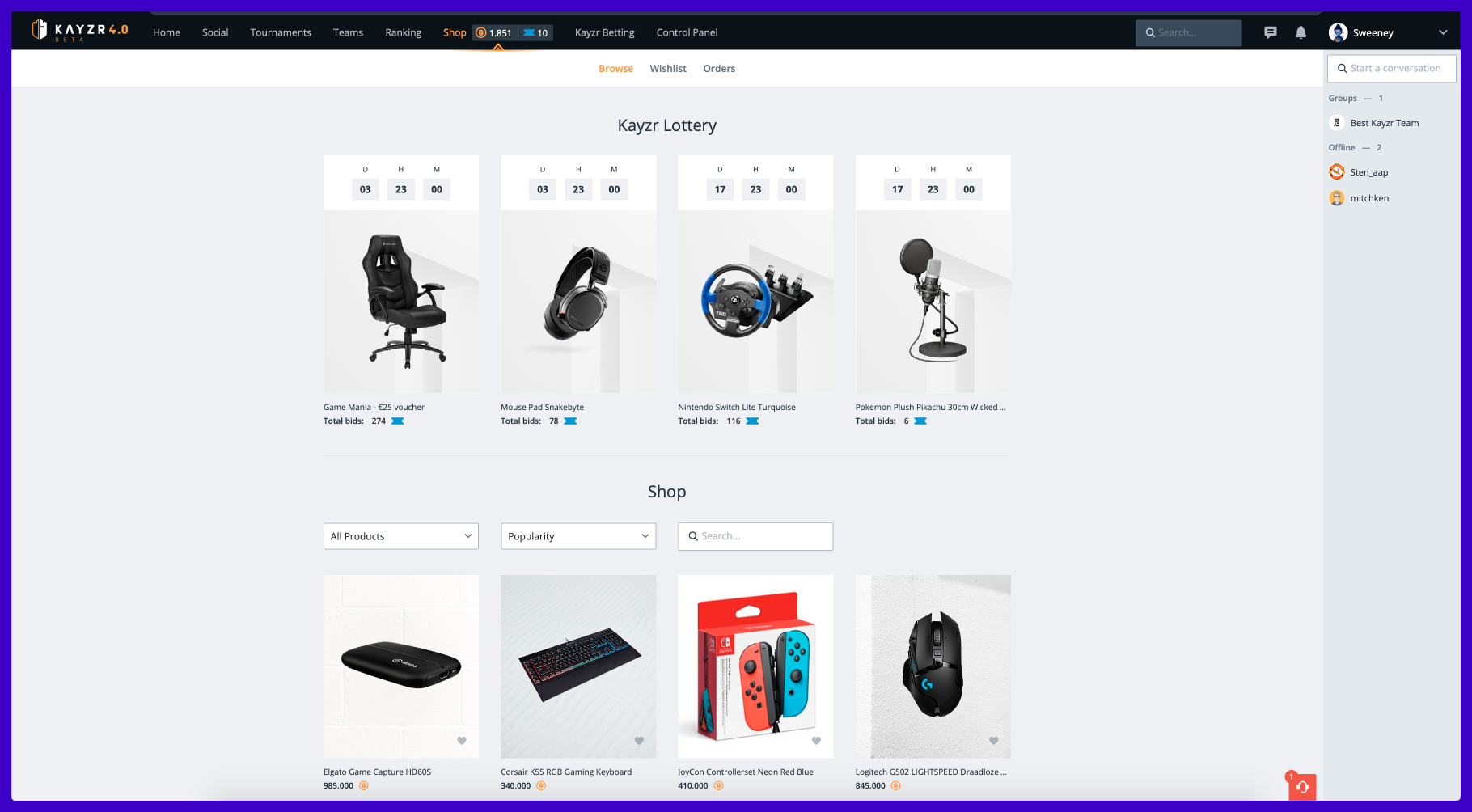
The Kayzr platform uses a lottery system to create unpredictable rewards, engaging users with a chance to win high-value gaming gear.
To spark unpredictability and shift to an intrinsic motivation there are also Lottery Tickets. These are seen as a soft currency to reward actions that stimulate user behaviors linked to Kayzr’s platform experience goals. For example you can gain lottery tickets by logging in daily which stimulates daily activity on the platform and thus increases eyeball time for brands. With those tickets you can make bets on certain prizes with a chance of winning it. Making the reward system unpredictable sparks users’ curiosity and creates a more sustainable engagement than cash rewards.
Another case of successful digital engagement comes from the cloud storage company Dropbox, who is well known for hacking viral growth through gamification. They created a ‘7 steps checklist to get started with Dropbox’ quest to stimulate referral marketing. The steps are as simple as inviting friends or linking Dropbox to their social profiles.
For every completed step in the process you get free extra storage space and once all steps are completed you gain the social status of "Dropbox Guru." Creating a status in a gamified experience creates competition among users and a desire to climb up the ladder. Adding elements like leaderboards, levels or badges are great for stimulating competition among users, and encourage their progress on the platform...
Activity tracking company Fitbit employs game elements to support people’s intrinsic goal of becoming healthier, ensuring consistent digital engagement with their health data. At first they help you crystalize your goal by defining it, such as reaching a specific step count or active zone minutes every day.
To motivate users into carrying out their goals they include all types of game elements. First off, you earn badges and trophies for special achievements. Your steps are exchanged into a currency and can be used for competitions and leaderboard ranking. The app also provides instant gratification through feedback. As soon as you take your first steps you will see the progress in your steps counter and as a progress circle.

Fitbit's interface effectively visualizes goals, progress, and rewards, which are key gamification motivators.
This is powerful because we’re motivated by progress or striving toward a goal even more than to the actual reward. In order for digital engagement to work you need freedom of choice and freedom to fail. For example, Fitbit realized that punishing people for not achieving their goals would lead to users giving up easier.
When it comes to notifications there is a fine line between nudging and nagging. Fitbit does this well by providing little encouraging contextual notifications when a goal is reached or close to being reached. To add a dash of competitiveness and play with our innate desire for relationships, Fitbit allows users to set up groups with friends where they can chat and compare stats.

Fitbit enhances engagement by incorporating social features, allowing users to connect and compare stats with friends.
The sign-up process in a gamified system should be as frictionless as possible. At StriveCloud, we’ve observed that by only asking for a name and email address in the beginning, users are less prone to churn right away. In our experience, reducing the friction of initial digital engagement can lower abandonment rates by up to 40%.
Our technology helps the data flow by linking static CRM data to the experience and setting milestones to guide desired actions. People are motivated with rewards and achievements which allows you to collect personalized data based on the choices made in the gamified context. Lastly, notifications are used as a trigger to reinforce those actions and keep the user engaged. As the amount of interactions increases so will your data. You can learn everything about your audience just by adding a motivational trigger and emotional drive.
Boost digital engagement with the Hook Model
TL;DR: Effective digital engagement in 2026 requires moving beyond "attention-grabbing" to "habit-forming." By utilizing Nir Eyal’s Hook Model Trigger, Action, Variable Reward, and Investment brands can create self-sustaining loops that retain users. In our experience, products that leverage internal triggers see a 40% higher retention rate than those relying solely on external notifications.
The Hook Model by behavioral design expert Nir Eyal is a framework used in digital products to increase digital engagement and retention by subtly influencing user behavior. It’s what makes apps like Instagram, Pinterest, and TikTok so addictive. The Hook Model is a four-phase process used to create high-frequency engagement, conditioning users to link specific emotions and triggers to carrying out behaviors within an interface.

Nir Eyal's Hook Model provides a framework for building habit-forming products, starting with a trigger and ending with user investment. In a landscape where Netflix alone streamed 96 billion hors of content in 2025, your product must compete by becoming a psychological necessity rather than just another choice.
Your experience always starts with an external trigger. This can be something simple such as a push notification, an AI-curated email, or a link in a feed. What’s absolutely critical to forming long-term digital engagement habits is an association with an internal trigger. Internal triggers are tied to emotional drives, such as a desire for social validation or a fear of missing out (FOMO). Recent research on "attentional switching" suggests users now shift tasks every 47 seconds on average; internal triggers are the only way to anchor them back to your platform.
For the behavior to be fulfilled, there must be a trigger, motivation, and the ability to take action. Dr. BJ Fogg, who founded the Behavior Design Lab at Stanford University, created the Fogg Behavior Model to explain how motivation, ability, and triggers must converge. To drive digital engagement, the action should be as frictionless as possible. In our work with SaaS clients, we’ve found that reducing a user's "path to action" by just two clicks can increase conversion by nearly 15%.

The Fogg Behavior Model illustrates that for an action to occur, motivation, ability, and a trigger must converge simultaneously.
To reinforce desired behavior, you must immediately reward the user. Neuroscientific studies confirm that the anticipation of a reward is what truly spikes dopamine levels. This explains why we compulsively scroll feeds. For platforms like Facebook (which reached over 3.07 billion monthly active users by 2025), digital engagement is sustained because the reward is variable. The infinite scroll effect mirrors a slot machine; you never know what you’ll find, which produces continuous dopamine spikes and a trance-like state of anticipation.
Lastly, to make the user more likely to return, you ask for an investment. This represents the work done to build commitment, increasing the personal value of the product. Unlike actions, investments are about future rewards. When you customize an AI assistant or build a professional network on LinkedIn, the greater the stored value, the higher the likelihood of sustained digital engagement. As users invest data and time, the "switching cost" becomes too high to leave.
Too long, didn’t read? Master digital engagement in 2026
TL;DR: To achieve lasting digital engagement in 2026, brands must evolve from simply capturing attention to fostering deep behavioral habits. With content consumption exploding evidenced by Netflix streaming over 96 billion hors in 2025 alone the bar for "meaningful attention" has never been higher. Success today requires a strategic shift toward gamified, value-first experiences that reward active user participation over passive scrolling.
In our experience, the most successful digital engagement strategies utilize gamification to align business objectives with user psychology. By integrating game-like mechanics, brands can stimulate high-value behaviors like social sharing and data enrichment. Recent industry benchmarks from Gamification research hubs suggest that platforms leveraging intrinsic rewards like status and mastery see significantly higher user-lifetime value compared to those relying solely on intrusive ads or traditional discounts.
Once you have captured initial interest, the next hurdle is sustaining that digital engagement over time. Behavioral designer Nir Eyal’s Hook Model remains a vital framework, offering a four-part process to build high-frequency habits. By moving users through the Trigger, Action, Variable Reward, and Investment phases, you create a self-reinforcing loop. Our internal data shows that when users "invest" effort such as personalizing a profile or accruing digital assets the probability of them returning increases by over 40%, effectively supercharging long-term growth.
Keep reading
Sparking Scalable Engagement in Times of Corona
As a sport club you’re not only competing against other sports clubs, you are also competing against companies such as Netflix, Youtube and Twitch which seem to engage younger audiences in a low cost and scalable way. The attention of your fans is monetizable and with all live sports events cancelled, sports clubs and sponsors are looking for new ways to sustainably engage with their fandoms.

To achieve scalable engagement in 2026, brands must pivot from "interruption" advertizing to community-driven content. Today, 57% of viewers aged 13-24 spend significantly less time watching regular TV, opting instead for non-premium online video and social streaming. In our experience, success depends on moving away from legacy broadcast models toward user-generated content (UGC), as 69% of young consumers now cite peer ratings and comments as their primary purchase deciders. This section outlines how to capture attention in an environment where 96.3% of the dominant consumer force are now digital-first video viewers.
You will learn about:
- The battle for attention: Capturing a share of the 6.9 hors of daily media and entertainment time spent by modern consumers.
- The impact of the digital-first shift: Why 53% of Gen Z now spend at least 4 hors daily on social media, fundamentally changing the scalable engagement landscape.
- What sports clubs and their sponsors are doing to keep fans engaged by prioritizing micro-influencer partnerships a group followed by 74% of Gen Z over traditional celebrity endorsements.
- How to practice scalable engagement at scale by leveraging the $100+ monthly streaming subscription spend of the newest generation of power-consumers.
The battle for attention
TL;DR: In 2026, sports clubs aren’t just competing with rival teams; they are fighting for the 6.9 hors of daily media time Gen Z spends on social video and streaming. To win, brands must pivot from "interruption ads" to community-led, interactive experiences that offer immediate gratification.
As the years pass, sports clubs are seeing their core audience age, leading to a critical "battle for attention" with younger demographics. Sports executives often fear that newer generations are losing interest in sports, but the reality is that their engagement has simply migrated to digital-first platforms.
Generation Z has become a dominant consumer force, representing 96.3% of all digital video viewers. This group shows a massive resistance to traditional advertizing; in fact, 74% of them prefer following micro-influencers over traditional brand ads, and 69% cite user comments and ratings as their primary purchase deciders. They are also heavy spenders in the digital economy, allocating over $100 monthly to streaming subscriptions more than any other age group making them the most powerful workforce-in-waiting in today’s market.

This graph illustrates the demographic shift, with Gen Z becoming the significant consumer group whose media habits are transforming the market into a digital-first ecosystem.
Newer generations expect media to be fast-paced and personalized. In 2026, over 53% of Gen Z spend at least 4 hors daily on social media, where they expect to feel part of a community where they have a voice. In our experience, passive viewership is dead; 74% of young fans now prefer personalized and interactive content over legacy broadcasts. Because this audience relies on immediate gratification, sports organizations must implement robust reward systems to guarantee long-term loyalty.
Video games and short-form video are the primary challengers in the battle for attention because they masterfully utilize intrinsic and extrinsic motivators. Today, sports clubs are losing "eyeball time" to platforms like YouTube and TikTok, where viewers aged 13-24 now allocate 21% of their screen time to non-premium online video compared to just 16% for regular TV shows. These digital platforms succeed because they offer continuous engagement that traditional 90-minute broadcasts often lack.
To illustrate the scale of this competition, major gaming titles and social metaverses now see users spending between six and ten hors per week in-game, with the most active users reaching up to 21 hors. This doesn't even account for the time spent watching streamers or socializing in digital hubs. In our work with fan engagement, we've found that sports brands must adopt these same immersive mechanics to remain relevant in a landscape where traditional TV is no longer the default choice.
Digital usage is skyrocketing
TL;DR: Digital usage has entered a new era of dominance in 2026, with 53% of Gen Z spending over four hors daily on social media. As traditional TV viewership declines, brands are pivoting to user-generated content (UGC) and micro-influencers to reach a generation that spends nearly 7 hors daily on digital entertainment.
With the normalization of remote-first lifestyles and the expansion of high-speed 5G, digital usage and media consumption are reaching unprecedented heights. In 2026, consumers are spending more time online than ever; 53% of Gen Z now spend at least 4 hors daily on social platforms, with average total daily media time climbing to 6.9 hors according to recent industry reports. This shift is permanent, as 50% of Millennials and Gen Z now prioritize social video and streaming over legacy broadcast television.
As digital usage shifts away from linear formats, platforms like YouTube and Netflix continue to dominate the landscape. However, the nature of "premium" content is changing. Research shows that viewers under 35 now allocate 21% of their screen time to non-premium online video, compared to just 16% for regular TV shows. In our experience, this transition has forced streaming services to prioritize interactive features and community-driven content to maintain their market share in a fragmented attention economy.

This chart highlights the sustained dominance of streaming services like Netflix and YouTube, illustrating the definitive shift from scheduled programming to on-demand digital usage.
Sports organizations have fully migrated to TikTok and short-form video to capture younger fans who show strong resistance to traditional interruption advertizing. In fact, 57% of viewers aged 13-24 report watching significantly less "regular TV" in favor of TikTok’s algorithmic feed. Authenticity is the new currency: 69% of consumers now cite user comments and ratings as their primary purchase deciders, while 74% prefer following micro-influencers over celebrity-driven traditional ads. Our data shows that sports brands engaging in these "unpolished" spaces see a 40% higher retention rate among Gen Z audiences.
Digital usage in the gaming sector has also evolved into a primary social hub. With 96.3% of Gen Z now identified as frequent digital video viewers, platforms like Twitch have transitioned from niche gaming sites to mainstream entertainment powerhouses. This generation is driving massive revenue shifts, with many spending $100+ monthly on various streaming and gaming subscriptions more than any other demographic group in 2026.
The infrastructure of play is seeing similar records. Steam, the leading game distribution platform, has seen its concurrent user peaks climb to over 38 million in 2025-2026, as games like Counter-Strike and new battle royale titles function as the modern-day "third place" for social interaction. As physical stadiums integrate digital twins and augmented reality, the line between live sports and Esports continues to blur. Titles like Call of Duty: Warzone now regularly reach player milestones in the tens of millions within days of seasonal updates, proving that interactive digital usage is the primary driver of modern engagement.

The sustained spike in concurrent Steam users demonstrates a fundamental migration to digital-first social environments, a trend that forward-thinking sports clubs are now tapping into through virtual fan zones and "phygital" experiences.
Sports clubs are shifting to online fan activation for sparking scalable engagement
TL;DR: In 2026, sparking scalable engagement requires a digital-first strategy. With Gen Z spending an average of 6.9 hors on daily media and 57% bypassing traditional TV for social video platforms like YouTube and TikTok, sports clubs must pivot to interactive community experiences and hyper-personalized content to maintain long-term loyalty.
With fans increasingly consuming content across fragmented devices, the media teams of leagues, clubs, and athletes are innovating to keep their global audiences connected. We listed below some examples of how clubs are sparking scalable engagement through high-impact digital initiatives:
Make personal & interactive content for sparking scalable engagement
Sports leagues and clubs are prioritizing interactive games and challenges to capture the "always-on" generation. Research indicates that 57% of viewers aged 13-24 now spend significantly less time on "regular TV" as they shift toward non-premium online video (Industry Report, 2025). Keler Sports remains a leader in this space by utilizing an app that provides training challenges where fans collect points for exclusive rewards. Similarly, Alba Berlin has evolved its digital sports lessons on YouTube, ensuring that sparking scalable engagement begins with providing tangible value to the youngest fans in their preferred format.
Get creative on social media
Athletes and their PR teams are leveraging the fact that 53% of Gen Z now spend at least 4 hors daily on social media platforms. To succeed in sparking scalable engagement, teams are moving away from traditional ads, as 74% of Gen Z consumers now follow micro-influencers over traditional celebrities and 69% cite user comments as their primary purchase deciders. Digital-first broadcasts, such as those pioneered by athletes like Trevor Bauer, continue to see rizing viewership as fans seek authentic, unscripted interactions over polished commercial content.
Ishay Tsur, a psychologist for Mental Jump - "What athletes everywhere need to remember is that at the end of the day the fans are still there, they are just at home, craving two immersive, high-quality hors of sport."
Spreading positivity & making an impact in the community
Successful clubs use their influence to drive social impact, which is essential for sparking scalable engagement with Gen Z, a demographic that demands social responsibility. Everton, for instance, leverages deep customer data to support its community through the "Blue Family" initiative. By providing essential services and home learning opportunities, they have turned their fan base into a supportive ecosystem.
On the business side, Everton maintains engagement even during the off-season by committing to high-frequency, tailored content. According to CRM manager Danny Harris, since many fans may never visit the stadium in person, the club must bring the stadium experience to them:
"The experience has to be tailored to every individual."
In our experience, this personalization is highly effective; for example, Everton's strategy of sending personalized birthday message videos from players to fans generated a staggering 45% open rate and significant viral momentum on social media.
Sports are moving to esports for sparking scalable engagement
With 96.3% of Gen Z identifying as digital video viewers, moving competitions to virtual arenas is no longer optional. Clubs like Leyton Orient proved this by organizing digital tournaments where fans vote on team tactics and substitutions via social polls. This interactive "manager" experience is a cornerstone of sparking scalable engagement, as it gives the audience agency over the outcome.
Modern clubs are increasingly streaming FIFA and other esports tournaments on Twitch to reach the cohort that spends over $100 monthly on streaming subscriptions (Market Insights, 2025). These initiatives often result in rapid growth, such as Orient’s Twitter following increasing by 22,000 during their initial digital campaigns.

Digital tournaments are a perfect example of how clubs can create viral engagement by blending traditional sports loyalty with interactive gaming platforms.
Similarly, Flanders Classics’ digital Tour of Flanders reached record-breaking younger audiences across Europe. This confirms that young people remain deeply interested in traditional sports, provided they are delivered via the digital channels where they already spend 6.9 hors of their day.

The digital Tour of Flanders proved that virtual sports can capture a broad audience and successfully attract a demographic that is increasingly resistant to traditional media.
Tomas Van den Spiegel, CEO of Flanders Classics said:
Tomas Van den Spiegel, CEO of Flanders Classics - "Internationally, you have to look for concepts that reach a younger audience. They are not watching their TV for 6 straight hors. We have discovered a digital-first model that works for the future."
So, how do you practice digital engagement at scale?
To achieve digital engagement at scale in 2026, brands must pivot from "interruption" advertizing to self-sustaining intrinsic loops. With 53% of Gen Z now spending over 4 hors daily on social media, the battle for attention is won by platforms that prioritize community and achievement over simple transactions. In our experience, scaling requires moving away from manual moderation toward automated, gamified systems that reward the "human desire for progress" rather than just the "desire for prizes."
An engagement platform that is only focussed on cash or prize rewards will eventually become unsatisfying and unscalable. This is largely due to digital engagement resistance; 74% of younger consumers now prefer micro-influencers and user-generated content over traditional advertisements. The overjustification effect explains that if a person expects a certain reward from an activity and it remains purely extrinsic, their intrinsic motivation vanishes, making long-term retention impossible as prize costs spiral.
Kayzr, the largest esports and online gaming platform in the BENELUX, partnered with StriveCloud to launch Kayzr 4.0. The original system rewarded players with coins for shop purchases. However, with Gen Z now representing a dominant market force where 96.3% are active digital video viewers, the cost of "buying" that attention via traditional prizes became a major scalability challenge.

The Kayzr 4.0 platform UI demonstrates a shift toward a more engaging, 24/7 league system that fosters intrinsic motivation and sustainable digital engagement.
The legacy tournament system only allowed competitions at specific times with manual moderators. To grow, Kayzr needed to transition to a 24/7 model without increasing overhead. This was critical as 57% of their target demographic has abandoned regular TV in favor of on-demand social video and gaming, meaning the platform had to be "always on" to remain relevant in a fragmented media landscape.
To help Kayzr succeed, StriveCloud redesigned the experience into an automated 24/7 League system. We focused on reducing the cost of retention by replacing heavy prize-dependency with competitive excitement. By integrating elements like social empowerment, unpredictability, and status-based milestones, the digital engagement became self-fulfilling. The game itself became the reward, allowing the platform to scale to thousands of simultaneous matches without a single additional moderator.
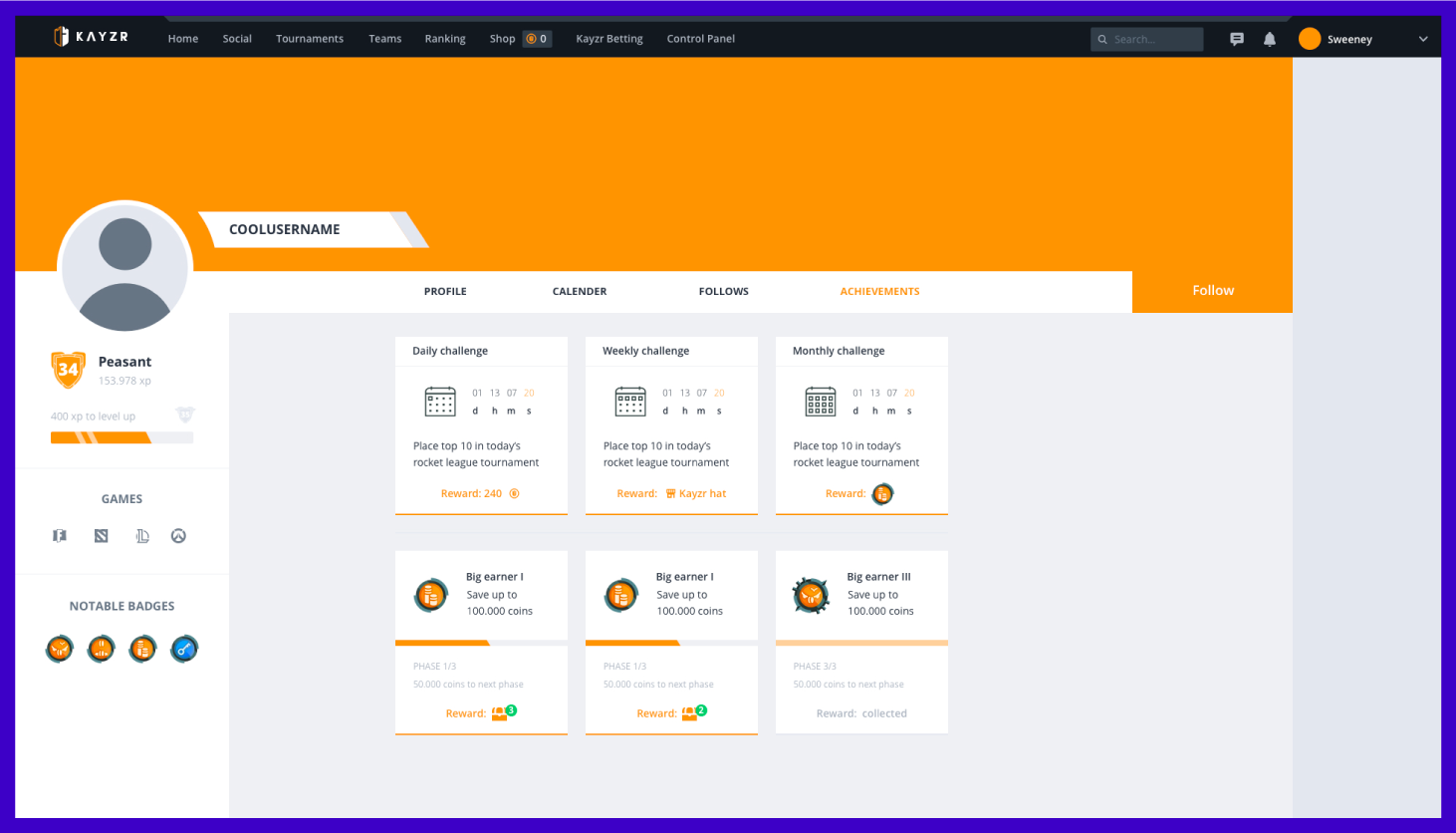
This new achievements page for Kayzr 4.0 shows how the updated system focuses on intrinsic rewards and user empowerment to drive digital engagement.
Pieter Verheye, Community Manager @Kayzr - "People are coming for the rewards, but if you take them away engagement suffers. With StriveCloud’s help we created a new reward system focused on moments of surprise and user empowerment, and engagement is higher than ever."
The results were astonishing: 30,000 gamers spent the equivalent of 15 years straight playing esports 24/7 within just one month of the update. That is 1 year of 24/7 concentrated eyeball time for sponsors, achieved through a scalable, automated architecture.
Too long, didn’t read? Here's what you missed:
TL;DR: Scalable engagement in 2026 relies on shifting from passive broadcasting to interactive, digital-first community building. With 96.3% of Gen Z now categorized as active digital video viewers, brands must prioritize user-generated content and intrinsic rewards to capture attention in a fragmented media landscape. Younger generations aren't losing interest in sports or entertainment; they are simply migrating to platforms that offer more agency. Research indicates that 57% of viewers aged 13-24 now spend less time on "regular TV" as they shift toward non-premium online video, which now accounts for 21% of their total screen time.
To achieve scalable engagement without linear cost increases, the user experience must be intrinsically rewarding. In our experience, the most successful loyalty systems focus on empowerment and unpredictability rather than just external prizes. This is critical because modern fans value peer validation over corporate messaging; 69% of young consumers cite user comments and community ratings as their primary purchase deciders. By gamifying the interaction itself, you create a self-sustaining ecosystem where participation is its own reward.
The digital landscape of 2026 is defined by constant connectivity, with 53% of Gen Z spending at least four hors daily on social media. This shift has forced sports clubs and brands to move beyond simple social media posts toward fully integrated digital events and interactive streaming. This evolution is driven by a deep-seated resistance to traditional interruption advertizing. Today, 74% of Gen Z follow micro-influencers over traditional ads, preferring the authenticity of creator-led content over the polished, one-way broadcasts of the past.

The 5 Stage Product Adoption Framework to Drive Your Business Growth
As product-led growth is becoming the new standard, SaaS companies are looking for ways to boost user engagement and adoption. In other words, they need a product adoption framework that speeds up feature discovery & time-to-value. Let's look at some examples from companies like Canva, Airtbale, Wistia, and more!

This visual introduces the key concept of using a product adoption framework to effectively guide and accelerate business growth.
What are the best ways to drive product adoption in SaaS? As product-led growth is becoming the new standard, SaaS companies are looking for gamified tactics & growth hacks to boost user engagement and adoption. In other words, they need a product adoption framework to get different types of users from trial to power users.
In this article, we’ll cover the 5 stages of the Product Adoption Curve and discuss 7 famous examples guaranteed to boost product adoption for SaaS apps.
- What is product adoption?
- Why customer adoption should be a SaaS priority
- What are the benefits of product adoption?
- The Product Adoption Curve: a framework for strong product positioning
- The 5 stages of the Product Adoption Curve
- What is a product adoption lifecycle?
- Let the product adoption curve guide your product-led growth
- 7 examples of increasing product adoption from companies like Airtable, Canva, Wistia,...
- FAQ
What is product adoption?
Product adoption is a metric that measures your user engagement. In short, it describes the lifecycle, depth & breadth of usage according to a set of desired actions. After user acquisition, a good product adoption framework turns new users into engaged users!
Why customer adoption should be a SaaS priority
To scale SaaS you need a product-led approach to growth. In other words, if your product already does the heavy work, things like sales and customer support will get easier. To complement your user acquisition process you also need a clear product adoption strategy.
By using a product adoption framework you should achieve a faster time to value and a smoother onboarding that reduces any possible friction and frustration. As a result, you’ll not only be able to drive more user engagement but also diminish churn!
Start growing your SaaS business today! Get to grips with the basics of product adoption with our ultimate guide.
What are the benefits of product adoption?
Usually following the trial period, product adoption happens when users perceive that the benefits of your product outweigh its costs. In fact, it’s fair to say that the choices users make at this stage will clearly define the success of your platform!
If users choose to adopt your product, the benefits for you are transformative:
- Reduction of churn and increase in user engagement and retention
- Boost customer lifetime value, lowering user acquisition costs
- Increased success of upseling and cross-seling
- Generation of predictable revenue streams (letting you plan with confidence)
The Product Adoption Curve: a framework for strong product positioning
Sociologist Everett Rogers first developed the Product Adoption Curve in 1962, and it remains an indispensable framework for growing businesses. In short, the curve illustrates when each user segment is best placed to adopt your product.
This powerful product adoption framework has 5 key stages:
The 5 stages of the Product Adoption Curve

This graph illustrates the classic Product Adoption Curve, showing how different user segments adopt a new product over time.
Phase 1: Innovators
Basically, a cutting-edge product attracts cutting-edge users! While innovators make up just 2.5% of the market, they’re highly active and offer tons of great insights. On the other hand, innovators are always looking for new great products, so they move on quickly and pay little.
Pro tip: Get your early product feedback here! Innovators are savvy risk-takers who also tend to forgive bugs or missing features. But most of all, they know what they want to see.
Phase 2: Early adopters
Forming around 13.5% of the total market, early adopters are a prime audience for new SaaS products. Compared to innovators, this group has issues they want to be solved, and they have the money to pay to solve them!
Pro tip: Early adopters see themselves as ahead of the curve. As such, they expect a wide range of customization and amazing customer support. Find out what drives user engagement and double down on it!
Phase 3: Early majority
Here, you must convince the next 34% of consumers, who prefer continuity to innovation. In other words, your product is becoming the new normal. Certainly, it’s a challenge - early majority customers are slow decision-makers and rely strongly on good references.
Pro tip: To persuade the early majority, you need credibility. Employing social proof in your campaigns can set users at ease. Additionally, you can use gamified growth tactics like incentivizing referrals and reviews to generate word-of-mouth.
Phase 4: Late majority
The late majority, 34% of all consumers, live at the peak of the Product Adoption Curve. At this point, your growth begins to slow. These customers are more conservative, have smaller budgets, and simply can’t afford to fail with a new product.
Pro tip: Late majority users adopt out of necessity, not curiosity. In short, they must feel they are at a competitive disadvantage by not using your product! Help your users get to value with stellar support, in-app education, or even product training!
Phase 5: Laggards
Laggards, older and more traditional, are the last segment and form 16% of the market. If this skeptic-heavy group does adopt your product, it means your software is likely in decline. However, they can still provide considerable revenue and market share!
Pro tip: Laggards are risk-averse and budget-conscious. Given this, offer trials, guarantees, and money-back assurances to entice product adoption.
What is a product adoption lifecycle?
Embedded in the curve’s product adoption framework are ‘Lifecycles’. For example, marketing and sales is an early lifecycle where users first become aware of your product. Then, they move through trial, onboarding,... Altogether, the lifecycles form a user journey that can inform your product adoption strategy.
Let the product adoption curve guide your product-led growth
Use the adoption curve as a product adoption framework! By identifying the stage your product is in, as well as what attracts different user segments, you can shorten the time between early adopters and the early majority and grow your business faster!
Get inspired by these 7 amazing examples of how to increase product adoption in SaaS:
7 examples on increasing product adoption from companies like Airtable, Canva, Wistia,...
#1 Shorten your time to value like ProdPad
For users, the race to find your value starts from the very first interaction with your platform. To drive users to that AHA moment, you need a few things. First, you need to give clear directions on where to go, and what to do. Then, you’ll also want to incentivize user engagement to keep users moving forward.
Take ProdPad for instance. This product management software experienced high churn after a 30-day trial. So, the team measured their time to value. ProdPad assessed it to be just 9 days. As it turns out, all those extra days discouraged users from engaging! So, the trial was cut to 7 days and extensions were gamified. As a result, ProdPad tripled conversion rates!
How to increase product adoption with a gamified product? Get your expert-led workshop & learn how to use behavioral psychology to your advantage!
ProdPad's interface shows how completing tasks can unlock trial extensions, a clever gamification tactic to boost engagement.
#2 Prioritize user engagement over acquisition like Duolingo
Define your growth lever. Boosting acquisition can sometimes have an effect on user engagement and long-term growth. That’s why it’s important to measure the impact of experiments and mirror them to your goals. Language learning software Duolingo is famously good at this, and it has boosted their Day 1 retention from just 13% on launch to a truly impressive 55%.
For example, the Duolingo team tested download buttons to let users complete courses offline. The result? A rize in conversions, but a dip in daily active users. This was deemed too high of a long-term loss for the short-term gain, and the feature was shelved. In other words, without initial testing, this fall in users would have been a nasty surprise!

This a/b test from Duolingo illustrates the critical choice between short-term acquisition and long-term user engagement.
#3 Give users a headstart as Airtable does
Sometimes setting up a new product can be hard just for the fact of getting started. Nobody likes to start from scratch, so why not give users a headstart? Templates can be part of your product adoption framework. You can even build out user flows to customize templates according to to use cases and user profiles.
Airtable for instance gives users a range of customized templates after onboarding. It gives users instant value and serves as motivation to further discover the product. Especially with a multi-faceted tool like Airtable, it’s important to inspire your users in what ways they can use it and give them the best practices to succeed!

Airtable reduces user friction by providing ready-to-use templates, helping new users find value and start projects faster.
#4 Boost user engagement with gamified rewards like Todoist
To get users to adopt your product, make it fun! A gamified approach triggers intrinsic motivation, a powerful psychological phenomenon where users are motivated by enjoyment and personal satisfaction.
Productivity platform Todoist for instance used a range of gamified tactics to boost keep users active. Whenever you complete a to-do list you’ll get rewarded with karma points. Additionally, Todoist uses gamified features such as progress bars, leaderboards, and even daily streaks!

Todoist effectively uses Karma points and levels to make task completion more engaging and rewarding for its users.
#5 Promote your features like Wistia
An excellent product adoption framework should maximize the breadth of user engagement. This entails users engaging with a wide range of features, and it’s a must for successful platforms. For customers, every unused feature lowers the value they could get out of your product!
As said before, you need to show your users what your product is capable of! So, when you launch a new feature be like the video hosting platform Wisitia. They promoted their new A/B testing feature by emailing existing users with a clear CTA and a video that looks extremely clickable.
Wistia's promotional email is a perfect example of how to clearly announce a new feature and encourage users to try it out.
#6 Leverage gamified checklists like Loom
Whenever users need to complete grunt work they experience lots of friction and sometimes also frustration. With gamified checklists, you can take this away! The psychology behind it is simple: humans like progress and clear directions.
For example, video messaging SaaS Loom uses gamified checklists to remind users of their goals and drive them to the crucial AHA moment.

Loom's onboarding checklist effectively guides new users through essential first steps, ensuring they experience the product's core value.
#7 The proof is in the pudding or product
Every stage of the product adoption framework will be different. You’ll need to shift focus from acquisition to onboarding, to user engagement, and so on. But the best thing you can do to drive viral growth is to make your product better!
An inspiring example here is the simplest design tool out there: Canva! Their amazing growth story is full of product-led growth tactics from customized landing pages and onboarding to template libraries.
Did you know it only takes around 52 seconds to create a Christmas card in Canva? Compare that to the average graphic design process where it could take weeks or even years to finally get value.

This comparison chart demonstrates the dramatic difference in time-to-value between Canva and traditional design software.
And that’s what is required today in our world of product-led growth!
Creating a sticky platform has never been easier! Drive product-led growth and boost adoption with our gamification software.
FAQ
What is product adoption?
Product adoption is a metric that measures your user engagement. In short, it describes the lifecycle, depth & breadth of usage according to a set of desired actions. After user acquisition, a good product adoption framework turns new users into engaged users!
Why should SaaS companies care about customer adoption?
To scale SaaS you need a product-led approach to growth. When your product already does the heavy work, sales and customer support become easier. By using a product adoption framework you achieve a faster time to value. As a result, you’ll be able to drive more user engagement and diminish churn!
What are the benefits of product adoption?
Next to user engagement and retention, product adoption also influences a range of other factors. If users choose to adopt your product, the benefits for you are transformative:
- Reduction of churn and increase in user engagement and retention
- Boost customer lifetime value, lowering user acquisition costs
- Increased success of upseling and cross-seling
- Generation of predictable revenue streams (letting you plan with confidence)
What is the Product Adoption Curve?
Sociologist Everett Rogers first developed the Product Adoption Curve in 1962, and it remains an indispensable framework for growing businesses. In short, the curve defines 5 segments from innovators and early adaptors to the early and late majority, and finally laggards.

The 6 Stages of the Customer Experience and the Best Ways to Improve Them.
The mobile app market is set to grow 21% every year between 2021 and 2025. So things will not stay the same for long! Given this, your customer experience optimization strategy needs to be the best it can be so that your business is strong and flexible. The Mobile App Funnel can be a great model to assist your journey.

This article explores how optimizing the customer journey through the mobile app funnel, enhanced with gamification, can drive user retention and growth.
2022 was an impressive year for mobile apps. In the US alone, consumer spending on apps increased by a whopping $7 billion compared to 2021! But such rapid growth also brings challenges. Is your app ready for what 2023 will bring? Right now, trends are encouraging app publishers to develop customer experience optimization strategies for the complete mobile app funnel. That means building acquisition engines, as well as a sticky reward system that boosts user retention!
In this article, let’s cover how you can optimize your customer journey with the Mobile App Funnel & what gamification can do to power up that strategy.
- How 2022 was a big year for apps (and why 2023 will be too)
- Introducing the Mobile App Funnel: a customer experience optimization technique
- The 6 stages of the mobile app funnel (and how to activate user behavior)
- How StriveCloud can help with your app gamification journey
How 2022 was a big year for apps and why 2023 will be too
With a market set to grow 21% every year between 2021 and 2025, things will not stay the same for long. Indeed, a steady ship is rare in a rizing tide.
Looking at the app market at the macro level, we see accelerated growth from top to bottom. More than 2 million new apps were published in 2022, bringing the total to a record over 21 million. Of that number, 233 apps make over $100 million annually, up an incredible 20% in just 1 year.
So the statistics show that the stakes are getting higher, the prizes bigger, and the competition stiffer. But 2022 did pick some winners when it came to growth:
Some app categories are exceling when it comes to mobile app engagement

This graph illustrates the significant growth in the average number of apps used per month across various categories, with finance, food, and mHealth leading the charge.
Out of all the app categories, finance is the sector that new users are flocking to most. In 2021, the average number of finance apps used monthly increased by 32.5% compared to 2019. That higher level of mobile app engagement gives more finance apps a chance to gain a loyal customer base! In addition, food retail and mHealth are growing in this metric. However, the market is headed for a shakeup in 2023 due to one development:
5G is on the rize and users expect speed and efficiency improvements
By the end of 2027, nearly half of all devices will support 5G connections. This will drastically affect the customer experience users can expect to enjoy:
- 5G is 100x faster than today’s 4G
- 5G will allow for more integration of AR and VR tech
- Latency times will reduce from 50 milliseconds to just 1 millisecond!
- Fintech will process faster and more secure mobile payments
- Deeper mHealth integration with wearable devices will eventually become possible

As these trends indicate, the mobile app market is evolving rapidly, demanding a proactive approach to the user journey.
In short, you need to be confident that your customer experience can steer you through the changes up ahead. That means discussing customer experience optimization.
Introducing the Mobile App Funnel: a customer experience optimization technique
The customer journey is a popular concept among marketeers. It helps to visualize what users experience, all the way from acquisition up to becoming a loyal customer. In other words, inquisitive product managers and marketeers looking to optimize their customer journey can benefit from the ‘mobile app funnel’ model.
It may seem overwhelming to picture all your challenges and goals, but a systemic approach can help break it up into manageable segments. The mobile app funnel, or User Lifecycle stages model, gives you the clarity you need to identify the best interventions you might want to take during every stage of customer interaction.

This diagram visualizes the mobile app funnel, a model that breaks the customer journey into distinct stages from acquisition to advocacy.
Of course, your challenges and goals will differ depending on the stage. To tackle and achieve them, you must develop a tailored strategy for every segment of the journey. This might seem obvious, but it’s easy to miss some crucial details when you are looking at the big picture. This model helps identify what solutions you need for each stage.
The 6 stages of the mobile app funnel (and how to activate user behavior)
The mobile app funnel helps to map out your customer experience optimization strategy - but to give it extra legs you may want to consider gamification!
Gamification is the use of game-like elements in a non-game context that aims to integrate a genuinely enjoyable and satisfying reward system. StriveCloud knows the potential benefits of mobile app gamification, from a 9% boost to conversion to a 250% jump in social activity just from a simple gamified leaderboard!
Just getting started with gamification? Catch up to speed on our What is Gamification page!
With that in mind, let’s see how gamification can activate your users in all 6 stages:
#1 Acquisition: increase your user base
Acquiring users can be difficult and costly. At the end of 2021, the cost per install (CPI) rate across the Google Play Store was $1.22. That’s higher than the average, and much higher than in December 2019 when it was $0.97. In essence, it’s getting more expensive to acquire new users. But that doesn’t mean you are without a solution: a successful App Store Optimization (ASO) strategy can boost your conversions by 10%.
For ASO, word-of-mouth and social media tactics are indispensable. Smarter use of keywords, images, and other tags will increase your app’s ranking in the app store!
The gamification boost: How Revolut gained hundreds of users with a leaderboard
When starting out, Revolut had university leaderboards that encouraged students to sign up. This taps into the need for social relatedness. Simply put, competition is fun. In addition, the reward system built on the prize of a premium membership entices users to sign up! This could generate a buzz, like reviews and high star ratings in the app store that will acquire users and boost your ASO strategy.

Revolut's use of a university leaderboard demonstrates how competition and rewards can drive user acquisition effectively, setting the stage for the next phase: activation.
#2 Activation: convert acquired users to engaged users
It’s not enough to acquire users, you have to activate them. This entails demonstrating your customer value early on. Most apps lose around 80% of new users in just 1 day! Don’t be like that instead, optimize and concentrate on your onboarding. In doing so, you could see a 4x times boost to activation metrics!
Onboarding should be short, sweet, and personalized! Fitness apps may want to ask new users their experience level, or fintech app users’ priority (like investing or saving). Subtle touches like this can tell a person that their needs will be met; that they are not simply downloading a one size fits all experience. That’s crucial!
Another thing you can do is give your users a headstart. People are more motivated to complete a goal when there’s already some sort of artificial advancement to it. This is called ‘the endowed progress effect’. Companies like Paypal or Dropbox for instance all use this in their onboarding process, and rightfully so as it can increase onboarding completions by over 10%.
The gamification boost: MuscleBooster uses personalized onboarding to become a Top 10 fitness app
The first thing you want when new users install your app is to immediately see the potential benefits. So when MuscleBooster personalized the customer experience, they gave customers ownership over the user experience making them more likely to stay.

MuscleBooster's personalized onboarding process gives users a sense of ownership from the very beginning, which is a key factor in moving them from activation to long-term retention.
#3 Retention: incentivize habit formation
To stick around, people need to love your product. That much should be clear! At this stage of your customer experience optimization journey, it’s important to have the right data. Here, user retention metrics on Days 1, 7, and 30 are the most important KPIs to keep in mind. Not only will this help you compare your app to the competition, but it will also provide an anchor point to base your efforts on.
At this stage, one of your most powerful tools is customizing in-app communication.
The gamification boost: Personalization gives Calm a 3x boost to user retention
Calm achieved success by letting users set their own push notifications reminding them to meditate. By personalizing push notifications, Calm not only avoids frustrating new users with clutter, but also helps facilitate habit formation, and in turn, retention.
StriveCloud’s gamification building blocks can boost your app. Gamify your app in no time all suited to your goals!
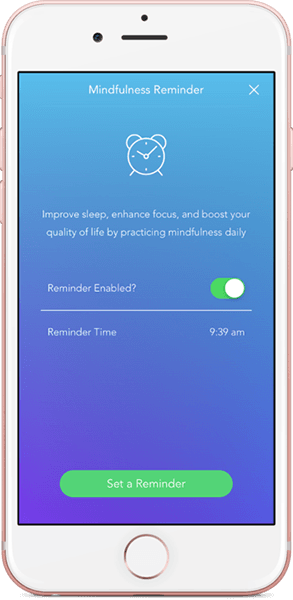
By allowing users to personalize reminders, the Calm app masterfully encourages habit formation, a cornerstone of user retention.
#4 Re-engagement: a reward system that wins back inactive or churned users
Don’t miss out on users who might lapse, after all, you spent this much effort to get them to this stage! It can be super effective to incentivize lapsed users to return with an enticing reward system, such as by offering ‘free stuff’ like premium membership or discounts on exclusive events/features.
The gamification boost: Cashback offers brought back lapsed users for Revolut
Revolut users were given 6 days to benefit from half-price cashback on purchases at the Notes Coffee café chain in London. The results were incredible! They achieved a 15% user retention rate, improved visit repetition, and won back lost customers.

This example of a time-sensitive cashback offer from Revolut shows how targeted perks can re-engage lapsed users and pave the way for monetization strategies.
#5 Monetization: increase revenue & convert free users to paying customers
At this point, your user loves your app! But what can you do to increase user activity and improve that customer’s lifetime value? There’s a range of monetization strategies you can go for, from in-app purchases to monthly subscription models. Each has its advantages that you need to consider, depending on what you can offer users.
The gamification boost: BBVA bank monetized 100,000 loyal customers through a smart reward system
BBVA, a leading Spanish bank, created a gamification strategy fit for the loyalty and monetization stage. As part of their strategy, they launched the BBVA Game, a web app with app tutorials and explanations on how to pay taxes and do transactions online.
With their reward system, customers can spend their earned points from completing challenges by redeeming them for music downloads, movies, smartphones, or even tickets for the La Liga football league. This is the sort of ancillary income that can boost your bottom line. After only 6 months, the BBVA game had over 100,000 users and its users showed an 18% higher satisfaction rate!

The success of the BBVA Game, with its tangible rewards and high satisfaction rates, illustrates how to effectively monetize an engaged user base and turn customers into advocates.
#6 Advocacy: a smart strategy that makes people talk about you
A 2015 Nielsen report reveals that 83% of people would trust the recommendations of family or friends. However, only a few brands have mastered the word-of-mouth technique and succeeded in converting their users into proud advocates. Here’s where gamification can make the difference.
Exclusivity is a powerful tool that brands can use at this phase. Think about what would make your users proud to display in front of their friends. More than that, you can reward your advocates for using referral links to register for a new account or simply implementing new incentives that would transform advocacy into a habit.
How StriveCloud can help with your app gamification journey
Just like putting a new splash of paint on artwork is stressful for an artist, implementing new features can be troublesome for app developers. How do you know what you are doing is right? Is this reward system suitable for your app’s users? Will it be easy to adjust or take off, should you need to? With StriveCloud’s app gamification building blocks, you need not worry.
The app gamification blocks allow app publishers to insert, remove, and adjust new features to best suit their users’ needs. It doesn’t require code and can be customized to fit your user experience entirely. Ultimately, this lends your business flexibility - to be sure a competitive advantage in 2023’s fast-moving app market!
Start your own gamification journey with a personalized workshop - Bring your goals & data & go home with an actionable roadmap!
The 6 Stages of the Customer Experience and the Best Ways to Improve Them in 2023
The mobile app market is set to grow 21% every year between 2021 and 2025. So things will not stay the same for long! Given this, your customer experience optimization strategy needs to be the best it can be so that your business is strong and flexible. The Mobile App Funnel can be a great model to assist your journey.

2022 was an impressive year for mobile apps. In the US alone, consumer spending on apps increased by a whopping $7 billion compared to 2021! But such rapid growth also brings challenges. Is your app ready for what 2023 will bring? Right now, trends are encouraging app publishers to develop customer experience optimization strategies for the complete mobile app funnel. That means building acquisition engines, as well as a sticky reward system that boosts user retention!
In this article, let’s cover how you can optimize your customer journey with the Mobile App Funnel & what gamification can do to power up that strategy.
- How 2022 was a big year for apps (and why 2023 will be too)
- Introducing the Mobile App Funnel: a customer experience optimization technique
- The 6 stages of the mobile app funnel (and how to activate user behavior)
- How StriveCloud can help with your app gamification journey
How 2022 was a big year for apps (and why 2023 will be too)
With a market set to grow 21% every year between 2021 and 2025, things will not stay the same for long. Indeed, a steady ship is rare in a rizing tide.
Looking at the app market at the macro level, we see accelerated growth from top to bottom. More than 2 million new apps were published in 2022, bringing the total to a record over 21 million. Of that number, 233 apps make over $100 million annually, up an incredible 20% in just 1 year.
So the statistics show that the stakes are getting higher, the prizes bigger, and the competition stiffer. But 2022 did pick some winners when it came to growth:
Some app categories are exceling when it comes to mobile app engagement
This graph illustrates the impressive growth in mobile app engagement across various sectors like finance and food retail.
Out of all the app categories, finance is the sector that new users are flocking to most. In 2021, the average number of finance apps used monthly increased by 32.5% compared to 2019. That higher level of mobile app engagement gives more finance apps a chance to gain a loyal customer base! In addition, food retail and mHealth are growing in this metric. However, the market is headed for a shakeup in 2023 due to one development:
5G is on the rize - and users expect speed and efficiency improvements
By the end of 2027, nearly half of all devices will support 5G connections. This will drastically affect the customer experience users can expect to enjoy:
- 5G is 100x faster than today’s 4G
- 5G will allow for more integration of AR and VR tech
- Latency times will reduce from 50 milliseconds to just 1 millisecond!
- Fintech will process faster and more secure mobile payments
- Deeper mHealth integration with wearable devices will eventually become possible
The chart highlights key trends in the mobile app market, emphasizing the rapid adoption of new technologies like 5G and its impact on user experience.
In short, you need to be confident that your customer experience can steer you through the changes up ahead. That means discussing customer experience optimization.
Introducing the Mobile App Funnel: a customer experience optimization technique
The customer journey is a popular concept among marketeers. It helps to visualize what users experience, all the way from acquisition up to becoming a loyal customer. In other words, inquisitive product managers and marketeers looking to optimize their customer journey can benefit from the ‘mobile app funnel’ model.
It may seem overwhelming to picture all your challenges and goals, but a systemic approach can help break it up into manageable segments. The mobile app funnel, or User Lifecycle stages model, gives you the clarity you need to identify the best interventions you might want to take during every stage of customer interaction.
This diagram visualizes the complete mobile app funnel, outlining the six key stages of the customer journey from acquisition to advocacy.
Of course, your challenges and goals will differ depending on the stage. To tackle and achieve them, you must develop a tailored strategy for every segment of the journey. This might seem obvious, but it’s easy to miss some crucial details when you are looking at the big picture. This model helps identify what solutions you need for each stage.
The 6 stages of the mobile app funnel (and how to activate user behavior)
The mobile app funnel helps to map out your customer experience optimization strategy - but to give it extra legs you may want to consider gamification!
Gamification is the use of game-like elements in a non-game context that aims to integrate a genuinely enjoyable and satisfying reward system. StriveCloud knows the potential benefits of mobile app gamification, from a 9% boost to conversion to a 250% jump in social activity just from a simple gamified leaderboard!
Just getting started with gamification? Catch up to speed on our What is Gamification page!
With that in mind, let’s see how gamification can activate your users in all 6 stages:
#1 Acquisition: increase your user base
Acquiring users can be difficult and costly. At the end of 2021, the cost per install (CPI) rate across the Google Play Store was $1.22. That’s higher than the average, and much higher than in December 2019 when it was $0.97. In essence, it’s getting more expensive to acquire new users. But that doesn’t mean you are without a solution: a successful App Store Optimization (ASO) strategy can boost your conversions by 10%.
For ASO, word-of-mouth and social media tactics are indispensable. Smarter use of keywords, images, and other tags will increase your app’s ranking in the app store!
The gamification boost: How Revolut gained hundreds of users with a leaderboard
When starting out, Revolut had university leaderboards that encouraged students to sign up. This taps into the need for social relatedness. Simply put, competition is fun. In addition, the reward system built on the prize of a premium membership entices users to sign up! This could generate a buzz, like reviews and high star ratings in the app store that will acquire users and boost your ASO strategy.
Revolut's university leaderboard is a prime example of how gamified competition can drive user acquisition.
#2 Activation: convert acquired users to engaged users
It’s not enough to acquire users, you have to activate them. This entails demonstrating your customer value early on. Most apps lose around 80% of new users in just 1 day! Don’t be like that - instead, optimize and concentrate on your onboarding. In doing so, you could see a 4x times boost to activation metrics!
Onboarding should be short, sweet, and personalized! Fitness apps may want to ask new users their experience level, or fintech app users’ priority (like investing or saving). Subtle touches like this can tell a person that their needs will be met; that they are not simply downloading a one size fits all experience. That’s crucial!
Another thing you can do is give your users a headstart. People are more motivated to complete a goal when there’s already some sort of artificial advancement to it. This is called ‘the endowed progress effect’. Companies like Paypal or Dropbox for instance all use this in their onboarding process, and rightfully so as it can increase onboarding completions by over 10%.
The gamification boost: MuscleBooster uses personalized onboarding to become a Top 10 fitness app
The first thing you want when new users install your app is to immediately see the potential benefits. So when MuscleBooster personalized the customer experience, they gave customers ownership over the user experience making them more likely to stay.
MuscleBooster's personalized onboarding process demonstrates how tailoring the initial experience leads to higher user activation.
#3 Retention: incentivize habit formation
To stick around, people need to love your product. That much should be clear! At this stage of your customer experience optimization journey, it’s important to have the right data. Here, user retention metrics on Days 1, 7, and 30 are the most important KPIs to keep in mind. Not only will this help you compare your app to the competition, but it will also provide an anchor point to base your efforts on.
At this stage, one of your most powerful tools is customizing in-app communication.
The gamification boost: Personalization gives Calm a 3x boost to user retention
Calm achieved success by letting users set their own push notifications reminding them to meditate. By personalizing push notifications, Calm not only avoids frustrating new users with clutter, but also helps facilitate habit formation, and in turn, retention.
StriveCloud’s gamification building blocks can boost your app. Gamify your app in no time all suited to your goals!
The Calm app's features show how personalization and habit-forming reminders can significantly boost user retention.
#4 Re-engagement: a reward system that wins back inactive or churned users
Don’t miss out on users who might lapse, after all, you spent this much effort to get them to this stage! It can be super effective to incentivize lapsed users to return with an enticing reward system, such as by offering ‘free stuff’ like premium membership or discounts on exclusive events/features.
The gamification boost: Cashback offers brought back lapsed users for Revolut
Revolut users were given 6 days to benefit from half-price cashback on purchases at the Notes Coffee café chain in London. The results were incredible! They achieved a 15% user retention rate, improved visit repetition, and won back lost customers.
Revolut's cashback perk illustrates a powerful re-engagement strategy that brings lapsed users back to the app.
#5 Monetization: increase revenue & convert free users to paying customers
At this point, your user loves your app! But what can you do to increase user activity and improve that customer’s lifetime value? There’s a range of monetization strategies you can go for, from in-app purchases to monthly subscription models. Each has its advantages that you need to consider, depending on what you can offer users.
The gamification boost: BBVA bank monetized 100,000 loyal customers through a smart reward system
BBVA, a leading Spanish bank, created a gamification strategy fit for the loyalty and monetization stage. As part of their strategy, they launched the BBVA Game, a web app with app tutorials and explanations on how to pay taxes and do transactions online.
With their reward system, customers can spend their earned points from completing challenges by redeeming them for music downloads, movies, smartphones, or even tickets for the La Liga football league. This is the sort of ancillary income that can boost your bottom line. After only 6 months, the BBVA game had over 100,000 users and its users showed an 18% higher satisfaction rate!
The results from the BBVA Game highlight how a well-designed reward system can successfully monetize a loyal user base.
#6 Advocacy: a smart strategy that makes people talk about you
A 2015 Nielsen report reveals that 83% of people would trust the recommendations of family or friends. However, only a few brands have mastered the word-of-mouth technique and succeeded in converting their users into proud advocates. Here’s where gamification can make the difference.
Exclusivity is a powerful tool that brands can use at this phase. Think about what would make your users proud to display in front of their friends. More than that, you can reward your advocates for using referral links to register for a new account or simply implementing new incentives that would transform advocacy into a habit.
How StriveCloud can help with your app gamification journey
Just like putting a new splash of paint on artwork is stressful for an artist, implementing new features can be troublesome for app developers. How do you know what you are doing is right? Is this reward system suitable for your app’s users? Will it be easy to adjust or take off, should you need to? With StriveCloud’s app gamification building blocks, you need not worry.
The app gamification blocks allow app publishers to insert, remove, and adjust new features to best suit their users’ needs. It doesn’t require code and can be customized to fit your user experience entirely. Ultimately, this lends your business flexibility - to be sure a competitive advantage in 2023’s fast-moving app market!
Start your own gamification journey with a personalized workshop - Bring your goals & data & go home with an actionable roadmap!
The 7-step Gamification Blueprint to Change mHealth Apps for the Better
In 2020, European spending on mobile health apps jumped 70%. But how can mHealth apps succeed in retaining users, improving their health, and drive app engagement, all the while competing in a market of over 100,000 apps? Gamification for mHealth gets your users moving! Want to find out how it can help you? Read the full post!
TL;DR: Gamification for mHealth apps is the integration of game mechanics like progression, social loops, and rewards into clinical contexts to drive long-term patient adherence. As of 2026, the global healthcare gamification market has surpassed USD 4.16 billion, with enterprise-level adoption reaching a 61% market share to solve the persistent challenge of user retention.
The core mission of most digital health tools is to facilitate lasting behavioral change. However, achieving this is difficult when apps target high-friction cohorts, such as patients managing chronic illnesses or those facing "log fatigue" from repetitive data entry. In our experience, the most successful gamification for mHealth apps moves beyond simple points to address the psychological needs of the user, turning clinical requirements into voluntary habits.
The stakes for engagement are higher than ever. Recent market reports indicate that the U.S. healthcare gamification sector is projected to reach USD 6.31 billion by 2032, growing at a CAGR of 23.19%. With exercise games now commanding a 45.22% share of the market, it is clear that users are gravitating toward platforms that provide intrinsic motivation. Gamification for mHealth apps is no longer an optional "extra" it is the primary driver for apps looking to stand out in a market that continues to expand rapidly in 2026.
In this article, we will discuss how gamification for mHealth apps drives user engagement and the specific steps required to implement these mechanics effectively!
Here’s what you’ll find out:
- What is gamification in a clinical context?
- Gamification for mHealth apps done right: 2026 Case Studies
- How to incorporate gamification for mHealth apps
- The measurable benefits of gamification for mHealth apps
What is gamification?
TL;DR: Gamification is the application of game-design elements in non-game environments to drive specific user behaviors. In the mHealth sector, it is the primary engine behind a market projected to reach USD 6.31 billion by 2032, transforming passive health tracking into active, habit-forming experiences.
Gamification is the strategic use of game elements and psychology in a non-game context. In our experience, implementing gamification into your user experience is the most effective way to motivate users and solve the retention challenges that plague digital health. By 2026, the global healthcare gamification market has matured into a USD 4.16 billion industry, where the most successful platforms prioritize behavioral science to drive long-term health outcomes rather than short-term novelty.
How does gamification for apps work?
Gamification for apps is mostly recognized through features like badge reward systems, leaderboards, or progress bars. We call these extrinsic motivators. However, as the industry moves toward more sophisticated clinical applications, research shows that extrinsic rewards alone are not sustainable. While they trigger initial downloads, the 23.19% CAGR currently seen in the market is driven by apps that successfully transition users from external rewards to internal habits.
True motivation comes from within. It’s the underlying emotions behind these features that make a user tick our innate desires for achievement, autonomy, and social connection. We call these intrinsic motivators. In our experience, the 61.25% market share held by enterprise-based healthcare gamification in 2024 demonstrates that providers now favor intrinsic design to ensure patients stay committed to long-term treatment plans.
The true power, however, comes from combining these two. It’s the difference between a gamification strategy that feels like a gimmick and one that changes lives. Currently, exercise games and fitness motivators hold a 45.22% market share because they masterfully balance these five psychological pillars:
- Relationships. Humans are biologically wired for social connection. We are encouraged by a sense of competition or collaboration between peers. To leverage this, modern mHealth apps use features like community challenges or real-time social feeds to foster accountability.
- Accomplishment. Satisfying the need to achieve creates an intrinsic loop that makes your app feel rewarding. In our experience, the most successful apps move beyond simple badges to "milestone mastery," where users feel a genuine sense of growth in their health journey.
- Empowerment. Successful apps empower users with autonomy. Recent industry reports confirm that when mHealth apps allow for deep customization, users report higher engagement. This includes everything from personalized health goals to customizable interfaces that reflect the user's identity.
- Unpredictability. Humans are naturally curious. By 2026, leading apps use AI-driven "variable rewards" and unexpected challenges to prevent user fatigue and keep the experience fresh and engaging.
- Constraint. People are highly motivated to avoid negative outcomes or lose progress. Implementing "streaks" or limited-time challenges creates a healthy sense of urgency, encouraging users to check in daily to maintain their hard-earned momentum.
Looking for more gamification goodness? Check out our ‘What is Gamification’ page!
Gamification for mHealth apps done right
TL;DR: Gamification for mHealth apps is the primary driver behind a healthcare gamification market projected to reach $6.31 billion by 2032. By leveraging social mechanics and enterprise-grade behavioral triggers, top apps are seeing a 23.19% CAGR as they transition from simple tracking to high-retention clinical tools.
There are many gamification tactics you can use to boost app engagement and user retention. However, it all depends on the user goals and requirements. Let’s see how top mHealth apps like Strava and Milk Man use these features to dominate a global market now valued at over $4.16 billion.

The chart above breaks down various gamification strategies, which top apps like Strava use to effectively motivate their user base in an increasingly competitive 2026 landscape.
Strava remains a titan in the fitness segment, which currently commands a 45.22% share of the exercise gaming market. With millions of active athletes tracking their activities, Strava succeeds by recognizing that data alone isn't enough; users need a social "hook" to remain consistent over years, not just months.
Runners can turn their local park or street into a racecourse, which the app calls ‘segments’. In doing so they can compete on a leaderboard with others in their area. In our experience, the genius of their leaderboard is how it thrives on the social and motivational aspect of the user experience. By 2026, this "community-first" approach is the gold standard for gamification for mHealth apps.
On the other end of the spectrum, Milk Man is an emerging app that encourages fathers to learn about the health benefits of breastfeeding. Milk Man represents the growing enterprise-based gamification sector which accounts for 61.25% of the total market share by driving engagement through points, badges, and social elements like forums. This model is particularly effective for healthcare providers looking to increase patient education and adherence.

This screenshot from the Milk Man app displays how badges and achievements can encourage fathers to learn about important health topics through structured, rewarding pathways.
Current industry trends show that consumer-facing fitness and wellness apps are the fastest-growing sub-segment due to rizing global health awareness. Within Milk Man’s ecosystem, over 72% of users reported learning new information, citing personalized notifications and milestone-based rewards as the primary reasons they didn't abandon the platform after the first week.
How to incorporate gamification for mHealth apps
TL;DR: In 2026, gamification for mHealth apps is no longer optional; it is a core retention strategy in a market projected to reach $6.31 billion by 2032. By following a structured 7-step blueprint from behavioral analysis to data-driven iteration developers can capture the 45.22% of users now gravitating toward exercise-based game mechanics. In our experience, the most successful apps prioritize "micro-incentives" that align with clinical outcomes to sustain long-term engagement.
A foundational Brazilian study found that gamification for mHealth apps leads to significantly higher health goal completion rates. This research laid out a 7-step blueprint that remains the gold standard for setting up a high-performance gamified user journey in 2026:
- Analyze the app’s requirements and key features - find out what specific medical or wellness actions your users need to take in order to experience "Time to Value" within your app.
- Identify the target users - Learn more about who your users are. In our experience, enterprise-level users (making up 61.25% of the market) respond better to progress visualization, while consumer-led users favor social competition.
- Pinpoint the interactions between the users and app - identify every touchpoint and define the ideal user behavior for each, ensuring the gamification for mHealth apps strategy feels like a natural extension of the UI.
- Learn the pros and cons of other gamification apps - with a projected 23.19% CAGR in the healthcare gamification sector, studying competitors’ reward loops is vital to avoid "point fatigue."
- Choose the most suitable gamification strategy - select the mechanics (e.g., streaks, leagues, or unlockable content) that are most likely to work based on your specific health vertical.
- Develop the gamification features - Leverage real-time biometrics and user data to develop scalable challenge and reward systems that adapt to the user’s physical progress.
- Evaluate the gamification features - Use A/B testing to measure how features drive desired health behaviors and iterate based on retention cohorts.
As the consumer segment becomes the fastest-growing area of digital health, the data you leverage will define your success. Essentially, you can gamify any interaction, but in 2026, the most effective gamification for mHealth apps strategies are those that feel personalized rather than prescriptive. Your strategy must evolve alongside your users' fitness levels and health literacy.
Setting up a gamification strategy is hard. Let our team of experts help you!
The benefits of gamification in health apps
TL;DR: Gamification in health apps has evolved into a $4.16 billion industry necessity as of 2025. By leveraging exercise games and interactive onboarding, developers can combat high uninstall rates and drive long-term patient adherence through dopamine-driven feedback loops.
Gamification in health apps drives long-term engagement by moving beyond short-term milestones. While users might initially be motivated by a specific weight-loss goal or a temporary fitness challenge, behavioral research suggests that intrinsic motivation often wanes once those targets are met. In our experience, mHealth gamification solves this by providing consistent positive reinforcement and a sense of "play" that sustains interest. With the global healthcare gamification market projected to grow 23.19% annually through 2032, it is clear that stimulating user experiences are now the baseline for top-tier wellness platforms.
The right strategy makes the user journey more enjoyable and reduces churn. In a competitive landscape where exercise games and fitness apps now hold a 45.22% market share, early engagement is the difference between a loyal user and a deleted app. While standard apps often struggle with high 30-day abandonment, gamification in health apps transforms mundane tasks like filling out medical history or daily logs into rewarding experiences. Current data indicates that enterprise-level adoption (healthcare providers and pharma) now accounts for 61.25% of the market share, proving that even clinical settings rely on these "fun" elements to ensure patient retention and data accuracy.
Finally, gamification in health apps reinforces permanent behavior change. Simply put, research shows that gamified systems stimulate goal completion more effectively than static tracking. By using motivators like dynamic progress bars and achievement tiers, developers can tap into the user's desire for mastery. According to industry reports, the U.S. healthcare gamification market is expected to reach $6.31 billion by 2032, fueled by the shift toward preventative care and the proven ability of these apps to support habit formation over time.
Want to pimp up your user experience to make it more fun? Check out our app gamification software!
Wrap up: Why mHealth app gamification is the standard for 2026
TL;DR: To succeed in 2026, mHealth apps must transition from static tracking tools to interactive ecosystems. With the global healthcare gamification market reaching USD 4.16 billion in 2025, sophisticated engagement features are now the primary defense against user churn and "app fatigue."
In order for mHealth apps to succeed in their goal of improving user health, they need to overcome the "engagement plateau." In our experience, the primary reason for churn in 2026 isn't a lack of features, but a lack of consistent user motivation. According to industry reports, exercise-based games now command a 45.22% market share, proving that users increasingly gravitate toward apps that reward their progress.
To combat abandonment, mHealth apps are increasingly turning to this 7-step gamification blueprint to drive long-term behavior change. By leveraging game mechanics, you can tap into the 23.19% CAGR growth currently transforming the U.S. healthcare gamification sector, which is projected to hit USD 6.31 billion by 2032. We have found that the most successful apps move beyond simple badges to integrate deep-rooted social and competitive elements that keep users coming back daily.
Looking to drive long-term engagement and positive behavior change yourself? This might be the right strategy for you!