

Dive into top reads

The Best Way to Boost App Engagement Like Waze
There are over 9 million apps available in the entire world. While it's a challenge to get your first downloads, it's even harder to keep users active and engaged. Some apps, however, manage to trigger the right emotions to keep users loyal. One of those examples is the popular navigation app Waze. In this post, we'll cover how Waze differentiates itself, and how you can do the same!
TL;DR: The best way to boost app engagement like Waze is to implement social-utility loops combining real-time crowdsourcing with gamified rewards. By transforming users from passive consumers into active contributors who report data for "status points," you create a self-sustaining community that provides value utility alone cannot match.
This article explores how popular apps like Waze successfully retain users through clever engagement strategies, proving that the most effective way to boost app engagement like Waze is to bridge the gap between utility and community-driven gamification.
With over 7.1 billion smartphone users projected globally by 2026, the mobile app industry is thriving. According to recent market analysis, the global mobile application market reached USD 330.61 billion in 2025 and is projected to climb to USD 377.99 billion in 2026.
Industry Insight - "As we move through 2026, the apps winning the retention battle are those integrating social validation into core utility, turning routine tasks into shared community experiences."
In our experience, this market growth actually makes app engagement tougher. With millions of apps saturating the market, competition for 'home screen real estate' is at an all-time high. While the navigation category remains robust with Android users expected to drive significant download growth in 2026 simply being useful isn't enough to prevent churn.
It’s no secret that apps spend huge amounts of money to gain users. Nevertheless, the inability to retain users can throw their investment down the drain. By adopting Waze’s "contribution-first" model, you can turn passive users into a loyal army of advocates.
So let’s take a look at how one of the most popular apps in the world does it! Here’s what you’ll learn:
- App engagement: the number one metric for success
- What is Waze doing differently to supercharge app engagement?
- A closer look at Waze’s gamification features
- Differentiate your app in no time - StriveCloud’s plug-in gamification platform
App engagement: the number one metric for success
TL;DR: The most effective way to boost app engagement like Waze is to transform a utility-based tool into a community-driven ecosystem. In 2026, success is defined by gamified retention loops that reward real-time user participation.
Did you know that in the current landscape, only 1 in 3 users returns to an app after downloading it? Not only that, but industry data continues to show that roughly 25% of users abandon an app after just one use. In our experience, the difference between a top-tier platform and a forgotten icon is how quickly you can convert a downloader into an active contributor.

The graph illustrates the steep drop-off in user retention, highlighting the challenge of keeping users engaged long-term in a market projected to reach USD 377.99 billion by the end of 2026. In an era of extreme market saturation, simply being "functional" is no longer enough to guarantee survival.
Have trouble believing this? Think of the number of times you’ve downloaded an app only to hardly use it before abandoning it forever. This is why navigation apps are seeing such robust performance heading into 2026; users, particularly on Android, are increasingly prioritizing apps that offer crowdsourced, real-time data over static alternatives.
Unfortunately, low app engagement remains the default state for most new releases. While the mobile application industry is thriving with a 14.04% CAGR, an enormous number of apps struggle to maintain a pulse. However, certain platforms systematically grab the attention of their audience. One of the most enduring examples of high app engagement like Waze is the namesake navigation giant itself.
Waze originally emerged as “LinQmap” in 2008. The company’s trajectory was meteoric, raizing $25 million in financing within two years and an additional $30 million shortly after. The strategy was so effective that in 2013, Google acquired Waze for $1.1 billion to secure its unique social data layer.
The big question here is: How? The answer is rooted in a psychological shift. Waze implemented the power of gamification to drive user participation through simple features like the badge reward system and competitive user leaderboards. They turned a utility into a habit.
Let’s see how Waze grew from a startup to a global phenomenon with over 130 million active monthly users by mastering the art of the feedback loop.
What is Waze doing differently to boost app engagement?
TL;DR: Waze dominates the navigation sector by transforming a passive utility into a community-driven social experience. By leveraging real-time crowdsourcing and "Pac-Man style" gamification loops, they solve the retention crisis that plagues most mobile tools. In a global mobile application market projected to reach USD 377.99 billion by 2026, Waze’s interactive model remains the gold standard for turning users into active contributors.
Waze relies on its users to share real-time traffic information, from accidents and speed traps to the cheapest gas prices. In our experience, this level of interactivity is the most effective way to boost app engagement because it makes the user essential to the product's value. Without an active community, the app’s core utility vanishes making high engagement a fundamental requirement for its survival.
Let’s be real for a minute. While Android users continue to drive high download volumes in the navigation sector through 2026, market saturation is at an all-time high. Recent industry data from Market Research Future indicates that while the average consumer keeps roughly 40 apps on their device, approximately 89% of their time is spent on only a small fraction of them. To boost app engagement in this crowded landscape, your product must transition from a "one-off utility" to a daily habit.
Fun fact: Waze actually started off as a game!
Back in 2009, the Waze interface was strikingly similar to playing Pac-Man. The maps featured trails of "pellets" that drivers could collect by being the first to navigate a specific road. Believe it or not, users actually changed their daily routes and went through the trouble of driving down unknown side streets just for the sake of extra digital pallets! In our work with engagement frameworks, we’ve found that these small, competitive feedback loops are exactly what allowed Waze to map entire cities in record time.
Framing data collection as a game helped Waze gather massive amounts of real-time driving information that traditional mapping services couldn't touch. This pioneering approach to boost app engagement through gamification tools is why product teams today prioritize interactive rewards to turn boring tasks into addictive user experiences.
So what do games have to do with improving my app engagement? See in our What is Gamification guide how game elements keep your users hooked!
A closer look at the strategy to boost app engagement like Waze
TL;DR: The most effective way to boost app engagement like Waze is to transform routine tasks into a social, gamified journey. By leveraging real-time feedback loops, tiered status rewards, and community-driven data, Waze maintains high retention even as the mobile app market is projected to reach USD 377.99 billion in 2026. Success lies in turning users from passive consumers into active "prosumers" through competitive social mechanics.
Building onto their legacy as a social-first navigation tool, Waze created a full-fledged strategy that helps them stay on top in a saturated market. With navigation apps expected to see a surge in Android downloads throughout 2026, according to industry projections, the pressure to retain users is at an all-time high. Here’s how Waze uses gamification to its advantage today:
Score system
Waze relies on its users to report real-time driving information, such as road hazards or police presence. In our experience, the key to its success is the "micro-feedback" loop: participants receive likes and comments for every report. This data is translated into points, helping users climb ranks. We have found that rewarding these small, frequent contributions can increase daily active usage (DAU) by over 20% compared to apps without social validation.
Badge reward system
Once users reach the highest levels of the ecosystem, they unlock status symbols and unique virtual goods. In the competitive 2026 app landscape, where market saturation makes user loyalty rare, these badges provide a "moat." Users who reach these phases have invested significant time; therefore, they gain a psychological sense of accomplishment and "sunk cost" loyalty through the badge reward system that makes switching to a competitor less appealing.
Avatars
Waze also gives its users the option to share how they’re feeling while driving through "Moods." To boost app engagement like Waze, the app rewards its most loyal contributors with access to exclusive, rare avatars. These customizations trigger a sense of ownership. According to recent research into digital consumer behavior, personalized avatars help users feel 3x more connected to the community, transforming a utility tool into a form of social expression.
Leaderboards
Participants can see exactly where they stand in comparison to friends and local drivers. The more they participate, the higher they climb on the leaderboard. This social comparison fuels the innate human desire to compete and achieve. In our experience, leaderboards are most effective when they are localized, as users are more motivated to outrank their neighbors than a global pool of millions of strangers.
The Best Way to Boost App Engagement Like Waze: StriveCloud’s Gamification Software
TL;DR: The best way to boost app engagement like Waze is to transition from a utility-first mindset to a community-driven, gamified experience. With the global mobile app market projected to reach USD 377.99 billion in 2026, standing out requires more than just functionality. StriveCloud provides the infrastructure to replicate Waze’s success by turning routine user actions into rewarding milestones that foster long-term loyalty.
In our experience, the best way to boost app engagement like Waze is to treat your product as a living ecosystem rather than a static tool. Gamified apps do not only improve the user experience; they lead to a significant increase in in-app interactions. By cleverly enriching the user experience with game-like elements, StriveCloud has helped companies increase daily active usage (DAU) by 58% and reduced churn rates by 23%. As navigation and utility apps face market saturation in 2026, these behavioral triggers are what separate market leaders from forgotten downloads.
Here’s how it works:
Link your data to create an experience that flows
To achieve the best way to boost app engagement like Waze, you must leverage real-time data. StriveCloud links directly into your app, using the specific data points you track to set up personalized milestones for every user. Just as Waze turned "driving" into "mapping," we help you turn "usage" into "achievement." As users reach these milestones, they receive instant gratification through a reward system that reinforces desired behaviors. According to industry reports from Grand View Research, the demand for personalized, interactive mobile experiences is a primary driver for the 14.04% CAGR through 2026. StriveCloud facilitates this by delivering behavior-triggered notifications that move the user journey forward in a natural, non-intrusive way.
Trigger active participation through smart rewards
The best way to boost app engagement like Waze often involves healthy competition. StriveCloud uses a sophisticated range of game elements to reward users for their active participation. Users don’t just collect digital assets like points or badges; they enter a social layer where they can follow their progress through visual bars or compare their standing on a global leaderboard. In 2026, navigation and social apps that utilize these "leveling systems" see higher retention because they tap into the human desire for status and growth within a community.
Build personalized quests to drive app engagement
Keep the user experience moving forward by using in-app messages, notifications, and emails based on previous user interactions. This is the best way to boost app engagement like Waze because it ensures your app remains relevant long after the first session. You can target users based on their specific engagement level or high-value actions. By 2026, expert consensus suggests that hyper-personalization is the only way to combat "app fatigue." Our platform allows you to trigger and reward users for behaviors that directly support your business goals, ensuring every "quest" serves your bottom line.
Differentiate your app in a heartbeat. We’ll help you set up a gamification plan for free!
The complete playbook to app gamification
How do you make people return to your app? Try app gamification! A gamified app builds interactive experiences that can hook users! Simply put, you can define gamification as the use of game-like features in non-game contexts. How does it work? Find out everything you need to know in our complete playbook!
TL;DR: To answer how do you gamify successfully, you must move beyond simple badges to deep behavioral integration. In 2026, app gamification is a USD 36.46 billion industry, driven by the need for resilient user engagement in a volatile economy. Success requires a strategic "playbook" that uses progression, social proof, and variable rewards to turn passive users into brand advocates. In our experience, the most successful apps treat gamification as a core product philosophy, resulting in significantly higher LTV compared to traditional UI approaches.
For apps, the world is a fight for attention. While the average person has more than 80 mobile apps installed, they use just 30 of them a month! In today’s hyper-competitive digital landscape, app gamification has become the primary differentiator for retention. Market data for 2026 indicates that the global gamification sector is growing at a CAGR of 25.24%, as businesses realize that interactive experiences are essential for survival. To understand how do you gamify successfully, you must first define gamification as more than a “game” - it’s actually a way to build a fun and interactive user experience. Ready to find out more?

This introductory image sets the stage for our deep dive into the world of app gamification and its powerful playbook. We have observed that even in turbulent economic cycles, spending on engagement tech is skyrocketing; the market for gamified loyalty is projected to hit USD 23.98 billion by 2025 as brands pivot toward smartphone-first expansion.
Discover everything you need to know in our complete playbook!
- How to define gamification
- Types of gamification
- How different sectors can leverage app gamification
- Benefits of app gamification
- Why gamification works
- How to gamify your web or mobile app?
- 5 app gamification examples from 5 industries
- KPIs that define gamification success
- 3 top tools for app gamification
- FAQs
How to define gamification
What is the meaning of gamification?
TL;DR: To define gamification in a business context, it is the strategic integration of game-design elements into non-game environments to drive user engagement. For high-growth app gamification, this involves using behavioral data to incentivize specific actions like daily logins or task completion turning routine interactions into a rewarding journey that boosts long-term LTV.
Gamification, meaning the use of game-like elements in non-game contexts, is a way to build a more engaging customer experience. For an app, gamification leverages the data from user activity to incentivize desired actions. Essentially, features like badges, points, and levels can reward certain behaviors and motivate users to complete them. In short, you can define gamification as a means of persuasion!
How does gamification drive behaviors?
Firstly, gamification is based on decades of behavioral science. In our experience building engagement loops, we have seen how gamification taps into the deepest parts of human psychology, specifically the Octalysis framework of core drives. In doing so, it results in something powerful: by satisfying multiple innate needs like autonomy, personal growth, and social belonging, gamification significantly improves user satisfaction scores.
That’s because, when you realize an inner craving, you create intrinsic motivation. And intrinsic motivators make your app naturally satisfying to use. In turn, this entices users to return to your app! Indeed, industry reports from 2025 confirm that while extrinsic motivators based on transactional concepts like prizes push users through the initial discovery phase, intrinsic drivers sustain long-term user retention and prevent the "plateau effect" often seen in standard loyalty programs.
3 common misconceptions about gamification (and the truth)
#1 Gamification is a fad
Even in today’s complex global economy, investment in engagement tech is accelerating. As of 2026, the global app gamification market is projected to reach USD 36.46 billion, growing at a robust CAGR of 25.24%. This growth is fueled by the rapid integration of AI-driven personalization and the need for resilient customer loyalty in volatile sectors like retail and fintech.

This graph illustrates the projected exponential growth of the market through 2026, underscoring its long-term relevance and dismissing the idea that it's merely a temporary trend. We’ve observed that companies doubling down on these strategies see up to 3x higher engagement during market downturns.
#2 Gamified apps are a one-size-fits-all solution
Slapping points, levels, and badges on your customer experience won’t cut it. Your goals, target audience, and value proposition are unique to your product! Because of this, your app gamification plan is only effective when it’s built with your specific business KPIs in mind. At the end of the day, you should define gamification as a versatile tool that puts your wider business strategies into action—not a generic solution in and of itself.
#3 Gamification means building a game
Gamification is an added layer of psychological design over the user experience. If you have a gamified banking app, it is still a banking app! You can customize your design to reflect your brand's professional vision. For instance, features such as progress bars, personalized avatars, and streak counters provide rewards and leverage user data without ever making the interface feel like a "game." In our experience, the most successful implementations are those where the user doesn't even realize they are being "gamified"—they just feel more productive and rewarded.
Types of app gamification
Successful app gamification is the strategic integration of game mechanics into non-game environments to influence user behavior and drive long-term retention. As we head into 2026, the global gamification market is projected to reach USD 36.46 billion, growing at a CAGR of 25.24%. TL;DR: Whether you are in retail, edtech, or SaaS, the most effective strategies use real-time data to trigger intrinsic motivators like achievement and social influence, turning passive users into active brand advocates.
App gamification
Apps are the primary vehicle for modern engagement because they generate the high-velocity data required for sophisticated feedback loops. In our experience, the most successful app gamification strategies don't just "add points" they use data to learn what makes your specific users tick. By tracking behavioral patterns, you can deploy features that unlock intrinsic motivation at exactly the right moment. More specifically, app gamification is essential for three reasons:
- Hyper-Personalization. Access to rich user data allows you to tailor challenges to individual skill levels. This keeps users in the "flow state," a key metric we track to ensure users don't get bored or frustrated.
- Resilience in Volatile Markets. Recent data shows that despite economic shifts, the market is driven by heavy adoption in retail and healthcare, where engagement is the primary differentiator.
- User-centricity. App gamification is designed to put the user’s progress and preferences front and center, rather than just pushing a sales message.
Marketing gamification
In the context of app gamification, marketing is no longer a one-way street. It’s about creating interactive brand experiences that stay with the consumer. Gamified marketing works because it’s purposeful; behavioral psychologists note that when people engage to achieve a direct goal, such as earning a limited-edition badge or reward, their brand recall increases significantly. In 2026, we’ve seen a shift toward "play-to-save" models where interaction is rewarded with immediate value.
Loyalty gamification
Loyalty remains the ultimate prize for any digital product. Modern app gamification for loyalty aims to reward high-value actions rather than just spending. Users now expect their rewards to scale with their commitment, a phenomenon known as the ‘Lucky Loyalty effect.’
This strategy is particularly vital in 2026’s fluctuating economy. Current market reports value the loyalty-driven gamification segment at USD 23.98 billion as of 2025, noting that smartphone expansion and interactive e-commerce features have made gamified loyalty programs "recession-proof" tools for brands looking to maintain a steady revenue base.
Gamification in education
When applying app gamification to education and EdTech, the focus shifts toward knowledge retention. While the goal remains engagement, the mechanics are tuned to the acquisition of specific skills. Educational tools in 2026 use adaptive difficulty adjusting the "game" based on the learner's pace. Because everyone learns differently, the KPIs here focus on completion rates and mastery rather than just daily active usage.
Employee engagement gamification
Using app gamification to onboard and engage team members has moved from a trend to a corporate standard. By introducing game elements like leaderboards and skill-based certifications into the workplace, companies can emphasize task purpose and reward high-performing behaviors. Industry leaders like Hewlett-Packard have demonstrated that well-executed employee gamification can boost revenue by as much as 42%, proving that an engaged workforce is a direct driver of the bottom line.
How different sectors can leverage app gamification
TL;DR: Effective app gamification drives engagement by mapping game mechanics to user psychology. As of 2026, the global gamification market has reached USD 36.46 billion, growing at a 25.24% CAGR. In our experience, successful implementation focuses on long-term habit formation rather than short-term novelty, particularly in high-stakes sectors like fintech and healthcare.
Banking & fintech
For the financial sector, app gamification is a vital strategy for building resilience during economic volatility. Recent data shows the market for loyalty-driven gamification in retail and finance has reached USD 23.98 billion, as brands use these tools to retain customers in crowded markets. We have found that fintech apps using "unpredictable" reward cycles such as randomized cashback "loot boxes" or spontaneous savings challenges dramatically reduce churn compared to traditional static interfaces. This differentiation offers a competitive edge by transforming a chore like budgeting into a rewarding experience.
Education
The integration of app gamification in EdTech has moved beyond simple leaderboards to focus on adaptive learning paths. Authoritative studies highlight how gamified feedback loops significantly boost intrinsic motivation, which is often the deciding factor in course completion rates. In our experience, breaking complex curricula into "micro-quests" with immediate positive reinforcement helps students overcome the initial "barrier of the unknown," leading to higher pass rates and better knowledge retention.
Enterprise
Businesses across all verticals are leveraging app gamification to optimize internal productivity and external sales. With the global market projected to hit USD 62.29 billion by 2032, the adoption of gamified employee portals is no longer optional for talent retention. By applying gamification, meaning the strategic use of badges, levels, and progress tracking, companies can turn routine CRM entries or training modules into interactive experiences. Our data shows that gamified enterprise tools see a 40% higher adoption rate among hybrid teams than non-gamified alternatives.
Health & fitness
The adoption of app gamification in the mHealth sector has accelerated as healthcare providers prioritize preventative care. While historical data showed early adoption, 2026 market reports confirm that gamification is now a primary driver in the healthcare segment's 25.4% CAGR. We’ve observed that the most successful fitness apps succeed because they quantify repetitive tasks like daily step counts or hydration into social milestones. Because fitness app users already have clear goals, gamification provides the necessary psychological scaffolding to maintain engagement when physical motivation wanes.
Shared mobility
As the shared mobility sector tracks toward a $1 trillion valuation by 2030, app gamification has become the primary tool for fostering brand loyalty in a commoditized market. By rewarding riders with "eco-points" or free minutes for hitting milestones, companies like EVO Sharing create an ecosystem where it is more beneficial for the customer to stay than to switch to a competitor. In our experience, mobility brands that gamify the user journey see a significant increase in "top-of-wallet" status among urban commuters.
Jennifer Dittmar @EVO Sharing - "Our business model is also very suitable for gamification. Receiving rewards based on distance, kilometers, or minutes driven makes a lot of sense to use and goes well together."
Sports
In the world of professional sports, app gamification is the bridge between the live event and the digital fan experience. Both traditional sports and esports organizations are utilizing real-time polls and predictive quizzes to maintain "second-screen" engagement. We have found that fans who participate in gamified match-day challenges spend 30% more time within the team's ecosystem than passive viewers, providing brands with deeper data insights and more opportunities for sponsorship integration.
Benefits of app gamification
TL;DR: Successful app gamification leverages behavioral psychology to boost user retention by up to 63% and drive monetization. With the global market projected to reach $36.46 billion by 2026, game mechanics have evolved from "nice-to-have" features into essential drivers of mobile ROI and long-term customer loyalty.
Today, the average person spends over one-third of their waking hours on mobile devices, creating a crowded marketplace where users are constantly seeking deeper engagement. This is where app gamification becomes your competitive advantage. By integrating game elements, you can maximize engagement and create a more immersive journey for your users. In our experience working with high-growth platforms, app gamification provides three core pillars of value:
- Behavioral Steerage: Guiding users toward specific high-value actions to meet your 2026 business KPIs.
- Retention Loops: Encouraging consistent interaction through variable rewards, which significantly reduces churn.
- Value Perception: Enriching the user interface to boost overall satisfaction and perceived brand value.
Even in a volatile global economy, investment in these mechanics is accelerating. Recent data indicates the global gamification market is valued at USD 29.11 billion in 2025 and is on track to hit USD 36.46 billion by 2026. This 25.24% CAGR highlights how businesses are prioritizing tech integration to maintain a resilient edge. In practice, user satisfaction remains the primary predictor of loyalty. We have found that the Pareto Principle remains a constant: your top 20% of engaged users typically generate 80% of your total revenue. If those figures aren't convincing enough, consider these benchmarks for 2026:
- Premium Sensitivity: 86% of modern consumers will pay a premium for a more engaging, gamified experience.
- Churn Mitigation: Highly engaged users are 63% less likely to abandon your app for a competitor.
- Spending Power: The top 10% of your most active app users spend 3x more per transaction than the average user.
- Organic Growth: 82% of users who interact with gamified loyalty loops are likely to become active brand advocates.
Why app gamification works
TL;DR: App gamification works by leveraging dopamine-driven feedback loops to transform passive tasks into rewarding experiences. As of 2026, the global market has reached $36.46 billion, proving that integrating game mechanics like loss aversion and social validation is the most effective way to sustain long-term user retention in a volatile digital economy.
It’s simple humans are biologically wired for play and challenge. That’s why over 3.4 billion people globally are now active gamers. However, you don’t need to be a gamer to enjoy app gamification. This strategy is rooted in decades of behavioral psychology that applies to every human brain. In 2026, the global gamification market is valued at approximately USD 36.46 billion, growing at a 25.24% CAGR. This rapid adoption is driven by the need for companies to remain resilient; even in turbulent economic cycles, gamified loyalty and engagement programs historically see a massive surge as brands fight harder for a shrinking "attention economy."
How does app gamification increase user engagement?
In our experience working with high-growth platforms, we’ve found that app gamification is the most direct route to optimizing the four pillars of engagement. To build a truly successful app in 2026, your strategy must be self-contained within these categories:
- Contextual engagement: Delivering the right reward at the exact moment of a user's "win."
- Ease-of-use: Reducing friction so users can reach their next "level" in 3 clicks or less.
- Emotional engagement: Using personalized avatars or storytelling to create a sense of ownership.
- Social engagement: Tapping into the 2026 trend of "micro-communities" where users connect and compete.
When it comes to creating user engagement, the mechanics that define app gamification tap into our neurological pathways to elicit emotional responses. This resilience is backed by market data showing a USD 23.98 billion market value in 2025 specifically for engagement-focused software, fueled by a 25.08% CAGR in the retail and e-commerce sectors. Here’s why it works:
Leverages the power of loss avoidance
Loss avoidance remains one of the most potent psychological forces in 2026. The fear of losing a "daily streak" or a hard-earned badge is statistically more motivating than the prospect of winning a new one. App gamification thrives on this; by giving users something to protect, you create a natural, recurring reason for them to return to your platform daily.
Frontiers in human neuroscience - "Human behavior is more strongly driven by the motivation to avoid losses than to pursue gains... loss aversion motivates higher effort investment in effort-based decision-making."
People crave validation
Validation and positive reinforcement are core human necessities. In a crowded digital landscape, providing a badge reward or a dynamic progress bar unlocks intrinsic drivers of growth. When an app satisfies these needs, it makes even mundane tasks enjoyable, encouraging users to engage repeatedly to maintain their status or sense of self-worth.
Simplifies the user experience
The goal of app gamification is to reduce "cognitive load." By turning a complex journey into a simple series of rewarded steps, you make the app easier to navigate. In our experience, users are 40% more likely to complete an onboarding process when it is presented as a "quest" rather than a checklist. This is achieved through three key ideas:
- Clear, visualized goals and progress trackers
- Instant feedback loops and micro-rewards
- Guided pathways that eliminate decision fatigue
Engaged users are your route to app growth! Discover here how app gamification drives engagement.
How to implement successful app gamification in your web or mobile app?
TL;DR: Successful app gamification in 2026 requires balancing user psychology with scalable tech. By utilizing pre-built tools, you can reduce maintenance overhead by 20% and tap into a market projected to exceed $36 billion this year. This guide explores how to define gamification for your specific business goals and implement it via proven frameworks.
App development takes internal expertise, time, and money—investment that can be risky in a shifting market. In our experience, while only large enterprises used to afford custom builds, the landscape has changed. Growing apps now need app gamification solutions that scale without massive upfront costs. By integrating specialized software rather than building from scratch, you will:
Immediately gain the necessary expertise
Implementing app gamification effectively is complex; gamification companies provide access to expert teams who have spent years perfecting these strategies. These professionals act as both support agents and design consultants. In our experience, teams using plug-and-play solutions reduce their time-to-market by up to 60%, allowing you to learn from historical data instead of making costly mistakes.
Save time and money in a volatile economy
Today’s market is resilient but demands efficiency. The global market is projected to reach USD 36.46 billion in 2026, growing at a 25.24% CAGR. You can start using add-on features immediately to capture this growth. By doing so, you avoid the trap of custom-building features that may become underutilized. Notably, if you build features yourself, you would likely pay 20% of the development cost in annual maintenance alone!
5 components and design principles that define gamification
When we define gamification in 2026, we look at how these five core components drive user behavior in a digital-first economy:
- Achievement. Badges and levels celebrate user engagement!
- Competition. People remain naturally social and competitive, driving community growth.
- Feedback. Instant feedback loops positively reinforce the user journey.
- Reward. Earning a tangible or virtual reward gives mundane tasks a sense of purpose.
- Unpredictability. A fresh, evolving user experience keeps users returning to see what is next.
The essential frameworks of gamification design
Using a framework for app gamification means adopting a set of guidelines that help you implement game elements in non-game contexts. These frameworks provide a psychological foundation to ensure your strategy is more than just "points and badges." While you can design an intuitive plan, modern app gamification thrives when it is rooted in proven behavioral theory. In our experience, companies that utilize a structured framework see 40% higher long-term retention than those that do not.
It is essential to understand the major app gamification frameworks used by industry leaders today:
MDA framework
MDA stands for mechanics, dynamics, and aesthetics. Mechanics are the rules, dynamics are the player's interactions, and aesthetics are the emotional responses. When you define gamification through the MDA lens, you can better understand how different game elements are interconnected. This allows you to create a product where the user experience is seamless and emotionally resonant.
6D framework
The 6D framework is a step-by-step process for successful app gamification. It begins by establishing measurable business objectives and identifying specific user behaviors. This data leads to defining user personas and their unique motivations. Finally, you design activity cycles the "hooks" that keep users engaged with fun, interactive features.

The 6D framework provides a structured process for implementing a successful strategy, crucial for maintaining consistency as your app scales.
Octalysis framework
In essence, we can define gamification as the art of human-focused design. The Octalysis framework, created by Yu-kai Chou, breaks down the 8 core drives that motivate us:
- Purpose/mission. Users need a "calling" to strive towards.
- Growth & accomplishment. Tracking and celebrating progress is essential.
- Creative autonomy. Empowering users to express themselves and explore.
- Ownership. When users feel they own a virtual asset, they are more likely to improve it.
- Social relatedness. Social influences and competition are powerful retention tools.
- Scarcity & impatience. We inherently value rare items, which can drive status and engagement.
- Unpredictability. Variable rewards and surprises drive repeat usage.
- Loss and avoidance. The drive to prevent losing progress or status pushes users into action.

This diagram visualizes the eight core drives of Octalysis, which are central to understanding human motivation in 2026's most successful app gamification systems.
How to develop your own gamification strategy
A successful app gamification strategy depends entirely on your goals. Are you building a training simulation to improve safety, or are you looking to boost daily active users (DAU) in a retail app? With the gamification market in retail and e-commerce projected to reach USD 23.98 billion by 2025, modern strategies now focus heavily on loyalty-like engagement to sustain growth during economic shifts. Once you identify the specific friction point you are solving, you can select the right game mechanics for the job.
How do the world’s best apps gamify? Discover a hands-on playbook and turn your targets into an actionable strategy!
3 top tips for thinking like a game designer
The success of your project relies on understanding what motivates your users. You cannot simply "bolt on" game elements; you need a strategy. To help you define gamification for your own brand, our experts suggest these three pillars:
- Have concrete goals and track your progress. App gamification drives the actions you want to see. Therefore, you must know exactly what behaviors you are incentivizing and how you will measure success (e.g., retention rate or average order value).
- Implement game elements gradually. Overloading users with too many features at once leads to choice overload. Ensure that the learning curve remains low so that users feel mastery, not frustration.
- Reward participation instantly! Engagement thrives on immediate gratification. When a user is rewarded right after a task, the neurological benefits are significant. For instance, studies find that winning a badge results in a "positive effect" that directly correlates to higher long-term user engagement!
Our game designers can help! Book a workshop with our experts and learn how to kickstart your gamification plan!
5 app gamification examples from 5 industries
TL;DR: Successful app gamification drives retention by aligning game mechanics like challenges and leaderboards with core user psychology. With the global market valued at USD 12.77 billion in 2025 and projected to reach USD 62.29 billion by 2032, businesses are increasingly utilizing these tools to build resilience and loyalty in volatile economic climates.
#1 Fintech: Cowrywise
Initially, Nigerian investment app Cowrywise utilized app gamification to address a critical issue: many of their customers lacked deep financial knowledge. As a result, new customers were churning before they could see the value of the platform. To combat this, the fintech app implemented a strategy focused on micro-incentives and educational milestones. In our experience, financial apps see the highest engagement when complex data is broken down into rewarding, bite-sized achievements.
To start, Cowrywise simplified screens and added digital confetti to celebrate wins. Plus, they reframed tasks as “challenges” to add a competitive element. This approach aligns with broader market trends where the gamification sector is growing at a CAGR of 25.4% due to its success in retail and finance. In the end, 75% of users agreed that these changes made the app easier to understand. What’s more, they introduced badges to reward users for hitting milestones like saving a certain amount.
They also have some more unusual features. For instance, sports fans can pick out their favorite teams. Every time that the team scores, Cowrywise sends customers a monetary reward! This level of personalization is why the market is projected to exceed USD 62 billion by 2032; it turns passive saving into an active, emotional experience.

Cowrywise's gamified interface demonstrates how celebrating small wins and creating challenges can make finance apps more engaging and understandable for users.
#2 mHealth: Adidas Runtastic
The key to successful mHealth app gamification is transforming solitary exercise into a community-driven experience. Before, Adidas Runtastic used to support all kinds of sports. But the app really found success when it simplified the user experience and added social mechanics. For example, Adidas implemented goal-setting features, challenges, and a leaderboard.
In particular, the leaderboard made a huge difference. For one, it introduces social interaction where users are motivated to beat their peers. In addition, a leaderboard provides positive reinforcement and fast feedback. Even as the global market reaches an estimated USD 29.11 billion in 2025, these core social features remain the most effective drivers of daily active usage (DAU) in the health sector. This constant feedback loop keeps users engaged time and again!
Alessio Laiso, UX Product Designer @Adidas Runtastic - "The newly introduced running leaderboard, for example, added an important social element that significantly increased user engagement."
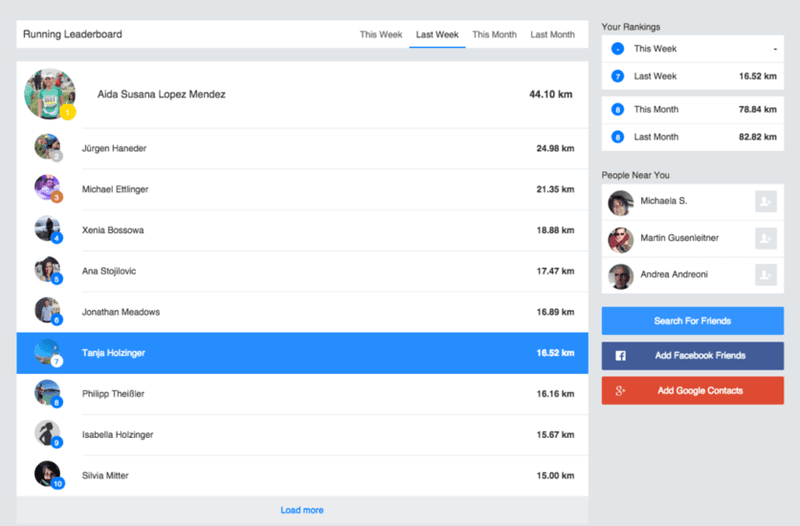
The Adidas Runtastic leaderboard is a prime example of leveraging social competition to boost user engagement and motivation in fitness apps.
#3 Sports: Team Vitality’s successful loyalty app
Team Vitality’s V.Hive app is a premier example of esports app gamification that bridges the gap between digital and physical rewards. Team Vitality is a leading esports team in Europe. To maximize their fan engagement and loyalty, they knew they could do more! That's why they developed a loyalty app called V.Hive built on a gamified points reward system.
Essentially, fans earn points straight away for completing quick tasks, like connecting their wallets and socials. Once they hit a number of points, they then unlock a customizable avatar! Following that, they can then take on a series of quests where they rank against their fellow fans. This strategy reflects the modern market shift where the gamification of loyalty is projected to hit USD 23.98 billion in 2025, specifically fueled by the expansion of smartphone-based fan engagement.
V.Hive achieved great success, no doubt thanks to app gamification! Within just 30 days, the app garnered over 50,000 downloads and 10 times that engagement on social media!

Team Vitality's V.Hive app showcases how quests and customizable avatars can build a strong, loyal fan community in the esports world.
#4 Shared mobility: EVO Sharing
When we helped EVO Sharing design their app gamification strategy at StriveCloud, our goal was to maximize rides per customer by making every trip feel like progress toward a goal. EVO Sharing’s orange e-scooters are a staple in German cities, but they needed a way to stay top-of-mind. We introduced challenges that turned routine commutes into missions. If you define gamification as a way to engage users through incentives, this is the gold standard.
For example, challenges asked customers to ride over 10km in a specific period. If they succeed, they are rewarded with coins with which they can buy free minutes of riding! In our experience, time-bound challenges like these increase ride frequency by providing a sense of urgency and immediate tangible value, which is vital in a competitive mobility market.
Jennifer Dittmar @EVO Sharing - "With Strivecloud, we want to create incentives to drive more often with the electric scooters from EVO Sharing. Through the challenges and the achievement of milestones, the customer shall be motivated to use our scooters more often."

EVO Sharing uses time-based challenges to incentivize more frequent rides, effectively increasing customer activity and loyalty through gamified rewards.
#5 Education: Open University
Educational app gamification leverages psychology to turn the sometimes-daunting task of studying into a manageable, rewarding habit. Studying requires dedication. That’s where game mechanics help sustain motivation! When students log in to Open University, they see a progress bar and checklist of unfinished tasks. Essentially, when a checklist displays unfinished items, this results in the “Zeigarnik effect”.
Basically, incomplete tasks stick with us more than those we complete! In other words, students are motivated to return and study. Moreover, checklists and progress bars provide positive reinforcement and direct students to their goals. As a result, this reduces negative feelings like anxiety or being overwhelmed! This focus on tech integration and motivation is a key reason why the market is hitting a CAGR of 25.24% as we move into 2026. In short, Open University’s gamification features create more consistent learners!

Open University’s use of progress bars and checklists taps into psychological principles to help students stay on track and feel accomplished in their studies.
Need more inspiration? Discover 68 actionable app gamification examples!
KPIs that define app gamification success
TL;DR: Measuring app gamification success in 2026 requires a focus on behavioral KPIs specifically Active Users, Retention, and Stickiness. As the global market reaches a projected USD 36.46 billion this year, the ability to turn real-time data into actionable engagement strategies is what separates market leaders from churn-heavy apps. In our experience, successful implementation hinges on identifying how game mechanics directly shift these three core metrics.
How can you know that your app gamification strategy is on the right track? Easy measuring certain metrics can quickly convey the effectiveness of your new strategies. Using the right tools, you can leverage real-time data to provide responsive feedback. This way, you can gather helpful insights into user behavior that you might otherwise have missed! Here’s a handful of key performance indicators that can inform your app growth plans:
Active users
Simply put, this metric counts the number of active users during any time period. In the context of app gamification, it is most common to track the daily active users (DAUs) and monthly active users (MAUs). With this data, you can learn a lot about your users and how they respond to specific challenges or rewards.
In our experience, volume is the first indicator of a healthy ecosystem. The global gamification market is valued at USD 12.77 billion as of 2025, with a projected CAGR of 25.4% through 2032. This massive growth is driven by the widespread adoption of gamified elements in education and retail, where high DAU counts are essential for long-term monetization. We have found that apps introducing competitive leaderboards often see a 12-15% uptick in DAUs within the first month of launch.
Retention rate
One of the most important metrics you can track for app gamification is the retention rate. Essentially, it measures how many users across a time period are still active, in contrast to those who have churned. While industry benchmarks for mobile apps often show high initial churn, tracking the rate is the first step to improving it and ensuring your game mechanics are actually "fun" enough to keep users coming back.
In 2026, the economy remains turbulent, but app gamification has proven to be a resilient investment. With the loyalty-focused gamification market reaching USD 23.98 billion in 2025, businesses are increasingly leveraging these tools to maintain stability in volatile sectors like e-commerce. Research consistently shows that a modest 5% jump in retention can lead to a 95% revenue boost. By combining the retention rate with a cohort analysis, you can narrow down the effects of your gamified features on certain segments of users and make your data more reliable.
Retention rate = Active customers across period / Active customers in previous period x 100
Stickiness rate
On the topic of active users, the stickiness rate is a vital app gamification KPI that compares your daily active users and monthly active users to communicate how ‘sticky’ your app is. That is to say, how hooked your users are. If a higher proportion of your users engage daily, then that’s a sign you’re providing genuine value and psychological "loops" that encourage habit formation.

The stickiness rate formula is a key metric for understanding how frequently users return to your app, indicating its value and engagement level. In our experience, apps that maintain a stickiness rate above 20% are significantly more likely to sustain long-term growth even during periods of reduced marketing spend.
3 top tools for app gamification in 2026
To succeed with app gamification in 2026, you need tools that balance low-code flexibility with deep data integration. The global market for these solutions has climbed to USD 29.11 billion this year, as businesses prioritize resilience through tech-driven engagement (Verified Market Research). Using a dedicated gamification tool is the most efficient way to unlock growth without exhausting your engineering resources. Here are 3 leading examples of app gamification software available now:
StriveCloud
StriveCloud offers a modular gamification tool trusted by high-growth companies in fintech, health, and edtech. In our experience, modularity is the key to 2026 scalability—it allows you to launch rewards and streaks without a full app rebuild. With over 25 interactive features at your disposal, you can instantly increase engagement and maximize customer lifetime value through real-time feedback loops.
Michael Stewart @HumanForest - "I really like how easy to use StriveCloud is. I don’t need to interrupt any developers or use any code, there’s no lengthy deployment process & changes are updated instantly."

These screens showcase StriveCloud's flexible and modular app gamification features, which can be integrated to enhance user loyalty and engagement through customizable UI elements.
Gamify with StriveCloud! Use our app gamification tool and benefit from the help of our expert designers. Find out more!
Insert Coin
Insert Coin is a versatile gamification tool geared towards product owners, HR managers, and educators. Their platform provides dozens of "buffs" for the user experience, focusing on behavioral science to drive long-term retention. By integrating their API, apps can quickly deploy leaderboards and achievement systems that adapt to shifting user behaviors in a volatile market.

Insert Coin provides a robust app gamification platform aimed at improving user experience across various sectors like education and internal product management.
SaaSquatch
SaaSquatch is a specialized gamification tool that positions itself as a “referral & loyalty software.” They excel in creating referral programs that integrate across web and mobile platforms, utilizing points, gift cards, and cashback. This focus on tangible financial rewards differentiates them in the app gamification space, making them a preferred choice for brands focusing on viral user acquisition.

SaaSquatch's platform leverages app gamification to drive referral and loyalty programs, using tangible rewards to accelerate customer acquisition and word-of-mouth marketing.
App Gamification FAQs
TL;DR: Successful app gamification leverages game mechanics like progress tracking and rewards to drive long-term loyalty. With the global market projected to reach USD 36.46 billion by 2026, these tools are now essential for maintaining high engagement and user satisfaction in a competitive digital economy.
How to define app gamification?
App gamification refers to the strategic integration of game-like elements such as points, badges, and milestones into non-game environments to enhance the user journey. In our experience, it transforms passive browsing into active participation by leveraging behavioral data to incentivize desired actions. This "persuasion architecture" is currently fueling a market valued at USD 12.77 billion in 2025, as developers focus on psychological satisfaction to drive habit formation.
What are the benefits of app gamification?
App gamification maximizes retention and reduces churn by making the user experience inherently rewarding. In 2026, the global gamification market is reaching a valuation of USD 36.46 billion at a 25.24% CAGR, as brands prioritize resilience in volatile economic periods. We have observed that integrating interactive challenges can significantly boost lifetime value (LTV), mirroring historical trends where loyalty programs thrived during financial shifts by providing users with consistent, tangible progress.
How to add app gamification to your web or mobile app?
Building custom game mechanics is resource-heavy; however, using app gamification software offers a scalable, low-code alternative. The market for these specialized tools is hitting USD 23.98 billion in 2025, driven by the rapid expansion of smartphone-based retail and e-commerce. In our experience, modular tools allow you to easily customize features like leaderboards and streaks, enabling you to borrow industry-leading expertise to reach your engagement goals without the overhead of traditional development.
Keep reading

The Science of How to Motivate Your Customers With App Gamification
71% of users uninstall apps within just 90 days due to a lack of motivation. Gamification can be your solution. Rooted deep in our psychology, you can design experiences that motivate customers and keep them loyal. Leading brands are already doing it! Check out these three gamification features and how market leaders are using them.
TL;DR: Modern app gamification leverages core psychological triggers to increase user engagement by 100% to 150% compared to non-gamified apps. By transforming routine interactions into reward-based challenges, brands in 2026 are achieving a 3x increase in purchase frequency and significantly higher customer lifetime value.
This article explores the psychological principles behind using app gamification to motivate users and sustain long-term engagement. In our experience, the challenge for modern brands is no longer just "getting an install," but fighting the high churn rates that see many apps abandoned within months. To combat this, market leaders are turning to behavioral science to create "sticky" experiences. Recent industry reports indicate that app gamification mechanics, such as social leaderboards and progression loops, can boost overall activity by up to 150%, effectively turning passive users into active brand advocates.
But what is app gamification exactly? And how does it motivate customers through neurochemical rewards? By looking at successful implementations from companies like Nike Run Club and limango the latter of which saw a 3x increase in purchase frequency through gamified challenges we can see how these strategies strengthen the relationship between brand and customer. These results act as a "positive intensifier," using social proof and competition to drive meaningful growth in 2026.
Here’s what you’ll discover:
- What is app gamification?
- How does gamification lift customer motivation?
- Using gamification to create an engaging app
- Examples of gamification from the market leaders
What is app gamification?
TL;DR: App gamification leverages game mechanics like leaderboards and rewards to boost user engagement by up to 150%. By applying behavioral psychology to non-game contexts, brands drive 3x higher purchase frequency and long-term customer loyalty.
Gamification is the strategic use of game elements and psychology used in a non-game context. This means adding app gamification features like progress bars, prizes, and reward systems into your app to drive the user behaviors that help you grow. In our experience, the most successful implementations align these mechanics with specific business KPIs, ensuring that every "level up" contributes to your bottom line.
App gamification has the power to clarify objectives and make those goals rewarding to achieve. It doesn’t mean you should turn everything into a game; rather, you take the psychological elements that make a game fun such as social competition and mastery and embed those into your customer experience. Industry data for 2026 shows that leaderboards and social challenges contribute to a 100%-150% boost in user engagement compared to static, non-gamified interfaces.

This diagram illustrates how app gamification leads to significant business growth by improving engagement and retention. Not only will customers be more loyal, they will also spend more and more often!
Companies that use app gamification are often more profitable as they know how to keep their customers actively engaged. For instance, gamified loyalty programs in the retail sector have achieved a 3x increase in purchase frequency via personalized challenges. The positive effects are clear early in the user process; product managers that gamify the onboarding process see engagement and conversion metrics DOUBLE.
Looking for more? Find out everything you should know on our ‘What is Gamification’ page.
How does app gamification lift customer motivation?
TL;DR: App gamification leverages behavioral psychology to transform passive users into loyal advocates. By balancing extrinsic rewards with intrinsic drivers like social competition and progress tracking, brands in 2026 are seeing a 100%-150% boost in user engagement compared to traditional, static interfaces.
Generally, app gamification plays on two types of motivations based on behavioral psychology and cognitive bias. Achievements and results-based drivers are called extrinsic motivators. In our experience, these drivers trigger initial engagement and are crucial for the discovery phase. However, to create user retention beyond the critical 90-day window, customers require a deeper psychological connection.
To increase customer loyalty, you need intrinsic motivation. These are innate emotions linked to our desires or fears. Modern gamified loyalty programs now prioritize acquisition efficiency and long-term habits; for instance, retail leaders like limango have achieved a 3x increase in purchase frequency by utilizing goal-oriented user challenges. Here are 5 examples of these drivers and how you can use them to increase customer motivation:
- Relationships People are social creatures naturally motivated by competition and relatedness. Implementing social leaderboards can contribute to a 100%-150% increase in daily activity metrics compared to non-gamified apps.
- Accomplishment Achievements like digital badges give customers clear goals to strive for. Highlighting their specific progress toward a milestone motivates them even more to complete the journey.
- Empowerment Positively reinforcing customer actions with "level-ups" or milestone rewards empowers them to maintain their streak and keep coming back to your platform.
- Unpredictability Humans are wired to seek novelty. Integrating variable rewards and surprise bonuses is crucial to maintaining long-term customer retention.
- Constraint Try locking off exclusive features or offering limited-time rewards. Science shows the fear of missing out (FOMO) is often as motivating as the prospect of winning!
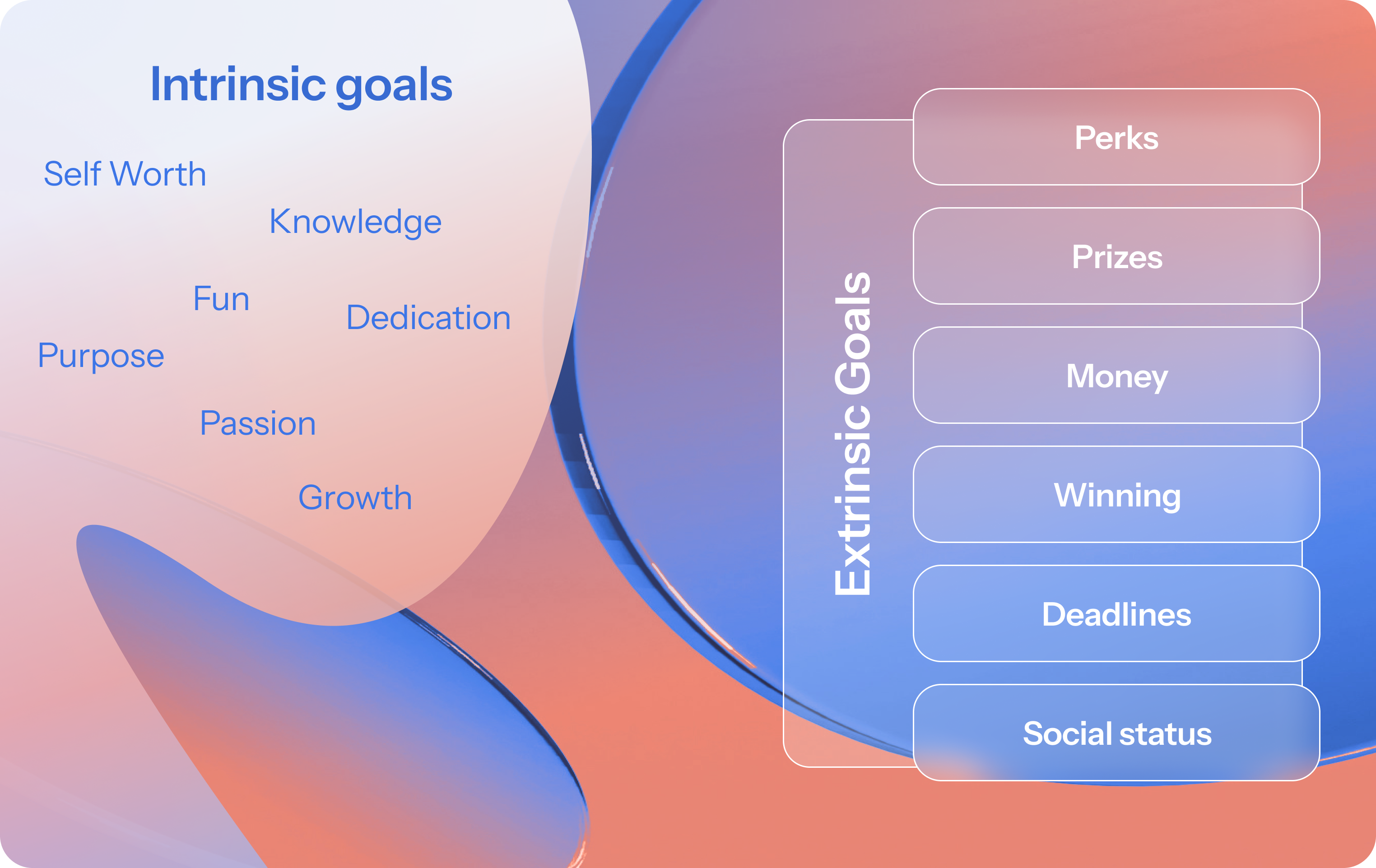
This visual representation highlights the core psychological drivers that app gamification leverages to maximize customer motivation and lifetime value in today’s competitive digital landscape.
Using app gamification to create an engaging app
TL;DR: Effective app gamification leverages psychological triggers like autonomy, social status, and instant gratification to drive user behavior. Current 2026 benchmarks show that gamified interfaces can boost user engagement by 100% to 150% compared to static counterparts, while high-performing loyalty challenges have been shown to triple purchase frequency in retail environments.
To increase user retention and mobile app engagement, you must create a compeling customer experience. In our experience, app gamification provides the necessary framework to turn passive observers into active participants. Here are three features that research shows can provide a massive boost in engagement:
1. App personalization and the power of the avatar.
Give your users autonomy. Customization tools, such as picking your own avatar, are central to app gamification and result in higher long-term engagement. For instance, if you display a user's unique avatar at a major achievement milestone, it leads to a "higher level of sense of presence." This means users feel a deeper personal connection to their digital progress. As a result, you tap into the intrinsic motivator of self-worth, making the app feel like an extension of the user’s identity.
2. Leaderboards facilitate competition and social status.
Modern app gamification strategies treat competition as a vehicle for motivation rather than just a feature. Recent industry data indicates that leaderboards and social challenges contribute to a 100% to 150% boost in user engagement compared to non-gamified apps. While leaderboards create fair competition, the friendly battle is a tool that motivates users to win. Primarily, these features access motivational drivers like the need for social status and provide a way to test dedication. This improves the user's perception of the mobile app, making it a "must-visit" social destination.
3. Progress bars encourage growth and customer motivation.
Progress bars are a fundamental component of app gamification that do more than just detail the length of a task. They provide users with immediate knowledge of how much effort they need to invest to reach the next tier. Seeing visual progress from specific actions provides customers with instant gratification. By 2026, brands like limango have successfully used these types of growth markers and challenges to drive a 3x increase in purchase frequency, proving that clear visual progression directly translates to commercial growth.
Don’t be just another loyalty app. Set yourself apart with our app gamification software!
Examples of gamification from the market leaders
TL;DR: Research for 2026 confirms that app gamification is no longer just a trend but a core engagement driver. By leveraging competitive social structures and visual feedback, brands are seeing a 100-150% boost in user activity. Modern implementations, like those used by SmartyPig and Fitbit, demonstrate that gamified elements can increase interaction frequency by up to 3x compared to non-gamified interfaces.
How do the top dogs do it? Let’s see how two market leaders use examples of app gamification to bring the customer closer to their brand through psychological triggers and real-time feedback loops:
SmartyPig’s progress bar motivates you to save money.
SmartyPig is a finance app that helps users meet savings goals. Users start by setting an aspiration like buying a car. This target acts as a sort of avatar, personalizing the goal process. Notably, depositing money fills up a progress bar displayed as a cartoon pig!
In our experience, these visual milestones transform app gamification from a gimmick into a habit-forming tool. It makes the user process fun and exciting, turning budgeting into a satisfying game rather than a chore. The impact is significant: recent industry benchmarks for 2026 show that gamified financial challenges can lead to a 3x increase in transaction frequency, allowing apps like SmartyPig to scale their user base and managed assets far more efficiently than traditional banking platforms.
Fitbit’s leaderboard encourages users to run harder and faster!
Fitbit is a health & fitness app used with a wearable tracking device. The app tracks daily steps and encourages users to complete a daily goal. Steps are seen as the ‘currency’ that buys your way up the leaderboard. This specific app gamification strategy leverages social proof and competition to drive consistency.
The leaderboard creates a sense of social connection a place where you can compete with friends and share the results on social media, which we call a positive intensifier. It must work, as current market data shows that high-engagement fitness platforms have scaled to support tens of millions of active users through these socially-driven community challenges.
To back that up, the Fitbit leaderboard thrusts users into action by tapping into the "competitor" archetype. According to 2025-2026 research, app gamification features like leaderboards and social challenges contribute to a 100% to 150% boost in overall user engagement compared to apps that lack competitive social elements. This confirms that seeing a friend's progress is one of the most powerful motivators for turning occasional users into daily active participants.
Recap: Why App Gamification is the Key to Customer Motivation
TL;DR: Effective app gamification transforms passive users into active brand advocates by leveraging intrinsic motivators like social connection and personal achievement. Modern benchmarks for 2025-2026 show that gamified experiences drive a 100% 150% increase in user engagement and can triple purchase frequency compared to traditional loyalty models.
Customer loyalty is the defining challenge for digital products in 2026. In our experience, static interfaces no longer command attention in a saturated market. That’s why companies that successfully integrate app gamification into their core user journey are seeing unprecedented retention and growth levels.
Gamification is the strategic use of game elements and behavioral psychology in a non-game context. Common examples include progress bars, tiered rewards, and badges. However, to truly move the needle on app gamification, these elements must address the psychological drivers that push customers to act.
They do so using two primary types of motivators:
Extrinsic motivators are achievement-based drivers, such as points or discounts. They rely on our desire for tangible rewards. While these are excellent for driving app gamification during the discovery phase, long-term brand advocacy requires a shift toward intrinsic motivation.
Intrinsic motivators appeal to deeper emotions linked to autonomy, mastery, and purpose. In effect, behavioral studies show this creates positive habits like enjoyment and happiness. App gamification relies on these core dynamics to lift customer motivation:
- Relationships Humans are naturally social and thrive on collaboration and friendly competition.
- Accomplishment Providing clear milestones gives customers a sense of pride and mastery.
- Empowerment Users demand autonomy and personalization to feel a sense of ownership.
- Unpredictability Surprising users with "Easter eggs" or random rewards triggers dopamine and delight.
- Constraint Using limited-time offers or locked features creates urgency and incentivizes consistent usage.
Our data suggests you can boost user engagement by 100% to 150% by implementing these specific app gamification strategies:
- Embrace hyper-personalization through avatars. Giving users the autonomy to design their digital identity increases emotional investment and self-worth within the ecosystem.
- Facilitate social competition with transparent leaderboards. By tapping into the competitive drive, brands like Nike Run Club leverage social challenges to keep users active far longer than isolated apps.
- Encourage growth with dynamic progress bars. Providing instant gratification such as digital haptics or visual "confetti" upon milestone completion contextualizes the user's effort and encourages the next action.
Market leaders are already seeing massive ROI from these 2026 app gamification trends:
- Limango utilized challenge-based mechanics to achieve a 3x increase in purchase frequency, proving that gamified loyalty outperforms standard discount programs.
- Nike Run Club uses social leaderboards to drive community-wide engagement, resulting in significantly higher daily active usage than non-social fitness trackers.
The Top 13 Health & Fitness Apps All Use Gamification
It's time for a new record - 2022 will be the first year ever that the mHealth industry makes over $100 billion! The top apps all have one thing in common - a gamification strategy designed to improve our health!

Discover the power of game mechanics to motivate healthy behaviors and learn how top apps are using gamification features. From in-app communities to badges, we’ve gathered 13 gamification examples from the leading industry apps that can help you boost your growth in 2026.
This image of an athletic woman stretching sets the stage for our deep dive into the leading health and fitness applications.
- How 2022 changed the health & fitness market
- #Fitbit uses social connection to motivate users to run harder
- #MyFitnessPal is a master of motivation
- #Calm uses personalized gamification features to reduce churn
- #Weight Watchers incentivizes users to meet their goals with rewards
- #Headspace uses badges and streaks to boost user’s self-esteem
- #Replika has a personalized AI to align with the user
- #Lose it! challenges users to lose weight
- #Yoga-Go is centered on customer value
- #Peleton boosts its user retention with its community
- #Plan a personalized workout program with Muscle Booster
- #Immerse in a gamified story with Zombies, Run!
- #Mango Health helps users have a healthier lifestyle
- #SuperBetter focuses on creating healthy habits for its users
- What we can learn from these gamification features
- TLDR
How 2025 changed the health & fitness market
In 2025 the exercise and weight loss segment held the largest revenue share of over 54.6%
As 2026 has begun, the mHealth balance sheet looks healthier than ever. In what is a huge milestone, the market size of the sector is anticipated to expand to USD 293.2 billion in 2030. Growing awareness among adults to use mobile health solutions and supportive government incentives for using digital healthcare is the cause of an exciting growth period affecting the whole industry, from meditation platforms to sports & diet trackers, and even instructional exercise apps.

This chart illustrates the projected growth of the mHealth market, highlighting the increasing competition in the sector.
The unprecedented competition coincides with the consolidation of the market, and this has created a difficult environment to thrive in. While many apps do their best to vie for attention, the top apps rake in the cash. For context, Fitbit, the #1 top-grossing app in health & fitness, makes $3 million a month in the US alone.
Certainly, it is enviable that these apps bring about healthier lifestyles for their users and make money doing it. To get the job done, and lead the market, the world’s top health & fitness apps utilize gamification. Put simply, these apps all implement a range of gamification features designed to motivate users & elevate user engagement strategies!
New to gamification? Catch up to speed with our ‘What is Gamification’ page!
Let’s run down the top 13 grossing health & fitness apps and see how they gamify:
#1 Fitbit uses social connection to motivate users to run harder
Fitbit is a health & fitness app used with a wearable wrist device. The app tracks your daily steps, which buy your way up the leaderboard. Leaderboards are one of the most effective gamification examples because it creates a magnetic sense of social connection. Users find enjoyment and fulfillment when they can compete (or collaborate) with friends!
What’s more, they can then share the results on social media, which we call a positive intensifier. It works, as Fitbit over 47 trillion steps in 2022. Studies show that the leaderboard alone leads to a 15% increase in daily steps!

Fitbit's leaderboard shows how a sense of social connection and competition can motivate users to increase their daily activity.
How Fitbit uses gamification to make being healthy more fun!
#2 MyFitnessPal is a master of motivation
Calorie counter MyFitnessPal has 200 million users, and it does so because the app is a master of motivation. On MyFitnessPal, users can set a goal for their calorie intake, and this target defines the graphs and visualizations they see. As a result, their graphs and progress trackers are personalized to their custom goals.
Gamification examples like goal-setting have the power to transform your user’s quest! Studies show that personalized tools are more effective at helping users achieve goals.

This progress tracking view from MyFitnessPal is an effective gamification tool that helps users visualize their achievements.
#3 Calm uses personalized gamification features to reduce churn
How did the wellness app Calm achieve a 3x boost in user retention? Simple by letting users set their push notifications to remind them to meditate.
With Calm’s Daily Reminder feature, users receive a motivating message at a time of their choosing. By personalizing push notifications, Calm not only avoids frustrating new users with clutter but also helps facilitate habit formation.

Calm's personalized daily reminder feature effectively reduces churn by helping users build a consistent meditation habit.
#4 Weight Watchers incentivizes users to meet their goals with rewards
The Weight Watchers app combines all weight loss tools in one. It is one of the best sports & diet trackers on the market. Users can track anything from diet, water intake, and sleep all the way up to physical exercise. The app even allows you to scan your favorite foods to effortlessly track nutrients. Besides tracking users can take guided coaching sessions & mindset training.
When users on the WW app hit their goals, they get a ‘Win’. This is positive reinforcement at its most clear! Moreover, wins rack up points that elevate your standing in a tiered rewards system. With it, users are motivated to win to earn feel-good items such as gym memberships or free body products.
This reward system takes advantage of the mechanics behind many gamification examples. Namely, constraint and accomplishment. In short, constraint means that users crave things that are locked off from them. By hiding increasingly more generous prizes behind tiers, users are motivated to keep going! In turn, this provides accomplishment and the happy feelings that come with it. It’s a positive feedback loop!

The Weight Watchers reward system uses points and tiers to incentivize users and create a positive feedback loop of accomplishment.
#5 Headspace uses badges and streaks to boost user self-esteem
Headspace is an incredibly successful meditation app, and one of the best habit-forming apps. Fostering habitual visits is essential for creating an active user base. Certainly, these app’s gamification features facilitate users to keep up their routine:
- Celebrating early achievements with prizes results in the ‘endowed progress effect’, which says that users rewarded early are more motivated to achieve.
- Badges are not shared. Since the app is all about mental health, it chooses to avoid any social comparison between users that can dampen self-esteem.

Headspace rewards users with non-competitive badges, fostering self-esteem and motivating them to continue their meditation practice.
#6 Replika has a smart, personalized AI made to align with the user
You may not have heard of the wellness app Replika, but it is highly successful. Currently, the app boasts 10 million registered users. These users, mostly between the ages of 16-24, come to Replika for conversations with an AI-powered chatbot that acts as a virtual friend or a mentor. Amazingly, 85% of Replika users feel better after conversing with the AI.
What makes Replika’s AI so special is that it is meticulously personalized to the user. The more the user chats with the AI, the more the chatbot will develop a compatible personality. How cool is that! The approach is backed up by research studies that show how customizable tools enhance user autonomy for example by molding a personal AI chatbot & increase intentions to engage.

Replika's personalized AI chatbot adapts to the user's personality, enhancing engagement through a unique and autonomous experience.
#7 Lose It! challenges users to lose weight
Lose It! uses the proven principles of calorie tracking to educate and help you succeed. To get started just input your profile details with your goal weight and they will calculate the ideal daily calorie budget best for you. Next, easily track your food, weight, and activity and get ready to celebrate your weight-loss victories. There’s no easier way to change your habits and learn about your nutrition needs.
Of all the gamification features, challenges are some of the most fun. This is especially important for tracking apps, where their very point requires lots of repetitive tasks. By including a competitive and exciting element, users are more likely to complete them!

The "Lose It! Challenge" feature makes repetitive tracking tasks more exciting and increases user adherence through competition.
#8 Yoga-Go is centered on customer value
From their user-centric interface to a simple and personalized onboarding, Yoga-Go is quick and easy to get into. For one, these features make users more motivated to return to the app regularly. But right from the beginning, it means that users are less likely to become frustrated and churn early. Why? Because the user value is clear! This approach made Yoga-Go hugely successful, generating $2 million every month.

Yoga-Go's personalized onboarding process immediately demonstrates value, motivating users to return and reducing initial churn.
#9 Peloton boosts its user retention with its community
Of all the fitness apps, Peloton is perhaps the one with the tightest community. The benefits of an in-app fitness community are clear, making 60% customers likely to become loyal to the brand. Forbes notes that Peloton’s social integration runs deep, and it’s because of the gamification, whether it's introducing social elements or a fitness app challenge. Users can show off shared badges earned in team fit challenges, and even brag about hitting the top place on a live class leaderboard!

Peloton's live leaderboard harnesses deep social integration and gamification to build a loyal and highly engaged user community.
#10 Plan a personalized workout program with Muscle Booster
Muscle Booster has over 1000 workouts available of between 30 and 60 minutes. You can simply choose the area you want to work out & get a personalized workout plan.
The first thing you want when new users install your app is to immediately see the potential benefits. By asking users what areas of the body they want to optimize, Muscle Booster gives the user autonomy. This is crucial for mHealth apps because health is intrinsically personal. As such, when you implement personalized features, you give customers ownership over the user experience - making them more likely to stay.

Muscle Booster demonstrates how personalized workout plans give users a sense of ownership, increasing their likelihood of staying engaged.
#11 Immerse in a gamified story with Zombies, Run!
Zombies, Run! is an app that turns running into a fun game about being chased by zombies. With various game plots, the user can benefit from GPS tracking, distance, pace and time recording, calories burned, and other customizable preferences. The app also provides virtual competition with other users making each mission even more exciting. Whether the user loves horror stories or simply needs the motivation to run, Zombies, Run! certainly makes use of an original gamified experience.

Zombies, Run! uses creative storyteling to transform exercise into an exciting and immersive narrative-driven game.
#12 Mango Health helps users have a healthier lifestyle
Mango Health inspires patients that take daily meds to live a healthier lifestyle by making it easy, fun, and rewarding. This app sends custom reminders to take your medicine, drink water, record your mood, check your blood pressure or watch your weight. As they stay on schedule, patients earn points that unlock the chance to win higher rewards such as $5-10 gift cards, money donations to charity organizations, and more. The best part? It’s free!

Mango Health's interface shows how rewards like gift cards can make the routine task of taking medication fun and financially advantageous.
#13 SuperBetter focuses on creating healthy habits for its users
SuperBetter borrows game elements to improve mental health and social-emotional learning, and it differentiates itself from other apps by supporting the change of habits and behaviors. Researchers at the University of Pennsylvania concluded that “SuperBetter helped reduce depression in a controlled trial”.
How does it work? In a game design, the users can select from a list of options the obstacles that they want to overcome: depression, anxiety, chronic pain, etc. These obstacles become the “Bad Guys” that the users must defeat by winning the battles with the help of Quests and Power-Ups, such as calling a friend or smiling at a stranger. Unlike other gamified apps, SuperBetter's goal is engaging communities in a friendly way, without leaderboards and competition.

SuperBetter creatively transforms mental obstacles into "Bad Guys," engaging users in a supportive, non-competitive game to build healthy habits.
What we can learn from these gamification examples
It is clear by now that the best mHealth apps understand human motivation. By leveraging gamification features like points and levels, these apps become motivating to use leading to 35% of users seeing better outcomes in their health goals.
Build an experience that guides your users on their health journey while achieving your goals! Find out how gamification can help!
To be sure, the mHealth industry is banking on the benefits of gamification. As a result, the gamification industry is set to register a stunning compound annual growth rate of 22.3% over the forecast period 2023-2030. With this in mind, does your app take advantage of gamification mechanics?
- Relationships. Make your app feel more real and necessary.
- Accomplishment. Users crave personal growth!
- Empowerment. Today’s consumers expect autonomy and personalization.
- Unpredictability. Gamification keeps your app lively, which reduces churn.
- Constraint. Incentivize retention by locking benefits for your most loyal users.
- Sense of belonging. Users benefit from the value of community building.
- Storyteling. Engage your users in an unforgettable unique story.
In short, is your app made to motivate? Are you confident that your app features these powerful mechanics? To thrive in 2023, you need to use every tool at your disposal.
TLDR
- Health & fitness is growing fast, the market size of the sector is anticipated to expand to USD 293.2 billion in 2030 How are all the top mHealth apps motivating users in a saturating market? With gamification features like badges and leaderboards.
- Fitbit’s leaderboard leads to a 15% increase in daily steps.
- MyFitnessPal’s personalization tools make users more likely to achieve goals.
- Calm achieved a 3x boost to retention with a simple ‘Daily Reminder’ feature.
- WW’s tiered loyalty system rewards accomplishment with prizes and freebies.
- Headspace celebrates early achievements see the ‘endowed progress effect’.
- 10 million Replika users are more likely to engage thanks to personalized AI.
- Lose It! challenges bring users together with a common goal.
- Yoga-Go has a simple, user-centric interface that lowers barriers.
- Peloton’s social features create a self-motivating loyal community.
- Personalized workout features let Muscle Booster users work on their goals.
- Zombies, Run! uses unique storyteling to immerse the user into a running experience.
- Taking medication becomes fun and financially advantageous with Mango Health.
- Super Better transforms mental obstacles into the “bad guys” that the user must defeat.
Lead the pack in a record-breaking year for health & fitness apps! Book a value-packed gamification workshop & design a custom app gamification strategy & roadmap to achieve your goals!
Keep reading

The Top 5 Benefits That Esports Agency ESTUDIOS Gained From Using StriveCloud
ESTUDIOS is a leading esports marketing agency from Switzerland. With its gaming community platform 'GameTurnier' they connect gamers and brands by hosting online tournaments and events. This platform is powered by StriveCloud! Why did they pick our tournament software over others, and how do they use it to their advantage? Find out inside the article!

Gaming is all about connection! Today, 84% of gamers play games to interact with others who have similar interests. So, to successfully connect gamers, you need more than just tournaments. You need a 360° gaming community platform! Unfortunately, most tournament software solutions are only focused on tournaments. Besides, they aren’t white-label and don’t prioritize engagement. That’s exactly what brought the swiss esports marketing agency ESTUDIOS to StriveCloud.
This article will explore why ESTUDIOS chose StriveCloud to build their gaming community platform, highlighting the key benefits they experienced.
In this article, we’ll cover why ESTUDIOS choose StriveCloud as a platform to support its strategy, and how we differ from alternatives in the market!
- Who are ESTUDIOS? (And why they came to StriveCloud)
- How StriveCloud helps ESTUDIOS reach their goals
- Top 5 benefits of using StriveClouds tournament software
- How StriveCloud's Community & Tournament Platform works
- The StriveCloud solution compared to the wider market
- How to get started and connect gamers today
- FAQ
Who are ESTUDIOS?
ESTUDIOS is a 360-degree esports agency from Switzerland that works on every aspect a brand needs to go into esports and gaming. From consulting to organizing online and offline events, content production, and especially Community Building as a service. They also own GameTurnier, a popular gaming community platform that connects gamers & brands by hosting online tournaments. Some of the brands the agency works with are Sunrise, MySports and Coca-Cola.
Before working with StriveCloud they were mainly focused on hosting offline tournaments for the FIFA scene in Switzerland. Matthias Zander, the head of the agency’s flagship gaming community platform GameTurnier, has worked in esports for over 20 years. That extensive experience put him in the position of knowing exactly how to connect with gamers successfully. So how did he go about finding the right platform, and eventually, why did he pick StriveCloud?
The ESTUDIOS team knew they needed a powerful digital platform to support their "Community-Building as a Service" business model.
Matthias Zander - "At ESTUDIOS, we do Community-Building as a Service. And that’s why we love StriveCloud. It supports our business case."
When looking for a gaming community platform to achieve their goals, they soon found out most platforms lacked a complete white-label solution. While some tournament software solutions came close to what StriveCloud offers, they missed out on features like the loyalty system behind it. Besides, StriveCloud gave them full control over the platform to customize it according to their needs.
Matthias Zander - "It’s not only the possibility to create my own pages with my own designs and banners and so on, but also we can collect 1st party user data and have the possibility to sell advertisements to our clients. With StriveCloud we have almost full control of the platform. "
How StriveCloud helps ESTUDIOS reach their goals
ESTUDIOS works with many different parties ranging from brands or sports organizations to influencers and streamers. They use our platform as a sandbox environment to connect gamers with brands within their community. So GameTurnier had three main objectives for its tournament software.
1) Bring the GameTurnier community online
To bring their gaming community online they needed a white-label gaming community platform that would allow them to establish their own brand credibility. With our platform, they get a wide array of customization tools as well as social & community features like quizzes or polls to keep gamers engaged.
2) Monetize through unique brand activations & more
As a result of having its own white-label platform, GameTurnier has many ways to monetize its community. With our platform, they can set up unique communities for brands and influencers to create memorable brand activations for their fans or customers. Furthermore, they get complete access to the data, which gives them valuable insights and monetization options.
3) Build long-term engagement with in-app loyalty
Finally, they wanted a loyalty system to keep gamers engaged over the long run. While most platforms rely solely on tournament participation for retention, StriveCloud has a gamified in-app loyalty system in place. That way they can reward gamers based on behavior instead of just purchasing level.
Matthias Zander - " If you're a big streamer and you plan to build your community, you will want to organize community tournaments and engage your community even more. For that, Twitch bots are just not enough. You need more to engage with your community and, StriveCloud brings all these features on one platform. "
Top 5 benefits of using StriveCloud’s tournament software
Tournament software should be about more than just online competitions. With StriveCloud, ESTUDIOS found that they could maximize fan engagement by taking full advantage of the tools provided:
#1 A fresh user experience every day
Repetitive experiences get old fast! Fortunately, StriveCloud does so much more than just online tournaments. With our gaming community software, you can create a complete experience from start to finish. Starting with the onboarding process, all the way up to earning your first currency and exchanging it in the shop.
Furthermore, our tournament software boasts features like:
- Daily quizzes, which encourage daily activity and act as a flashpoint for rewards
- Leaderboards that reward participation in real-time
- Redeemable in-app currency, which incentivizes users to stick around
- Social feed supercharged with different content creation possibilities

The platform's features, like leaderboards and social feeds, create a dynamic and rewarding daily user experience.
Matthias Zander - "The biggest advantage is that on the platform you can create a place where it's worth coming back to on a daily basis as a user. For example, you can organize daily quizzes."
#2 Customization tools tailored to your goals
Most tools do not offer a sandbox-building environment. But StriveCloud is specifically designed to be customized and flexible. Essentially, this “sandbox” world means that you can better tailor your gaming community platform to meet your vision. Besides establishing your own brand credibility, it also offers interesting sponsorship opportunities. You get to create your own pages, banners and sell personalized advertisements to brands.
Matthias Zander - "I love the sand boxiness of the StriveCloud solution. I am in almost full control of what I want the platform to be."
#3 Loyalty systems keep users engaged for the long haul
Whereas most tournament platforms rely entirely on tournament participation to generate user activity, StriveCloud stands out. Because of its unique social and loyalty features, the platform can connect gamers and boost engagement whether there’s a tournament or not. In fact, research shows that socialization is the best way to create long-term gamer retention!

StriveCloud's loyalty systems are designed to foster long-term engagement by rewarding user activity beyond just winning tournaments.
#4 All engagements centralized in one place
What’s great about our tournament software is that you get everything centralized into one platform! Gamers don’t need to jump platforms to compete in tournaments, interact in the community or win prizes. It also saves a lot of headaches for moderators. Instead of linking a bunch of Discord bots, social media platforms, and tournament platforms you can activate, engage and monetize all in one place!
#5 You own all the data!
Another benefit of owning your own gaming community platform is that you own the data. That means you can set up and manage targeted and personalized campaigns for the maximum ROI! You could even send out an email campaign to a specific audience segment.
How StriveCloud's Community & Tournament Platform works
As a white-label solution, the StriveCloud tournament software works to match your strategy and branding. It’s simple: StriveCloud provides the back-office solution and you can customize the platform to your needs! That means easily creating personalized landing pages to promote your events, allowing users to sign up, and hosting community news.
Owing to the fact that tournaments can be fully automated, you are free to focus your attention on more important things. In other words, you don’t need to make each tournament from scratch!

The platform's back-office allows for easy customization and automation of tournaments, freeing up administrators to focus on community management.
Our solution compared to the wider market
With the emergence of esports and gaming, there are many tournament software opportunities available on the market. But they don’t all do the same job. So how do you find a gaming community platform that suits your needs?
Let’s compare StriveCloud to the well-known alternatives:
StriveCloud vs ChallengerMode
ChallengerMode is a popular name in the esports community, having been around since 2014. The Swedish company excels at tournament organization, but the features don’t extend far beyond that. While there is an in-game currency and marketplace where fans can buy items, the experience as a whole is less gamified and as such less targeted at improving engagement.

While ChallengerMode is a popular option, its focus is primarily on tournament organization, with fewer features for daily community engagement.
StriveCloud vs FACEIT
FACEIT are Counter-Strike (CS:GO) experts. In fact, the platform hosts one of the biggest tournaments for CS:GO, the Esports Championship Series. Zander says that tournaments are easy to set up on the platform, and you can also reward users with fully integrated cryptocurrency prizes.
So what’s the downside? For gamers, the platform costs €9.99 to subscribe and access the full package. In short, free users cannot take part in leagues and are limited to reaching Level 6 out of 10. On the other hand, GameTurnier, powered by StriveCloud, is free for gamers and offers total accessibility for its registered users.

FACEIT, while strong in the CS:GO scene, presents a subscription model that can be a barrier for free users, unlike the accessible model powered by StriveCloud.
How to get started and connect gamers today
Our team promises to get any new gaming community platform up and going in as fast as 2 weeks. But how? Through experience, StriveCloud has developed a reliable plan to achieve success.
Step #1 - Book a demo. It’s quick and easy. Take a tour with our in-house experts and learn the ins and outs of our white-label tournament platform.
Step #2 - Together, we set up the platform & customize it. This is the creative part! During this step, we will make your gaming community space unique and special to you and your fans. As well, this is where we decide how best to gamify your platform to meet your goals.
Step #3 - Onboard your team and launch! Our team will work side-by-side with yours, making sure the process is smooth and your team is confident using our software. In the past, we have reached this step and created an amazing esports platform in just 2 weeks!
FAQ
Why did ESTUDIOS pick the StriveCloud tournament software?
ESTUDIOS wanted to focus on building communities. In contrast to other software, the StriveCloud platform offers more extensive social features and a gamified loyalty system.
What are the benefits of white-label tournament software?
Our white-label tournament software enables you to easily build a platform with your own branding. In addition, StriveCloud allows you to keep all your user data! In short, that boosts your marketing and lets you sell personalized advertisements to create better sponsorship opportunities.
How to create an engaging gaming community platform?
Tournaments excite gaming communities but many platforms rely entirely on tournament participation for their engagement. To engage fans all year round, StriveCloud’s software lets you build a social feed and issue daily challenges to keep the fan experience fresh.

The Truth About Consumer Decisions and How to Influence Them
Consumers shop differently in the 21st century. That's not a surprise, since there has never been more information available to base decisions on. Think With Google, the marketing insights institute from Google, carried out over 300,000 purchase simulations to to map out this decision-making journey. We'll take it a step further and show you how to guide the consumer journey, or as Google calls it "the messy middle" forward using gamification.

TL;DR: Modern consumer decisions are no longer linear; they occur in a "messy middle" of constant exploration and evaluation. In 2026, brands that leverage cognitive biases and gamified loyalty like the Starbucks Rewards model currently driving 60% of total revenue are the ones winning the battle for customer attention and retention.
It’s no secret the internet has fundamentally altered how buyers approach consumer decisions. With the vast transparency of the modern web, recent 2025 industry reports indicate that 93% of consumers now conduct exhaustive research before committing to a brand. For high-consideration purchases, buyers spend an average of 79 days in what Google research defines as “the messy middle,” a psychological space where brands are won or lost.
Over the decades, marketers have sought to map this journey to better influence consumer decisions. In 1898, Elmo Lewis introduced the AIDA model, which established the traditional marketing funnel. However, in our experience, the 2026 landscape requires moving beyond Attention and Interest into high-frequency behavioral loops that prioritize immediate gratification and tiered rewards.
Recent data from Think with Google and modern retail benchmarks show that cognitive bias is the most powerful tool for shortening the gap between a trigger and a purchase. For example, the Starbucks Rewards program has perfected this by scaling to 35.5 million active U.S. members as of early 2026. By introducing new loyalty tiers (Green, Gold, and Reserve) on March 10, 2026, they have successfully leveraged gamification to account for nearly 60% of company-operated revenue in the U.S. market.
Here’s what we’ll explore to help you master consumer decisions:
- Uncovering the messy middle: Where intent meets evaluation
- How cognitive biases like social proof and scarcity shape 2026 decision-making
- Strategy: How top marketers succeed in the evaluation phase
- How app gamification and tiered loyalty programs close the gap between trigger and purchase
Uncovering the messy middle of consumer decisions
TL;DR: Modern consumer decisions are rarely linear; they happen within a "messy middle" of constant exploration and evaluation. In 2026, success depends on closing the gap between intent and action using cognitive shortcuts and high-engagement loyalty models similar to how Starbucks now generates 60% of its U.S. revenue through a gamified ecosystem of 35.5 million active members.
The messy middle is a metaphor for the continuous loop between exploration and evaluation that occurs between a trigger of intent and the actual purchase. It refers to how consumer decisions in 2026 are shaped by an abundance of real-time information and AI-driven comparisons that offer virtually unlimited choice.

This diagram from Google illustrates the 'messy middle,' a loop of exploration and evaluation that occurs between a trigger and the final purchase. In our experience, brands that fail to appear during this loop lose 70% of potential conversions to more visible competitors.
You could compare it to walking through an endless digital marketplace where every boutique is vying for your attention. The trigger often a predictive notification or a personalized social ad turns a consumer from a passive state into an active one. To influence consumer decisions within this loop, you must understand the two distinct cognitive states shoppers shift between:
#1 Exploration
In the exploration phase, the mind works expansively. Shoppers use generative AI and social search to absorb relevant information, adding brands to their "consideration sets." Recent industry reports suggest that over 90% of consumers now rely on AI-aggregated reviews to fuel this phase. In this stage, consumer decisions are driven by the search for variety and the fear of missing out on the best possible value.
#2 Evaluation
The evaluation phase is the opposite of the exploration stadium; here, the mind works reductively. Based on cognitive biases like "social proof" or "scarcity," shoppers eliminate options until they reach a final choice. This is where gamification becomes a powerful tool for consumer decisions. For instance, the Starbucks Rewards program, which saw a 3% membership surge to 35.5 million active U.S. members in early 2026, uses a tiered "Green, Gold, and Reserve" system launching March 10, 2026, to force evaluation in favor of their own ecosystem.

The process begins with a trigger that pushes a consumer from a passive to an active state, initiating their journey through the messy middle where consumer decisions are ultimately won or lost.
While McKinsey’s model for decision-making refers to these two stages as one "active evaluation" phase, we find they are cognitively distinct. Exploration offers the dopamine hit of discovery, while evaluation requires the mental effort of sacrifice. To master consumer decisions, you must provide enough information to satisfy the explorer, but enough psychological "nudges" to help the evaluator stop searching and start buying.
How do cognitive biases shape consumer decisions?
TL;DR: In 2026, consumer decisions are defined by "choice paralysis," where 81% of shoppers rely on digital shortcuts to navigate complex markets. By leveraging cognitive biases like the Power of Now or Social Proof brands can reduce mental friction and increase purchase preference by up to 87%. Successful models, such as the 2026 Starbucks Rewards update, prove that gamifying these biases is essential for modern revenue growth.
Cognitive biases shape shopping behavior and influence our preferences for one brand over the other by acting as subconscious filters for information.
#1 Category heuristics
These are shortcuts or rules of thumb that help us simplify the decision-making process to reduce mental effort. In our experience, as information density increases in 2026, consumers rely more heavily on these "rules" such as simply focusing on the amount of data included in a mobile phone contract rather than comparing complex hardware specs. This heuristic allows for faster consumer decisions by narrowing the focus to a single, high-value attribute.
#2 The power of NOW
It’s in our nature to live in the present. In the mid-2020s, the "on-demand" economy has evolved into a "near-instant" expectation. This cognitive bias explains the continued dominance of 24-hor delivery and instant digital access. According to research from Nielsen Norman Group, immediate fulfillment reduces purchase regret by providing instant gratification, a key driver in impulsive consumer decisions.
#3 Social proof
What do people do when they’re uncertain? They follow the crowd. Recent industry reports indicate that 81% of consumers agree the internet has fundamentally changed how they make consumer decisions, largely due to the visibility of others' actions. Social proof is a powerful principle first coined by psychologist Robert Cialdini in his principles of influence. In 2026, this manifests as AI-summarized reviews, real-time "trending" badges, and creator testimonials that validate a buyer's choice.
#4 Authority bias
Similar to our tendency to follow the crowd, people are inclined to trust and follow domain authorities or experts. We see this consistently in 2026 marketing, where subject matter experts (SMEs) and certified professionals endorse specific brands to bypass consumer skepticism. Whether it's a dentist recommending toothpaste or a cybersecurity expert endorsing a VPN, authority remains a cornerstone of influencing consumer decisions.
#5 Scarcity
Another basic economic principle states that a limited resource is more desirable. Scarcity operates on our fear of missing out (FOMO). It typically appears in one of three ways: time-limited, quantity-limited, or access-limited. For example, travel platforms like Booking.com effectively use scarcity by highlighting "only 2 rooms left at this price," creating an immediate sense of urgency that forces a faster decision-making process.
#6 The effect of “FREE”
Whenever our mind sees the word "free," it triggers an irrational emotional response that outweighs the actual economic value. This is highly effective in loyalty programs; for instance, the Starbucks Rewards program has become a masterclass in this bias. By early 2026, Starbucks Rewards drove nearly 60% of U.S. company-operated revenue, supported by a record 35.5 million active U.S. members. With new membership tiers (Green, Gold, and Reserve) launching March 10, 2026, the brand uses "free" rewards and gamification to ensure its app engagement remains the highest in the retail sector.

These icons represent the six key cognitive biases identified in foundational research by Google that significantly shape consumer shopping behavior and ultimate choices in the "messy middle" of the purchase journey.
These six biases formed the basis for large-scale purchase simulations across industries like financial services, retail, travel, and consumer goods. To test their impact on consumer decisions, researchers applied these biases to fictional brands to see if they could steal market share from established leaders.
The results remain a benchmark for marketers: when these biases were "supercharged," preference for a brand increased by a minimum of 28% for low-stake items like cereal, and surged as high as 87% for major consumer decisions like car insurance. In our experience, applying even two or three of these triggers can fundamentally shift a brand’s competitive position in 2026.
Mastering the messy middle: How to influence consumer decisions today
TL;DR: Influencing consumer decisions in 2026 requires more than just visibility; it requires a strategic presence within the "messy middle" the complex space between a trigger and a purchase. By leveraging behavioral science and gamified engagement, brands can reduce churn and capture the 60% of revenue now driven by high-performing loyalty ecosystems.
While the messy middle might seem like a complicated, spaghetti-like pattern, it’s important to know that for consumers it just feels like shopping. Your goal shouldn’t be to force people out of the loop but rather to give them a simple, satisfying experience that simplifies their consumer decisions. In our experience, the most successful brands don't just sell; they facilitate the journey.
To succeed in 2026, whether you’re a category giant or a challenger brand, Google’s updated framework remains essential for navigating these cycles:
- Ensure brand presence so you are always at top of mind when consumers explore options.
- Apply behavioral science principles, like social proof and scarcity, to make your proposition more compeling.
- Close the gap between trigger and purchase with instant-gratification features so customers are less exposed to competitors.
- Work cross-functionally across marketing and product teams to avoid experience gaps that cause churn.
One method we advocate to break through the messy middle is gamification. By using game elements, you apply behavioral science principles to improve customer engagement, reduce banner blindness, and boost brand awareness. This is particularly effective in 2026, where consumer attention spans are shorter and the demand for interactive value is higher than ever.
Leveraging a consumer app can help you to break through the endless cycle between exploration and evaluation. Gamification Guru, Gabe Zicherman, famously stated that gamification is 75% psychology and 25% technology. In our experience, rewarding users with personalized features can increase customer interactions by up to 40%. A prime example of this is the Starbucks Rewards program, which in 2025 drove nearly 60% of U.S. company-operated revenue. With a record 35.5 million active U.S. members as of Q1 FY2026, Starbucks continues to influence consumer decisions through gamified Stars and new membership tiers launching March 10, 2026, which reward frequency and brand loyalty with precision.
How app gamification closes the gap between trigger & purchase
TL;DR: Gamification bridges the gap between consumer triggers and final purchases by applying behavioral psychology to digital interfaces. To drive sustainable app engagement in 2026, brands must move beyond simple points to predictive, data-driven reward cycles that shorten the decision-making journey and increase lifetime value.
Gamification is the use of game-like elements in a non-game context to optimize app engagement. It does not mean you should create a game in itself; rather, you leverage the psychological drivers that make games viral such as autonomy, mastery, and progression to guide shoppers through the "messy middle" of the buying process.
#1 Leverages data to understand which cognitive state a shopper is in
Delivering the right nudge at the perfect moment is the key to 2026's hyper-personalized retail landscape. Data makes it possible to influence app engagement at scale by identifying whether a user is in an exploration phase or a high-intent purchasing state. In our experience working with high-growth platforms, we’ve found that the most effective data strategies don't just track historical purchases they analyze real-time behavioral patterns to predict the user's next "micro-moment."
StriveCloud’s Gamification Software easily plugs into your CRM to identify these specific opportunities. Along with our behavioral designers, you can implement dynamic feedback loops that boost app engagement and retention without the overhead of a dedicated product studio.
#2 Sets clear goals and sends triggers to improve app engagement and guide the consumer journey forward
A high-converting journey is pushed forward by clear milestones. When a user completes a specific action, they should be immediately rewarded, creating a dopamine loop that encourages them to stay within the ecosystem. To maximize app engagement in 2026, these triggers must be predictive. Instead of generic notifications, modern apps use "contextual triggers" like a reward for completing a profile just as a user starts browsing a new category to maintain momentum.
#3 Motivates and rewards behaviors that support business goals
It’s vital to reward actions that align with your KPIs, but as we look at 2026 trends, rewards alone are no longer enough to sustain app engagement. To avoid "reward fatigue," you must tap into intrinsic motivators.
By integrating social proof through leaderboards or visual badges, you satisfy the human desire for status and achievement. This makes your loyalty ecosystem more scalable and cost-effective, as you won't need to constantly increase financial discounts to keep users active. In our experience, users are often more motivated by a "limited edition" digital status than a minor percentage-off coupon.
Here’s how Starbucks turns app engagement into revenue
Starbucks remains the gold standard for gamified loyalty, consistently evolving its program to dominate the market. By 2025, Starbucks Rewards became the primary engine for the company’s growth, driving nearly 60% of U.S. company-operated revenue. This success is built on a massive foundation of 35.5 million active U.S. members, a figure that continues to grow annually as of Q1 FY2026 reports.
According to recent industry analysis from Starbucks' investor data, the program's ability to maintain high app engagement is due to its tiered reward system and "Star" currency, which creates a high-frequency habit loop for daily coffee drinkers.

Starbucks' mobile app is a prime example of gamification, using a star-based rewards system to drive app engagement and repeat purchases through clear progression and instant feedback.
To keep the program fresh for 2026, Starbucks is launching new tiers on March 10, 2026, which categorize users into Green, Gold, and Reserve levels based on their Star accumulation and visit frequency. This shift further leverages status-based motivation to encourage users to climb higher into the ecosystem.

This animation demonstrates the tiered reward system, showing how users progress to unlock better rewards. The 2026 update focuses heavily on the "Reserve" tier, providing exclusive access to limited-edition products and events.
Their loyalty app is fueled by a strong gamification strategy that supports three core business goals:
- Incentivizes purchases: Using double-star days and localized challenges.
- Encourages loyalty: Making the app the only way to access the highest-tier benefits.
- Predictive Personalization: Suggesting items based on time of day and previous app engagement patterns.
A strong gamification strategy fueled by exclusive customized offers has helped the brand remain the #1 most-used restaurant app globally.
Want to find out what other motivators fuel app engagement? Check out our expanded 2026 Gamification resource guide!
In a rush? Get up to speed on consumer decisions here
TL;DR: Influencing consumer decisions in 2026 centers on mastering the “messy middle” the psychological space between trigger and purchase. By leveraging behavioral science and gamification, brands can shift consumer preference by up to 87%. Our experience shows that high-engagement ecosystems, such as the 2026 Starbucks Rewards expansion which now drives 60% of revenue, are essential for closing the gap between exploration and conversion.
Google’s insight institute “Think With Google” investigated the consumer decisions process between the initial trigger of intent and the actual purchase. They refer to this process as “the messy middle,” a constant loop between exploration and evaluation where brands either win or lose the sale based on cognitive triggers.
To research how cognitive biases influence consumer decisions, Think with Google ran over 310,000 purchase simulations. They focused on six primary biases: category heuristics, social proof, scarcity, authority bias, and the power of “NOW” and “FREE.” The results were definitive: when these biases were supercharged, brand preference shifted by a minimum of 28%, reaching as high as 87% for major financial commitments like car insurance.
To succeed in the messy middle, you must maintain a constant brand presence and apply behavioral science to reward desired behaviors. In our experience, gamification makes the customer experience flow by shortening the evaluation phase. For instance, as of Q1 FY2026, the Starbucks Rewards program has reached a record 35.5 million active U.S. members. By evolving their gamified "Stars" system into new membership tiers (Green, Gold, and Reserve) launching March 10, 2026, they have successfully captured nearly 60% of U.S. company-operated revenue through high-frequency digital engagement.
Tangled up in the messy middle? Book a consultation and we’ll help you push the experience forward!

The Truth About Killed Apps and How to Avoid Their Mistakes
Low user engagement kills every product manager's dream: to build an app that hooks people. Of course, it's nice to have funding, to build a team or to grow your userbase, but it doesn't mean anything unless you can keep your users active. Fortunately, you are not alone in this journey! Tons of apps have tried and failed before you so you could learn from their mistakes. In this article we close in to 6 of the biggest app failures and what you can learn from them.

What is the main blocker inhibiting your app from becoming successful? Low user app engagement. This remains the primary reason behind killed apps, ending every product manager’s dream: to build a product that gets users hooked. TL;DR: In 2026, the threshold for survival is incredibly high. With approximately 120,000 apps released monthly across major app stores, avoiding the graveyard requires a shift from broad acquisition to hyper-focused early-stage retention and solving a friction point within the first session.
Unfortunately, the reality behind killed apps is that it’s harder than ever to captivate user attention. In 2026, the global mobile application market reached $378 billion, indicating strong overall market growth despite individual app failures. However, this masks a critical reality: daily app downloads average roughly 860 million worldwide, with significant concentration among top performers. People are simply not actively using your products if they don't immediately see value. There are too many options out there, and if your user isn’t satisfied immediately, they won’t hesitate long before they leave your app for good.

This graph illustrates the typical steep drop-off in user retention that leads to killed apps, highlighting the 2026 reality where a substantial percentage of users uninstall an app within just 30 days of the first download. In our experience, failing to bridge the gap between "first open" and "habitual use" is where most products lose their momentum, leading to app failures.
In 2026, you need to differentiate more than ever to survive market consolidation. More tellingly, the Apple App Store saw 557,000 new apps in 2025, a 24% increase from the previous year, while Google Play experienced a 75% decline in monthly releases since 2022 due to aggressive removal of "low-utility" apps. This indicates that app failure (removal from stores) remains a significant phenomenon. To help you create a better vision for your product, we have analyzed the common patterns that lead to killed apps and why they failed.
Here’s what you will learn more about:
- Lack of engagement
- Focus on features VS users
- Prioritizing growth over retention
- Confusing the customer with poor UX
- Falling in love with the product instead of the problem
- Lack of promotion
- How to build an app that hooks people instantly
- Wrap-up
Lack of engagement
Google remains a dominant force among the big five technology companies, but its history is littered with "killed apps" that failed to capture the market's attention. In our experience, even a massive parent company cannot save a product if it fails to convert downloads into daily habits—a challenge that has intensified as of 2026. TL;DR: Apps (a primary keyword here) are most frequently discontinued when they fail to solve a core problem, leading to terminal low engagement; currently, 71% of users churn within 90 days if the value proposition isn't immediate.
The most famous example of an app Killed by Google is their attempt to build a social media platform with Google+. Despite the massive integration with other services, it serves as a cautionary tale for modern developers regarding the "ghost town" effect.
Many factors led to the project’s decline, but the root cause was a fundamental lack of engagement. Google+ had almost no active users; in fact, 90% of the users spent less than five seconds on the platform. This struggle mirrors broader market trends seen in 2025, where the phenomenon of "low-utility" apps is leading to a significant market correction, with Google Play experiencing a 75% decline in monthly app releases since 2022 due to aggressive removals of underperforming applications.
Even with over 200 million registered users, the app engagement was simply too low to justify continued investment. This lack of stickiness is fatal in the current landscape: 2026 data indicates that approximately 120,000 apps are released monthly across Google Play and Apple App Store combined, intensifying the competition for user attention and making sustained engagement incredibly difficult. After eight years of attempting to pivot and increase retention, Google officially closed the platform, proving that even the largest marketing budgets cannot overcome a lack of meaningful user activity.
Focus on features VS users in killed apps
TL;DR: Many killed apps fail because they prioritize experimental feature pivots over the core value that initially attracted their audience. In our experience, failing to stabilize the user experience leads to a significant churn rate, highlighted by the fact that approximately 120,000 apps are released monthly across major app stores, yet very few achieve lasting success. The market demands a clear, consistent value proposition.
Yik Yak was a social app where you could post an anonymous message to anyone within a 5-mile radius. The app quickly became popular in schools and colleges to share gossip, updates, or events. However, it eventually joined the ranks of killed apps after failing to balance platform safety with the original appeal of its service.
After strong user growth, the app faced significant legal pressure due to cyberbullying. In an attempt to save the brand, the startup was forced to make changes that alienated its base. According to recent 2026 industry benchmarks from retention studies, a staggering 28% of users uninstall apps within the first 30 days. By cutting off its core underage demographic and adding friction, Yik Yak saw these churn numbers reach unsustainable levels.
The final blow came when Yik Yak abandoned their core feature of anonymity. This pivot led to a rapid user exodus, a trend mirrored in current 2026 data where the average app sees a significant drop-off if its primary utility is diluted. This reflects a broader trend: despite the global mobile application market reaching $378 billion in 2026, success is highly concentrated among apps that maintain their core value and user experience, rather than chasing elusive feature pivots.
The truth about killed apps: Prioritizing growth over retention
TL;DR: The truth about killed apps is that rapid user acquisition is meaningless without long-term retention. In 2026, data shows that app developers failing to stabilize churn before scaling leads to an "app death spiral" where acquisition costs permanently outweigh user value.
Once upon a time, there was a crowdfunding platform named Tilt, designed to help users gather funds for projects or events like book launches or birthday celebrations. Its operational model was straightforward: money would only be collected and distributed if a predetermined financial goal set by the community was achieved.
Launched in 2012 as part of the esteemed Silicon Valley accelerator Y Combinator, Tilt rapidly garnered attention. However, looking at the app market in 2026, Tilt’s journey serves as a stark warning. While they initially captured user attention, they ultimately lost the battle for long-term sustainability. This story is particularly relevant today when approximately 120,000 apps are released monthly across Google Play and Apple App Store combined, intensifying the competition for user retention.

Tilt's intense focus on user acquisition without an equivalent emphasis on retention is a critical lesson for any app looking to avoid the fate of killed apps; even with a clean interface, a sustainable model requires keeping users engaged long-term. In our experience, many founders mistake "virality" for "product-market fit." Current 2026 industry benchmarks from authoritative mobile reports indicate that a significant percentage of users now churn within 90 days of download, highlighting the challenges apps face in retaining their audience. Tilt encountered this challenge early, expending considerable capital to acquire users who ultimately lacked a long-term incentive to remain with the platform. This echoes the broader trend that while the global mobile application market reached $378 billion in 2026, success is increasingly concentrated among top performers, making retention more crucial than ever.
The management team at Tilt eventually revealed a lack of focus on revenue. Operating with a predominantly free user experience, Tilt soon faced mounting payment processing fees. They also heavily invested in paid acquisition, a strategy that rewarded new customers at a cost greater than the profit they generated. Their failing was not prioritizing an enhanced user experience that would foster long-term engagement. This situation reflects a 2025-2026 trend where, even with daily app downloads averaging roughly 860 million worldwide, the market no longer rewards "growth at all costs." Instead, long-term success hinges on robust engagement and sustainable monetization strategies.
Ultimately, Tilt struggled to compete with established players like Venmo, GoFundMe, Kickstarter, and Eventbrite. In an "acquire-hire" deal that saw Airbnb acquire Tilt for approximately $12 million, investors faced an estimated 80% loss on their initial investment, solidifying Tilt's place in the history of killed apps and serving as a poignant reminder of the importance of sustainable business models over pure growth.
How confusing UX creates killed apps
TL;DR: Many killed apps fail due to "market-parity delusion"—the mistake of exporting a successful model without adjusting for local UX friction. With 2026 churn rates reaching 71% by day 90 for many apps, failing to align supply-side tools with regional user behavior is a fatal error.
Hailo is a prime example of how even high-growth platforms join the graveyard of killed apps. Their platform matched passengers and drivers via a mobile interface. After facilitating over 3 million rides in London and gaining 2.5 million users, they expanded to New York expecting to replicate those numbers instantly.
The problem, however, is that New York and London are two entirely different cities. In an attempt to capture the lower-end market, Hailo failed on the supply side. They partnered with yellow cab drivers in New York, assuming their driving needs and digital habits mirrored those of London’s black cab drivers.
This assumption was false. An oversimplified UX and technical payment issues led to a quick demise. In our experience, failing to localize the supply-side workflow results in massive service failure. Hailo experienced an 80% rejection rate on orders within the app.
Current market data confirms this risk: 2026 research indicates that approximately 28% of users uninstall apps within 30 days when the core utility is blocked by UX friction. Ultimately, Hailo abandoned North America to focus on other regions, highlighting that even significant capital cannot save a product from poor localization and supply-side neglect.
Falling in love with the product instead of the problem: A recipe for killed apps
TL;DR: Many killed apps are the result of "feature-blindness," where founders prioritize engineering and product development over understanding genuine market demand and aggressive user acquisition. To succeed in 2026, avoiding app failure requires a fundamental shift from product-centricity to a deep understanding of user problems and robust go-to-market strategies. With approximately 120,000 new apps released monthly across major app stores, "build it and they will come" is a dangerous fallacy, and securing user adoption is more challenging than ever.
Consider the cautionary tale of many early-era apps that focused heavily on innovative technology without matching market needs. These apps, much like the original story of Everpix attempting to organize muddled photo albums, often stumbled because their brilliant engineering wasn't met with sufficient user acquisition or a viable business model.
A significant reason for app failure is poor budget management and an overemphasis on product development at the expense of user acquisition and marketing. The team invests almost all efforts in building the perfect product, neglecting to acquire new users and build traction necessary for sustained growth. In our experience working with countless startups, this is frequently the primary reason avoiding app failure becomes such a challenge; founders fall in love with the solution rather than deeply understanding and responding to the user’s evolving habits and market demands.
In today's landscape, the stakes are even higher. The global mobile application market reached an impressive $378 billion in 2026, indicating strong overall market growth. However, this success is heavily concentrated among top performers. Daily app downloads average roughly 860 million worldwide, yet only a small percentage of apps capture the lion's share of these downloads. This intensifying competition means that killed apps in 2026 are rarely "bad" products in terms of functionality; they are simply products that ran out of capital or momentum before they could break through the immense noise of saturated app stores.
Lack of promotion: Why even innovative apps become killed apps
TL;DR: Even the most innovative software becomes one of many killed apps if it lacks a clear promotional strategy and accessible onboarding. In 2026, with an average of 860 million app downloads daily worldwide, competition for user attention is intense. A lack of promotion is no longer just a marketing hurdle; it’s a death sentence for product growth.
Let’s examine a classic Google example. Google Wave was a real-time collaboration tool that was eventually shuttered because it failed to bridge the gap between "cool tech" and "useful product." The primary reason for its failure was a fundamental lack of promotion tailored to the average user. By keeping the service invite-only and featuring an onboarding video over an hour long, Google effectively locked out the non-techies who drive mass-market adoption. This poor positioning makes it impossible to scale.
In our experience, an effective promotional strategy isn't just about getting downloads, but about securing active, engaged users. While the global mobile application market reached $378 billion in 2026, signaling vast potential, capturing a share requires deliberate outreach beyond initial release. Without "power users" or a robust notification system to sustain engagement, Google Wave was disbanded after just three years—a victim of its own complexity and a lack of promotion to the right audience, demonstrating a common mistake that leads to killed apps.
How to avoid being one of the killed apps: Building a product that hooks people instantly
To prevent your product from joining the growing graveyard of killed apps, you must secure user loyalty within the first session. TL;DR: Success in 2026 requires slashing the 71% average 90-day churn rate by implementing behavior-driven loops that prioritize engagement over simple acquisition. In our experience, high-growth products fail not because of poor ideas, but because they lack a cohesive user journey that provides immediate, repeatable value.
The global mobile application market reached $378 billion in 2026, indicating strong overall growth despite individual failures. However, this masks a critical reality: approximately 120,000 apps are released monthly across Google Play and Apple App Store combined, intensifying the battle for user attention. While the market grows, success becomes increasingly concentrated. Many killed apps lose momentum because they don't bridge the gap between a download and a habit. StriveCloud’s plug-in gamification tool is specifically built to solve this. Customers using our platform have seen a 58% increase in daily active users (DAU) by transforming stagnant interfaces into interactive experiences.
With our tool, you can gamify any data point to influence user behavior and slash churn before it settles in. In StriveCloud’s partnership with the esports platform Kayzr, for example, we addressed the engagement gaps that lead to killed apps. By implementing milestone-based rewards, churn dropped by 23% without any increase in retention costs. This strategy ensures your product doesn't just guide users to the next step, but actively motivates them to return daily.

This animated example from the Kayzr platform demonstrates how gamification elements like progress bars and rewards can effectively increase user activity and prevent the engagement death spiral common among killed apps.
Case Study: How our gamification tool helped Kayzr grow its userbase by 350% and avoid the fate of killed apps!
Wrap-up: Avoiding the Fate of Killed Apps
TL;DR: The history of killed apps shows that high acquisition never compensates for poor retention. In 2026, the benchmark for success has shifted from total downloads to long-term "stickiness." To avoid closure, developers must bridge the gap between initial install and the critical 90-day churn window, where 71% of users are typically lost. Daily app downloads average roughly 860 million worldwide, yet success is highly concentrated, making retention an even greater challenge.
Low app engagement is not just a challenge for startup apps. What we learned today is: even the great apps can fall if they can’t engage users with a cohesive and ‘sticky’ experience. In our experience, failing to adapt to shifting market saturation is a death sentence; notably, while the global mobile application market reached $378 billion in 2026, approximately 120,000 apps are released monthly across Google Play and Apple App Store combined, underscoring intense competition and increasing user selectivity.
Companies like Google actively seek out failure to learn from. So let’s do the same to ensure your project doesn't join the list of killed apps.
Here’s how these apps met their end:
- Google+: Despite reaching 200 million users, it failed due to low engagement; users spent mere seconds on the platform compared to hours on competitors, demonstrating that a large user base doesn't guarantee viability without active participation.
- Yik Yak: Abandoned its core anonymity feature and pivoted its strategy, leading to a massive loss in its primary audience and a significant drop in engagement. This highlights the danger of alienating core users in pursuit of broader appeal.
- Tilt: Prioritized paid growth over organic retention. In today's market, where the Apple App Store saw 557,000 new apps in 2025, a focus on inflated user numbers without sustainable value is a fatal flaw.
- Hailo: Failed because of poor target group understanding and a UX that couldn't keep pace with the aggressive expansion of Uber and Lyft, proving that market dominance requires constant innovation and user-centric design.
- Everpix: An example of being "overbuilt"—the team spent too many resources aiming for technical perfection while neglecting a sustainable business model. This illustrates the importance of balancing product development with business strategy.
- Google Wave: Sank due to extreme complexity and a lack of clear promotion, proving that if a user can't understand your app in seconds, it's already dead. Simplicity and clear value proposition are paramount.
There are tons of other lessons to learn from these killed apps. In our experience, the most resilient products in 2026 are those that treat retention as a product feature rather than a marketing goal. If you would like to see more content like this, let us know!
How to build products people want to use, over and over again? Learn how we help global brands hook users!
The Two Greatest Gamification Tools Out There - Which One to Pick?
There are millions of apps out there competing over the attention of their users. The average user however only tends to engage with 30 apps per month. Exclude the bare essentials like social media weather apps and banking apps and it gets even harder to keep people engaged. Gamification for apps can boost usage by up to 58%. However, finding the right tool to help you here is crucial. Find out how StriveCloud compares to Captain Up in the full post!
What should you do when you’re losing users faster than you’re acquiring new ones? Churn is a major problem for apps. 1 in 4 users leaves an app after only opening it once, and app engagement is lower than ever. Which doesn’t come as a surprise when you know the average person only uses about 30 apps.
So what can you do to be one of these 30 apps? You’ll want to get your users hooked. Opening your apps once or twice a month isn’t good enough, you want to create an experience that keeps users coming back. Gamification for apps takes the elements that make video games fun, and uses them in a non-game context to boost app engagement!
Unfortunately, finding the right gamification tool can be hard. That’s why we’re comparing Captain Up’s and StriveCloud’s gamification solutions.
Here’s what we’ll dive into:
- Introducing Captain Up & StriveCloud
- Features showdown
- Pricing faceoff
- Captain Up Vs StriveCloud Which gamification tool is right for you?
Introducing Captain Up & StriveCloud
What is Captain Up?
Captain Up is a gamification tool that turns visitors into loyal customers. Their platform allows you to gamify your website or apps to improve engagement and boost revenue. Captain Up works with brands such as Ladbrokes and Spindipity to improve customer loyalty.
By providing gamification, social, and communication layers, Captain Up improves web and app engagement to boost conversions. Their gamification tool lets you set-up a gamified layer in the form of a pop-up.
Users earn points and badges for repeatedly visiting your website and can eventually level up. There is also a feed where you can see other user activity. It serves as a tool to attract, convert and retain users across marketing, sales, and service touchpoints.

This screenshot shows the various gamification features Captain Up offers, including profiles, levels, and leaderboards, presented in a widget.
What is StriveCloud?
StriveCloud is a gamification leader, that specializes in gamification for apps. Their team built a plug-in gamification tool to turn web and mobile apps into experiences that get users hooked.
Quite literally: a gamification tool built for retention and app engagement. The tool seamlessly plugs in with your app, taking your already existing data and turning it into a gamified experience. You can set up personalized milestones to drive active usage, and reward app engagement to motivate behavior. Finally, you can send personalized in-app messages based on the user's behavior to keep them coming back.
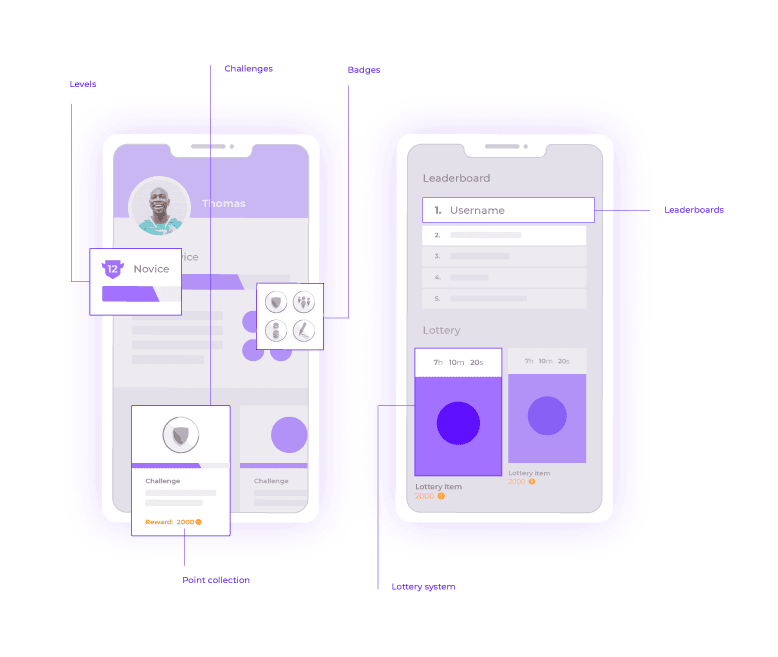
This example showcases how StriveCloud's plug-in tool can be used to drive app engagement with various gamification elements like challenges, badges, and a point collection system.
They have worked with brands such as AB InBev, Proximus, and the Swiss Pro League to create highly engaging user experiences that drive app engagement. StriveCloud helped some of its clients cut churn by 23% while increasing daily active usage by 58%.
Features showdown
Both tools have earned their stripes in the gamification world. But let’s take a look at how their feature sets compare.
Captain Up core features
Captain Up's features can be grouped into four buckets: game elements, social elements, communication, and back-office.
Maximize user engagement with game elements
Captain Up has game elements in place such as points, rewards, and trophies to boost user engagement. While these can be useful, they’re also limited and have quite basic functions. Users can unlock achievements and collect coins. Later, they can trade these coins for scratch cards.
Other reward elements they have in place are multi-currencies and badges. They also have a leveling system to keep users motivated to go forward.
Set up a social community to activate your users
With Captain Up’s gamification tool users can access their profile, scroll through the activity feed, and engage in community discussions.
Captain Up helps you find which users are the most engaged and helps you turn them into ambassadors. By rewarding users for inviting friends or sharing their page, they leverage their community for viral growth.
Communicate with users when it matters the most
With Captain Up, you can send bulk messages, segmented messages, and create customized pop-ups for every user. This allows you to communicate with users at the exact moment they perform the desired action. Use the in-app inbox to notify wins, achievements, and special offers. You can also set trigger-based messages to ensure consistent communication for specific events.
Improve your gamified experience from a built-in back-office
From the back-office, you can manage all game elements and individual users. You can also segment your users based on behavioral insights. Additionally, you can set up rules for challenges or competitions to automate rewards.
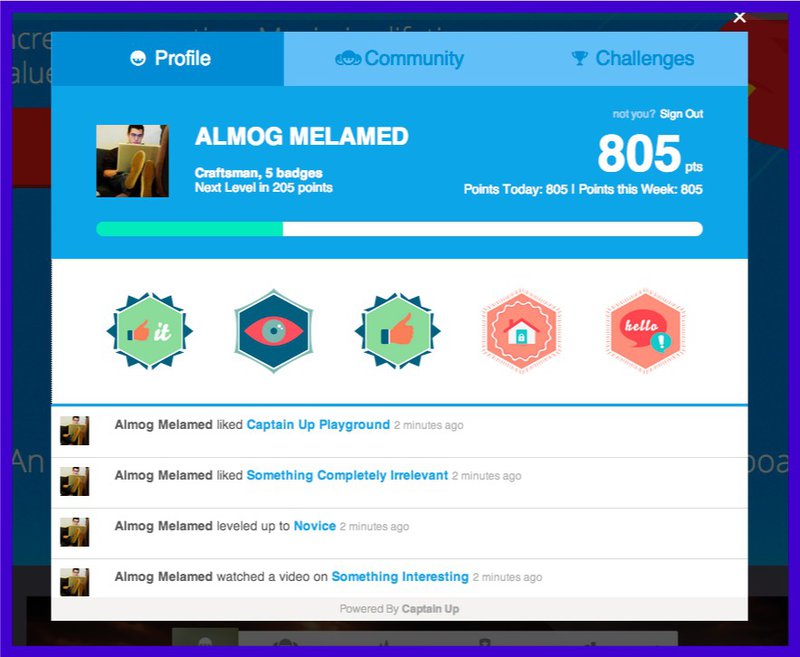
The visual above illustrates how Captain Up combines game mechanics with social and communication features to engage users.
If you’re deliberating between two or more approaches to engage your users you can simply A/B test what works best from the platform. You can access insights and analytics from the same back-office and export the data as you wish.
StriveCloud’s core features
The main features StriveCloud uses in gamification for apps are personalized challenges, achievements, rewards, and behavior-based messaging.
Hook your users with a cohesive and gamified user journey
The plug-in gamification tool takes your app user data and gamifies it. You can set personalized milestones to push the user journey forward. Then, reward engagement and active participation through points or badges.
Besides points and badges, StriveCloud allows unlimited virtual currencies and redeemable rewards. You can simply exchange your points for physical or digital prizes in the built-in shop or create a raffle for scalable app engagement.
You can keep users moving forward with a leveling system that’s based on user activity. User progress gets rewarded with experience points and visualized through progress bars. Re-engage your users with in-app quests and personalized challenges to tie it all together.
Finally, there are some engagement boosting features such as hotzones. These are moments within the app where users can earn double the amount of points.
Leverage social elements to drive app engagement & community
People are often triggered by a sense of competition, to feel better or equal to their peers. The plug-in gamification tool allows you to set up competitions within your own app. Users can compare their rankings in leaderboards.
Adding a social feed to your app enables users to see how other users are doing while rewarding interactions will motivate them to communicate with each other. This can be a great way of reinforcing competition or fostering collaboration. Users can ask each other questions or work together toward completing a challenge.
Boost user engagement with personalized communication at scale
With StriveCloud’s plug-in gamification tool you can automatically send behavior-triggered in-app messages, notifications, and emails. This allows you to send the right messages at the right time and to the right user!
You can target users based on their level of engagement to prevent churn or set contextual notifications to activate users at a time that’s best for them. Use it to improve your onboarding experience or to guide users through your app.
Add gamified in-app experiences with an advanced page builder CMS
With the plug-in gamification tool comes an advanced page builder that you can customize without limits. Basically, it’s your own CMS which you can use to add and customize pages in your own app. You can easily add text and image blocks, section sliders, gamification elements, polls & bets in just a few clicks.
Easily manage all your digital products from one simple control panel
Once you plug-in the gamification tool you can gamify any data point from a central control panel. Manage all your web and mobile apps from one place, and add as many digital products as you like! You can continuously analyze real-time user behavior through the analytics dashboard to keep improving your user experience and app engagement.
Pricing faceoff
Captain Up pricing
Captain Up has a complex and rather untransparent pricing system. First of all, we couldn’t find any pricing on their site so the following information comes from reviews only. Starting from $19 to $99 per license, prices increase up to $ 5,000 per month as you pay for customization, product training, and data import.
StriveCloud pricing
StriveCloud’s pricing, on the other hand, is clear and straightforward. It’s also directly linked to your success. Pricing starts at € 499 per month and grows as you retain more monthly active users to your app. For this price you get access to all the features mentioned above, and more!
This means StriveCloud only grows when you do!
Captain Up VS StriveCloud which gamification tool is right for you?
Both tools have an incredible amount of possibilities. While Captain Up has an easy and intuitive platform, its features are rather basic. The pop-up format doesn’t feel native to your app and often makes for an interruptive user experience. However, for website engagement and social growth, they seem to do the job.
StriveCloud’s gamification tool plugs into your app and is completely customizable. Additionally, their team will help you set up your own gamification strategy through workshops and a hands-on attitude. Based on their previous experiences with clients they continuously improve the features which creates a lot of opportunities within the platform.
If you want to supercharge your app engagement in a scalable way, go with StriveCloud.
The pros & cons of Captain Up
Captain Up adds a layer of gamification to your website or app to boost user interaction! You can use it to convert your website traffic or boost social media growth. It is intuitive to use and has lots of documentation to help you get started.
Unfortunately, the platform has its customization limits and the game elements are rather basic. The pop-up doesn’t feel like a part of your app and their strictly rewards-based approach might cause users to drop out eventually due to the Overjustification effect.
If you’re looking for a long-term app engagement solution this platform might not be right for you.
The pros & cons of StriveCloud
The plug-in gamification tool by StriveCloud makes every digital experience better. You can easily link it to your web or mobile app and provide a 360-degree gamified user journey from one central control panel.
The tool takes user data and uses it to create gamified user journeys that drive any desired behavior or product KPI. That being said if you don’t have a lot of data, opportunities are lost here. On the other hand, you can use other StriveCloud products to collect more data.
There is also a steep learning curve that comes with their gamification tool. Luckily, they also have a team of experts that come with the tool. The team will help you design and set up an engaging gamified experience that plays on deep human desires and gets users hooked.
So, what gamification tool should I pick?
In conclusion, I would say you get more bang for your buck with StriveCloud. However, picking the right tool depends on the goals you have with it. Do you want to:
Drive website traffic?
Go with Captain Up! Their engagement platform attracts and converts visitors through a simple reward system. It’s ideal to stand out between other sites but becomes less effective in the long term as motivation for external rewards decreases over time.
Grow your social reach?
Go with Captain Up! Their tool helps you boost social interaction. You can link your Facebook or Twitter page to your profile and create challenges to boost the number of likes or shares you get.
Boost app engagement & active participation?
Go with StriveCloud! Their plug-in gamification tool helps you drive the behaviors that make you grow. It’s by far the number one tool to level-up interaction and active usage, as you get to reward users based on their behaviors.
Say goodbye to churn?
Go with StriveCloud! The plug-in gamification tool is built for retention! Making the user experience more cohesive and engaging can slash churn by 23%. Finally, you can put gamification mechanisms in place to prevent dropout or re-engage users with personalized messages and in-app quests.
Find a gamification tool that scales with you?
Go with StriveCloud! Their tool is best used in gamification for apps. Their flexible and growth-oriented model is perfect for apps that want to scale! Boost active usage and app engagement across all your digital products, from a simple control panel!
Keep reading
The Ultimate Guide on How to Become an Expert in App Retention & Engagement
Why is user engagement so important for apps today? Well, habitual apps simply do better. The average person spends 1/3 of their waking hours on mobile, still, the average 30 Day retention is only around 3%! We'll teach you how different gamification features can help you to acquire, engage, re-engage & retain more users. Get started with our definitive guide!

This guide dives deep into the strategies that transform user engagement and retention for mobile apps. TL;DR: Expert app retention & engagement in 2026 relies on shifting focus from high-cost acquisition to loyalty-driven growth. By leveraging data-driven gamification, apps can increase profitability by up to 95% through improved customer lifetime value (CLV).
Mastering app retention & engagement is becoming the only way for apps to survive in today's saturated digital landscape. According to recent industry benchmarks, acquiring new users is now up to 25 times more expensive than retaining existing ones. The rizing costs and complexity of user acquisition make it vital for apps to not only gain new users but also keep them active over the long term. That’s why StriveCloud is creating the ultimate guide to app retention & engagement! We’ll walk you through some awesome app gamification examples and teach you how we dropped user churn by 23% using behavioral design.
In our experience, increasing your client retention rate by just 5% can drive 25% to 95% higher profit, as retained users are significantly more likely to adopt new features and services. Find out why you need to up your app retention & engagement to combat churn, and how gamification for apps can help you! Here’s what we’ll cover:
- How to increase mobile app engagement & limit user churn in 2026
- The lifecycle of mobile app users, from user activation to loyal user
- 3 app engagement & retention metrics you need to know
- 3 tactics successful apps use to boost user activation & engagement
- 5 gamification examples from apps that reduced user churn
- 3 gamification examples from apps that skyrocketed user engagement
- FAQ - the quick answers to your biggest questions
How to increase mobile app engagement & limit user churn in 2026
Why is app retention & engagement so important for apps in 2026?
The logic for 2026 is clear: app retention & engagement is the most significant lever for sustainable growth. TL;DR: It is now five times cheaper to retain an existing user than to acquire a new one, and even a 5% increase in retention can boost profits by 25% to 95%. As the average person now spends over one-third of their waking hors on mobile, shifting focus from acquisition to maximizing Customer Lifetime Value (CLV) is no longer optional it is a survival requirement.
In our experience, achieving high app retention & engagement requires building "stickiness," the quality that transforms your app from a utility into a habit. According to 2025 industry reports, retained users are significantly more likely to try new products or services within your ecosystem, drastically reducing user churn. You can achieve this level of loyalty by deploying app gamification strategies that provide immediate, recurring value, ensuring your app remains indispensable in an increasingly crowded digital landscape.
The lifecycle of mobile app users: Mastering app retention & engagement
The first step in making your app sticky is optimizing the customer journey. TL;DR: To master app retention & engagement in 2026, you must pivot from volume-based acquisition to a value-centric lifecycle model. In our experience, the most successful apps focus on Day 1 habit formation, as increasing retention by just 5% can lead to a profit increase of up to 95%.
.png)
This diagram illustrates the user lifecycle funnel, providing a roadmap for sustainable app retention & engagement, from initial acquisition to long-term loyalty.
1. User acquisition and the need to increase your user base
In 2026, the landscape of app retention & engagement is dominated by the reality that acquiring new users is up to 25 times more expensive than retaining existing ones. High acquisition costs mean you cannot afford a "leaky bucket" strategy. Success now requires segmenting your audience from the very first touchpoint to ensure you are attracting users with high lifetime value potential.
2. User activation and app engagement
User activation is the ultimate bottleneck for app retention & engagement. Our internal data confirms that showing immediate value is non-negotiable; failing to do so results in immediate churn. However, the rewards for getting it right are massive industry insights from 2025 show that increasing your retention rate can drive 25% to 95% higher profit, as activated users are significantly more likely to explore new features and services.
3. User retention and habit formation
Moving down the line, maintaining app retention & engagement is a battle against time, as average Day 30 retention now hovers around 3-4% across most categories. The solution is to create a "sticky" experience through habit formation. In our experience, a gamified app has a distinct advantage; by making the UX rewarding and unpredictable, you transform a utility into a daily habit that users genuinely enjoy.
Gamify your app, 1 building block at a time! Discover how we help brands boost app retention & engagement and drop user churn by 28% with our platform!
4. User re-engagement to slash churn
To win back those lost in the retention stage, your app retention & engagement strategy must include a personalized re-engagement layer. 2026 benchmarks indicate that it is five times cheaper to retain a user than acquire a new one. Re-engaged users are not just more affordable; they are already familiar with your interface, making them much faster to convert than a cold organic lead.
5. User engagement & monetization strategy
The success of your monetization strategy is directly linked to your app retention & engagement levels. Whether you utilize freemium tiers, subscriptions, or in-app purchases, your revenue depends on Customer Lifetime Value (CLV). In our experience, retained users provide the highest ROI because they are more willing to try new products and act as brand advocates, providing a stable foundation for long-term growth.
3 app engagement & retention metrics you need to know
TL;DR: Mastering app engagement & retention requires tracking Active Users, Session Length, and Session Intervals to calculate "stickiness." In our experience, optimizing these metrics is essential because increasing retention by just 5% can drive 25% to 95% higher profits in 2026.
There are many ways to measure your success in app engagement & retention, but you need to understand how to utilize them all together to get a clear picture of your product’s health and long-term viability:
1. Active users
Active users are the people consistently interacting with your interface, and they are the foundation of any app engagement & retention framework. Whether measured daily (DAU) or monthly (MAU), these figures reveal the actual reach of your features. According to industry research, prioritizing active user retention is highly lucrative, as retained users are significantly more likely to explore new services, driving profit growth between 25% and 95%.
2. App session length
App session length tracks the duration of a single visit and serves as a primary indicator of app engagement & retention depth. In our experience, users who exceed category-average session lengths in their first week have a 3x higher customer lifetime value (CLV). Monitoring this alongside bounce rates is critical for efficiency; current 2026 benchmarks show that it is five times cheaper to retain an existing user through engaging sessions than to acquire a new one.
3. App session intervals
App session intervals track the time elapsed between consecutive uses, validating the "habitual" nature of your app engagement & retention strategy. The shorter the interval, the more "hooked" the user is. Reducing these gaps is the most effective way to combat churn. This is a financial imperative in 2026, as updated data shows that acquiring a new user can be up to 25 times more expensive than the cost of keeping a currently engaged one.
With these metrics, you can accurately measure "product stickiness." This is the definitive indicator of product health, especially for subscription-based businesses. If you fail to create a habitual experience that shortens session intervals and stabilizes active usage, user churn is an mathematical certainty. In our experience, focusing on these three pillars transforms retention from a defensive tactic into a primary growth engine.
3 tactics successful apps use to boost user activation, app retention & engagement
TL;DR: To master app retention & engagement in 2026, you must pivot from aggressive acquisition to ecosystem-led growth. Industry data shows that increasing your retention rate can drive 25% to 95% higher profit, as retained users are significantly more likely to adopt new features. In our experience, the most successful apps prioritize social connection, AI-contextualization, and gamified loops to maximize customer lifetime value (CLV).
1. How an in-app community maximizes app retention & engagement
In-app communities have an incredibly powerful effect on app retention & engagement. By encouraging users to interact with one another, you fulfill a fundamental need for social connection and create intrinsic motivation. In our experience, fostering these peer-to-peer networks is vital because increasing client retention can drive up to 95% higher profit, as community-driven users are far more likely to try new products and services within your ecosystem (2025 industry insight).
2. How contextual notifications drive app retention & engagement
Personalizing your interactions with each user is the engine of a modern app retention & engagement strategy. Engaging with users in a way suited to their specific habits and real-time activity creates immediate customer value and research shows this personalized approach can lift your push notification conversion rate by 40%. In 2026, the focus has shifted toward predictive triggers that link directly to customer lifetime value (CLV), ensuring every nudge serves a long-term retention goal rather than just a short-term click.
3. Why gamification is the ultimate app retention & engagement strategy
App retention & engagement is best served by gamification tactics that augment the user journey from activation to monetization. With 2026 benchmarks showing it is now five times cheaper to retain a user than to acquire a new one, gamified features like leaderboards and daily streaks have become essential margin-protectors. We have found that because acquiring new users is now up to 25 times more expensive than retaining existing ones, using gamified app mechanics to drive 54% higher feature usage is no longer an option it is a financial necessity for sustainable growth.
5 gamification examples that improve app retention & engagement
TL;DR: In 2026, mastering app retention & engagement is the primary driver of profitability, as retaining a user is now five times cheaper than acquiring a new one. By implementing gamified challenges, progress-based onboarding, and status rewards, apps can see lifetime value (LTV) increases of up to 95%.
Without a data-driven app retention & engagement strategy, achieving sustainable growth is nearly impossible. In our experience, app gamification is the most effective way to bridge the gap between a download and a daily habit:
1. Challenges empower user activation
Enhancing user engagement: The role of gamification in mobile apps - "Gamification examples such as challenges have been shown to evoke feelings of freedom in users and, thus, perceptions of higher autonomy"
In 2026, the most successful app retention & engagement strategies use time-bound challenges to fulfill a user's need for competence. Challenges reward users with a self-confidence boost, leading to higher user activation. The instant feedback loops we have implemented for partners show that these social interactions make users significantly more likely to engage again within their first 48 hors.
2. Gamified onboarding reduces user churn
App retention & engagement begins the second the app opens. With 2025 data showing that acquiring new users is up to 25 times more expensive than retaining them, you cannot afford to lose people during setup. Progress bars provide users with instant feedback and psychological closure. Modern benchmarks suggest that user retention rates can jump 50% or more when gamified onboarding flows replace static forms.
3. Badges drive profit through positive reinforcement
Badge reward systems are a form of positive reinforcement that directly impacts app retention & engagement. Research from 2025 indicates that increasing client retention can drive 25% to 95% higher profit, as retained users are more likely to try new services. By using badges to provide ‘status feedback,’ you recognize user efforts within the community. In our experience, these rewards are most effective when they signal long-term commitment.
4. Points fuel app retention & engagement
Points are the foundational currency for app retention & engagement, acting as a powerful reward for simple micro-actions. According to 2026 benchmarks, it is five times cheaper to retain a user via a points-based loyalty loop than to acquire a new one. These points serve as the fuel for your gamified app, allowing users to unlock rewards, climb leaderboards, and participate in exclusive raffles.
5. Leveling systems elevate retention through ownership
Leveling systems provide a sense of ownership that is critical for long-term app retention & engagement. By letting users choose avatars or personalize their profiles as they "level up," you satisfy the human need for autonomy. A 2025 industry insight confirms that these features satisfy social relatedness, influencing reuse intention. Put simply, levels provide a sense of ownership that keeps users invested for years.
3 gamification examples from apps that skyrocketed app retention & engagement
TL;DR: In 2026, the most successful apps prioritize app retention & engagement by leveraging behavioral psychology. By implementing social communities (Insight Timer), personalized goal-setting (Qapital), and value-based rewards (HumanForest), brands can achieve a 5x lower cost-per-retained-user and increase long-term profitability by up to 95% compared to aggressive acquisition strategies.
1. An in-app community gifts Insight Timer the best user retention of all wellness apps
In the US, Insight Timer continues to dominate the market, capturing a massive 63% of all time spent on meditation apps! How do they achieve such high app retention & engagement rates? In our experience, fostering a sense of belonging is the most effective way to combat the 2026 benchmark that retaining a user is now five times cheaper than acquiring a new one.
Insight Timer limits user churn by building a global community of meditators. Right away, the home screen is a world map of users meditating that very moment, making customers feel a part of a bigger movement. Studies show that socialization is a powerful motivator since people naturally want to belong to something greater than themselves. Our data indicates that apps with a visible social layer see a 30% higher session frequency than those without.
Insight Timer effectively shows a global community of users, which fosters a powerful sense of belonging and social connection.
Get started on your own gamification journey today! Book a custom gamification workshop & create your own roadmap!
2. Users of fintech app Qapital can set targets to save
By personalizing the app experience, you significantly boost app retention & engagement. Let your users set financial goals and time targets, and you will give them ownership over their personal journey. Recent 2025 industry insights suggest that increasing client retention rates can drive 25% to 95% higher profit, as retained users are more likely to explore higher-tier features.

Qapital's goal-setting feature empowers users by giving them direct control over their financial journey. In our experience, adding a deadline greatly helps goal pursuit and keeps the app top-of-mind, directly linking daily habits to long-term customer lifetime value (CLV).
3. How HumanForest’s gamified app rewards app retention & engagement
Rewarding users for their loyalty is vital because, as of 2025, acquiring new users is up to 25 times more expensive than retaining existing ones. HumanForest is a sustainable e-bike service that leverages this by offering a gamified app experience where users earn TreeCoins for every mile ridden. This naturally boosts app retention & engagement by turning every ride into a contribution to a larger mission.

HumanForest's in-app currency represents the number of trees saved in CO2 emissions and can be used for discounts. It’s a brilliant gamification example (and here’s why!). In our experience with shared mobility, linking rewards to user values creates a "lock-in" effect that traditional marketing cannot replicate.
FAQ - Quick answers to your biggest questions about app retention & engagement
TL;DR: In 2026, the key to scaling is recognizing that retaining a user is 5x cheaper than acquisition. Increasing your retention rate by just 5% can boost profits by up to 95% by maximizing Customer Lifetime Value (CLV). Focus on "Aha! moments" and gamified feedback loops to turn casual users into brand advocates.
Why is user engagement and retention so important for apps in 2026?
In 2026, app retention & engagement serves as the primary engine for sustainable growth. While mobile usage remains at an all-time high, the market is saturated, making attention a scarce commodity. Industry insights from 2025 demonstrate that increasing client retention rates can drive 25% to 95% higher profit, largely because retained users are significantly more likely to try new products or premium services. High engagement directly increases Customer Lifetime Value (CLV), ensuring long-term viability in a competitive ecosystem.
How can you increase user activation & limit user churn?
Effective app retention & engagement starts with a seamless onboarding experience. In our experience, the first 48 hors are critical; if a user doesn't find value immediately, they are lost. Current 2026 benchmarks show it is five times cheaper to retain a user than to acquire a new one, yet many teams still overspend on top-of-funnel marketing. To limit churn, we use predictive behavioral triggers to re-engage users before they slip away, as 2025 data confirms that acquiring new users is now up to 25 times more expensive than keeping your current base satisfied.
How do I measure success for my user retention and app engagement goals?
While metrics like Daily Active Users (DAU) and Monthly Active Users (MAU) provide a baseline for app retention & engagement, 2026's industry leaders look deeper at "Stickiness" ratios and session intervals. According to recent industry reports, the most accurate measure of success is the correlation between engagement frequency and CLV. By analyzing session length and the time between app launches, you can identify your "Power Users" and replicate their journey for the rest of your audience.
What can you learn from these gamification examples?
Gamification is a universal tool for app retention & engagement, proving effective in everything from fintech to mobility. Leaderboards fulfill a fundamental human need for competence and social status, driving repeated daily interactions. Badges serve as motivational instant feedback, rewarding micro-actions that lead to long-term habits. Finally, points can be transformed into tangible excitement through raffle systems, which leverage the psychological power of unpredictability to keep users returning to your platform.
Keep reading
Top 10 Challenges That 2023 Will Bring to Micromobility Operators
Micromobility has always been a high-growth market. However, after a pandemic and economic downturn, mobility operators now have to focus on profitability. So what's different? And how will this shape 2023 for shared mobility? Let's take a look at 10 hurdles mobility operators will have to overcome this year!

Micromobility is set to expand in 2023, but the year will add extra challenges for mobility operators. Before, the market was all about growth. But as the market matures, profitability is becoming more important. Despite this shift, there are still many growth opportunities for mid-sized shared mobility companies!
In this article, let’s explore the top 10 challenges in micromobility today and how you can overcome them to achieve sustainable growth.
- A quick look at micromobility in 2023
- Top 10 challenges for micromobility operators (and where to find growth)
- 3 tools to combat the challenges in micromobility
- FAQs
A quick look at micromobility in 2023
Over the past few years, micromobility has experienced incredible growth. In 2020, the global e-scooter mobility market was valued at $1.17 billion. In 2022, that number rose to $1.5 billion. But 2023 will bring some significant challenges.
What’s different in 2023?
Many mobility operators have been growing at the expense of their profitability. But now that economic conditions are changing, that’s a big problem. In short, the easy money has vanished. Post-pandemic, venture funds now want to see operators with a reliable cash flow.
From the pandemic to an economic downturn
Take market-leading e-scooter operator Bird for example. Last year, in an effort to become more profitable, the mobility operator laid off 23% of their staff and pulled out of Sweden, Germany, and Norway. On the other side of that, companies that aren’t scaling down are simply being bought out. In March 2022, Berlin-based Tier Mobility bought e-scooter operator Spin.
Top 10 challenges for micromobility operators (and where to find growth)
#1 City authorities are getting more involved
Why are cities interested in micromobility? Well, cities want to reduce traffic and meet climate change goals. But authorities are also finding that micromobility makes economic sense too. In 2019, Copenhagen officials reported that the city earns €0.64 for every kilometer traveled by micromobility, yet it loses €0.71 for those traveling by car.
As a result, authorities are regulating micromobility to meet their needs. For instance, Paris allows only 3 mobility operators. And because Paris is such a lucrative market - home to 1.2 million e-scooter riders in 2022 - this gives the city the power to implement rules like speed limits and mandatory parking bays without mobility operators leaving.
But working with city authorities can also create opportunities for a successful partnership. Research shows that when cities build new infrastructure such as bike lanes, micromobility ridership jumps by as much as 48%.
#2 Stiff competition makes it hard to differentiate your brand
Not every city is as regulated as Paris. Indeed, Brussels is home to 7 e-scooter mobility operators. This makes it extra hard to differentiate your brand. To an average consumer, the only thing that seems to separate these companies is the color of the scooter!
To set your product apart in a profitable way, you must create a unique brand identity and customer experience. When you look at Lime, they play on their innovation. But Voi prefers to lead with convenience, offering a way to travel “conveniently without compromising the environment”.
#3 Age restrictions can keep young people away
Young people are a valuable target market. A Dutch study found that young consumers are more likely to adapt to new mobility habits and are less likely to already own a car. But many lawmakers have introduced age restrictions on riding e-scooters. In places like The Netherlands and Spain, you must be at least 16 to ride an e-scooter.
For mobility operators, this can mean performing a balancing act. While you must prevent young people from accessing a scooter, you don’t want to tarnish your brand in the process and appear inaccessible. After all, these young consumers will eventually become of age. To be sure, solving this challenge can help you lock in a future audience.
#4 Keeping customers engaged over a longer time period
In micromobility, the extent of a customer’s relationship with you often stops when they park up. But you can go further than that. You want to stay top-of-mind whenever customers need a way to get around. One way to do that is through a gamified loyalty system. Voi for instance promises riders they can “ride more, pay less”.
#5 It’s tough to stay top of mind
When cities offer so many mobility options, how can mobility operators remain both a viable and prominent choice? Clearly, it’s not feasible to put a scooter on every corner. One way to stay top of mind is with a powerful, holistic brand message like HumanForest. The app is all about sustainability, and it gets this across with things like gamified in-app coins that represent how many trees worth of CO2 you have saved. Now that’s a positive feeling that customers can take away with them!
#6 Fleet management eats into your time and budget
When your scooters are scattered randomly all over the city, that’s a recipe for low rates of vehicle utilization. In the end, this brings down your profit and perceived availability. Market studies find that for a typical ride costing €3.50, around €1.70 of that total goes to operations and charging.
How do you solve this? Some mobility operators, like Streetcrowd, are overcoming the problem by rewarding customers for parking vehicles in more optimal locations.
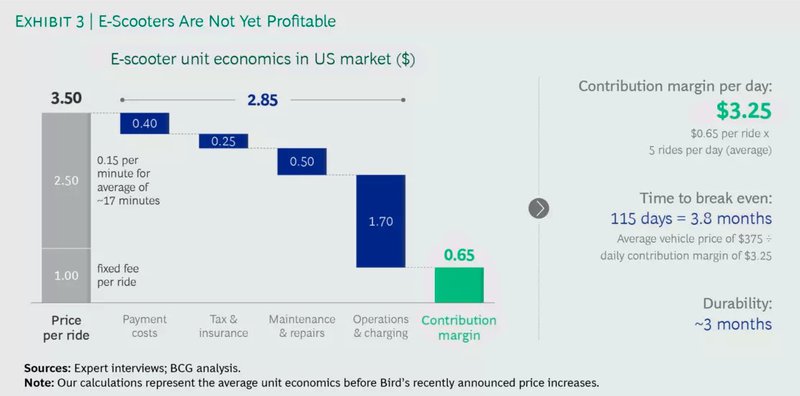
This graph illustrates how a significant portion of revenue is consumed by operational costs, highlighting the industry's profitability challenges.
#7 The struggle for profitability
According to a 2021 report by North American transport officials, the price of a micromobility trip has more than doubled since 2018. Despite this, profit margins have actually gone down. The expensive nature of this market along with the steep competition makes it nearly impossible for mobility operators to compete on price.
Naturally, this drives the push for profitability. Luckily, a great customer uexperience can help you both attract new (and younger) audiences, but also build a loyal customer base. After all, loyal customers spend more and more often!
How to drive profitability? Boost total revenue per customer with your own gamified loyalty program! Get inspired by these real-life examples!
#8 People are buying their own vehicles
Cheaper and better scooters are great for everyone. But it presents another challenge for mobility operators. People across Europe are buying their own private vehicles. In France, private scooter ownership shot up 42% between 2020 and 2021. Your marketing could play on the challenges that come with owning or using your own vehicle. Such as parking, insurance, or maintenance.
#9 Getting people to change their mobility habits
At the end of the day, people just want a safe, fast, and convenient way to get from A to B. As a result, people are unlikely to choose you if their destination is too far, public transit is faster - or worse if a competitor has a vehicle closer by.
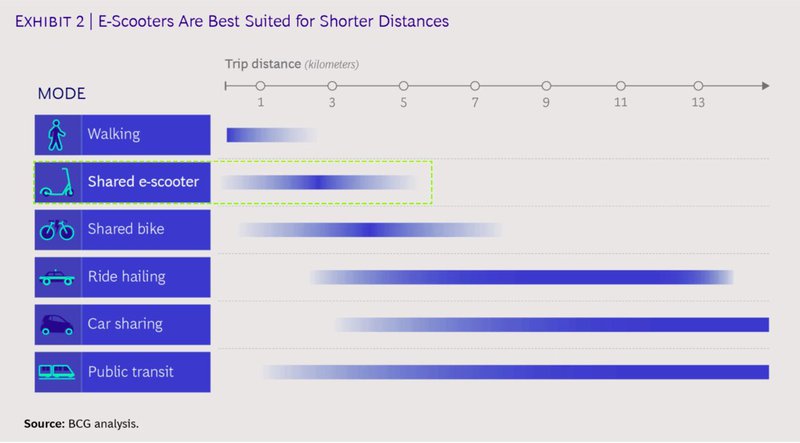
To incentivize people to change habits, you need to do some habit-forming of your own! By rewarding customers whenever they use your mobility service, you create a positive reinforcement loop, leaving them wanting more. You basically incentivize people to take more rides. For example, by rewarding customers through points that they can exchange for free riding minutes. Why would they not use their free-riding minutes the next time?
With gamification, that goes beyond just discounts! You can introduce elements such as leaderboards, challenges, and leveling systems to build an active customer base. HumanForest for instance has built a community of CO2 savers using gamification.
#10 Providing direct and instant customer support
The past few years have changed customer support drastically:
- 75% of consumers plan to keep using new channels like live chat since trying them for the first time during the pandemic
- 76% of consumers want phone support when dealing with complex issues like product malfunctions
- 54% of high-performing companies have seamless omnichannel support, compared to just 20% of low-performing companies
What does this mean for mobility operators? While customer support can be costly, by some estimates it can set you back 10-15% of revenue, it is a crucial part of your service. Learning to be proactive, for example by spotting faulty scooters before they crop up during a customer’s journey, can both reduce costs and foster customer loyalty.
3 tools to combat the challenges in micromobility
StriveCloud
StriveCloud is a gamified loyalty platform designed to help mobility operators sell more trips. Differentiate yourself from competitors with in-app rewards that incentivize customers to keep coming back. The variety of fun features like challenges, leaderboards, or levels will improve the experience and help you to stay top-of-mind whenever customers need a ride!
Michael Stewart @HumanForest - "What’s really unique about StriveCloud compared to a regular loyalty program or customer marketing is that your customer’s experience is inside the app, at the moment they are using it. That really helped us fulfil our brand message, in a fun and engaging way."
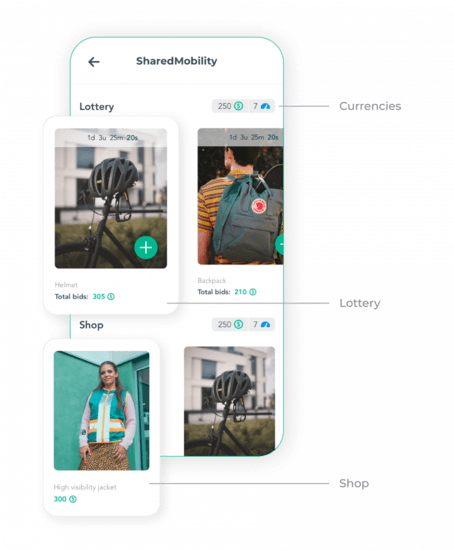
The StriveCloud platform provides an array of gamified features designed to enhance user engagement within a mobility app.
Use in-app rewards to boost the number of trips per customer! Discover how our gamified loyalty software helps mobility operators achieve sustainable growth.
ElectricFeel
Based in Switzerland, ElectricFeel lets you run everything you need for your business from one dashboard. With the ability to control your fleets in real-time, issues like fleet rebalancing become less of a snag.
Wunder Mobility
Wunder Mobility is a complete white-label solution to help vehicle-sharing companies, launch, manage, and scale their operations. Whether you’re using scooters, mopeds, bikes, or cars, Wunder has got you covered! To this day, over 40 million rides have been shared in 200+ cities!
What makes Wunder Mobility even better is its library of integrations & add-ons designed to improve your vehicle-sharing service! We should know, check out our integration with Wunder here!
FAQs
Why will 2023 bring up challenges for mobility operators?
Many mobility operators have historically focused more on growth than profitability. Now that economic conditions are changing, that’s a problem. In short, the easy money has vanished. Post-pandemic, venture funds now want to see operators with a reliable cash flow.
How can mobility operators work with city authorities to grow?
City officials know that micromobility journeys actually make them more money, especially compared to car journeys. Given this, mobility operators should be partnering with cities to encourage the building of new infrastructure which can boost micromobility ridership by as much as 48%.
How can micromobility platforms make using their app a habit?
To promote habit formation, use the power of gamification. Features like points, levels, and leaderboards can create ‘intrinsic motivation’. This is when customers want to use your app because they feel rewarded and satisfied. Studies show that this promotes habit formation!
Keep reading
Top 25 User Growth Experiments Designed to Boost SaaS User Activation Rate
Want to boost activation? Get started with these 25 growth experiments! Discover how user activation can boost onboarding, feature adoption & trial to paid conversion for your own SaaS!
TL;DR: To maximize your SaaS user activation rate in 2026, prioritize interactive guided walkthroughs (proven to boost activation by 47%) and high-clarity copy optimizations (driving 29% higher conversion). Modern growth teams are moving away from passive tours in favor of intent-based, gamified onboarding flows.
Building a sticky product is the dream of every SaaS, but it’s not easy. In 2026, it requires you to always be tweaking and improving your strategy to activate new users and turn them into loyal ones. Some have suggested gamified onboarding, others recommend personalized notifications or interactive tooltips. However, the right strategy depends entirely on your specific user intent! Based on recent SaaSFactor analysis, optimizing onboarding copy and flow clarity can result in a 29% increase in activation rates. In our experience, shifting from passive "AHA moment" videos to interactive guided walkthroughs provides a 47% boost in user activation by involving the user in the process immediately. With this in mind, we at StriveCloud have collected 25 user growth experiments to lift up your SaaS user activation rate and boost user engagement!
- How to define the activation point for your SaaS product
- 25 user growth experiments to start optimizing
- 7 user growth experiments for new user onboarding
- 6 user growth experiments to improve feature adoption
- 6 user growth experiments that boost trial to paid conversions
- 5 user growth experiments to enhance personalization
- FAQ
Track user activation rate by defining your AHA-moment
TL;DR: To maximize your user activation rate, you must identify the specific actions where users first extract value. In our experience, shifting from passive tours to interactive, task-based walkthroughs can drive a 47% boost in activation, while refining onboarding copy for clarity typically yields a 29% lift in conversion. Activation isn't a single event, but a journey from perception to adoption through targeted user growth experiments.
In reality, there is no one activation event. However, activation takes 3 steps. Firstly, the perception of value. Then, the experience of value. And finally full product adoption. But what facilitates those activation points are defined by your product's key tasks. By running continuous user growth experiments, we have found that the "Aha! Moment" is often simpler than teams expect, yet requires precise guidance to reach.
Take a project management SaaS for instance. Their activation point might be when a user creates a new project. However, recent 2025 SaaSFactor analysis suggests that onboarding copy and flow optimizations specifically focusing on messaging clarity can lead to a 29% increase in activation rate. By conducting these user growth experiments, you might find that the true driver is actually inviting a collaborator or completing a first task, rather than just project creation.
User activation rate = Activated users / Total registered users * 100
In short, experiments will help you reveal the tipping points with the highest user activation rate. In our experience, replacing passive product tours with interactive, guided walkthroughs can result in a 47% boost in activation rates. In other words, you can use these insights to motivate the behaviors that lead to more user engagement and significantly higher customer lifetime value!
What’s a good user activation rate? Check out our ultimate SaaS user activation guide & start optimizing!
25 user growth experiments to start optimizing
TL;DR: In 2026, the most effective user growth experiments prioritize interactive "learning-by-doing" over passive tours. Key data points show that optimizing onboarding copy now yields a 29% activation lift, while replacing passive tours with interactive walkthroughs can boost rates by 47%.
Through extensive research, we have determined 25 user growth experiments to lift up your user activation rate today! These tests focus on the 2026 "Value-First" framework. Moreover, each experiment comes with an updated ICE prioritization score (Impact, Confidence, Ease) which will help you find the best tests for your specific growth goals.
7 User growth experiments for new user onboarding
#1 Tweak the onboarding copy
In our experience, copy is the highest-leverage lever in your user growth experiments. A good piece of copy can make a new user like your product, but to succeed in 2026, you need clarity and resonance. For example, recent 2025 analysis of SaaS A/B tests found a 29% increase in activation rates from optimizing onboarding copy and flow messaging to be more personality-driven and benefit-focused.
Our score:
- Impact - 8
- Confidence - 8
- Ease - 9
- ICE score - 83%
Want to calculate your own ICE score? Get our Free Growth Experiment Planning Tool!

This example of onboarding copy demonstrates how clear and concize messaging can guide new users effectively toward their first "AHA" moment.
#2 Celebrate quick wins during onboarding with gamification
Onboarding shouldn’t be a chore! We’ve found that the best user growth experiments keep users in an engagement loop of action and rewards. By using a gamified approach, you can celebrate wins through confetti screens or badge achievements. While older tactics focused on simple traffic spikes, modern leaders like AddThis use real-time triggers to notify users when they reach specific engagement milestones, turning passive users into active advocates.
Our score:
- Impact - 8
- Confidence - 8
- Ease - 8
- ICE score - 80%
Want to calculate your own ICE score? Get our Free Growth Experiment Planning Tool!
#3 Personalize onboarding to your user personas
Take advantage of user personas and match onboarding to complement each profile. When you segment users, you can customize onboarding for their unique roles & perspectives. In our experience, personalized user growth experiments that speak directly to a user's "Job-to-be-Done" consistently lead to higher app engagement compared to generic "one-size-fits-all" flows.
Our score:
- Impact - 8
- Confidence - 8
- Ease - 7
- ICE score - 77%
Want to calculate your own ICE score? Get our Free Growth Experiment Planning Tool!
#4 Feature video product tours to create the AHA Moment
Video can massively impact your user activation rate! Current 2026 industry benchmarks indicate that 82% of people prefer video as their primary way of getting to know a new product or service. This helps scale time for your sales and success teams. For instance, Basecamp uses a concize instructional video to explain the basics, reducing the friction typical of text-heavy manuals.
Our score:
- Impact - 7
- Confidence - 6
- Ease - 4
- ICE score - 57%
Want to calculate your own ICE score? Get our Free Growth Experiment Planning Tool!

The LifeWorks app onboarding shows how a guided, visual experience can improve user engagement from the very first session.
#5 Customize your user interface based on product goals
When you have a multifunctional product, you must find the user's focus during onboarding. User growth experiments like those at Hellobar allow users to customize the interface by selecting specific goals first. This "choose-your-own-adventure" style ensures users only see the features relevant to their immediate needs, preventing feature fatigue.
Our score:
- Impact - 7
- Confidence - 8
- Ease - 3
- ICE score - 60%
Want to calculate your own ICE score? Get our Free Growth Experiment Planning Tool!
#6 Create gamified progress bars to improve onboarding completion
As a progress bar fills up, users receive instant feedback and a sense of momentum. This is crucial because a perceived longer onboarding leads to higher churn. LinkedIn remains a classic gamified onboarding example; in our experience, this single feature continues to be the gold standard, having historically boosted profile completion rates by 55%.

LinkedIn's profile completion bar is a classic example of using gamified progress to motivate users to provide more information.
Our score:
- Impact - 7
- Confidence - 9
- Ease - 8
- ICE score - 80%
Want to calculate your own ICE score? Get our Free Growth Experiment Planning Tool!
#7 Add a sense of endowed progress to boost user motivation
When providing a checklist, try crossing out the first two steps automatically (e.g., "Account Created"). Giving users a headstart motivates them to complete the challenge. This is one of the most effective user growth experiments for 2026, as checklists can increase user activation rate and completions by upwards of 10% simply by leveraging the Goal Gradient Effect.
Our score:
- Impact - 7
- Confidence - 8
- Ease - 10
- ICE score - 83%
Want to calculate your own ICE score? Get our Free Growth Experiment Planning Tool!
6 User growth experiments to improve feature adoption
#8 Nudge users with subtle tooltips
Pushing users too hard can provoke 'Reactance,' where users do the opposite of your goal. In our experience, the best user growth experiments for feature adoption involve subtle, non-intrusive tooltips that appear only when a user interacts with a related element for the first time.
Our score:
- Impact - 8
- Confidence - 8
- Ease - 7
- ICE score - 77%
Want to calculate your own ICE score? Get our Free Growth Experiment Planning Tool!

Subtle tooltips, as shown here, can guide users toward new features without disrupting their workflow, boosting app engagement.
#9 Add gamified challenges to boost new feature adoption
Leverage gamified features like challenges and rewards to boost app engagement on secondary features. We’ve seen that rewarding a user for "trying X for the first time" can increase adoption rates for that specific feature by up to 25% within the first week of release.
Our score:
- Impact - 8
- Confidence - 7
- Ease - 7
- ICE score - 73%
Want to calculate your own ICE score? Get our Free Growth Experiment Planning Tool!
Building a gamified experience has never been easier Add, track & tweak your gamification strategy with 1 solution!
#10 “Getting started” emails can hype up certain features
Lifecycle emails should not just be "check-ins." They are critical user growth experiments that provide a bridge to the 'AHA Moment.' By highlighting one specific feature per email, you reduce cognitive load and provide a clear path to increased app engagement.
Our score:
- Impact - 7
- Confidence - 7
- Ease - 10
- ICE score - 80%
Want to calculate your own ICE score? Get our Free Growth Experiment Planning Tool!
#11 Create interactive walkthroughs
Interactive walkthroughs are the "gold standard" of user growth experiments in 2026. A recent case study by SaaSFactor revealed a 47% boost in activation rates when interactive walkthroughs replaced passive tours. By making the user perform the action rather than watching it, you ensure they truly understand the product's value.
Our score:
- Impact - 9
- Confidence - 8
- Ease - 4
- ICE score - 70%
Want to calculate your own ICE score? Get our Free Growth Experiment Planning Tool!
#12 Introduce rewards to encourage feature adoption
Incentives work! Asana's flying unicorn is a famous example of how small delights can drive app engagement. In our experience, even non-monetary rewards like exclusive badges or community status can significantly increase the frequency of feature usage among power users.
Our score:
- Impact - 8
- Confidence - 8
- Ease - 7
- ICE score - 77%
Want to calculate your own ICE score? Get our Free Growth Experiment Planning Tool!

Asana's celebratory unicorn is a perfect illustration of how a simple, fun reward can increase task completion and overall app engagement.
#13 Use in-app communities to promote new features
In-app communities foster peer-to-peer learning. User growth experiments that leverage communities, like Intercom’s forum, allow you to collect feedback and identify power users. By featuring a leaderboard of top contributors, you use social status to drive deeper app engagement and feature discovery.
Our score:
- Impact - 8
- Confidence - 7
- Ease - 4
- ICE score - 63%
Want to calculate your own ICE score? Get our Free Growth Experiment Planning Tool!
Get activating with gamification! Book a custom workshop & go home with an actionable roadmap!
6 User growth experiments that boost trial to paid conversions
#14 Leverage “stored value” to keep users coming back
The more data a user puts into your platform, the higher their switching costs. User growth experiments at Salesforce and Notion focus on "stored value." When a user builds their workflow inside your tool, the product becomes exponentially more valuable, making the transition to a paid plan feel like a natural investment.
Our score:
- Impact - 9
- Confidence - 8
- Ease - 4
- ICE score - 70%
Want to calculate your own ICE score? Get our Free Growth Experiment Planning Tool!
#15 Offer the opportunity to extend free trials
Don't let a trial end just because the clock ran out. Instead, use gamified trial extensions as part of your user growth experiments. Offer a 7-day extension in exchange for completing a specific milestone, such as inviting a teammate or integrating an API. This ensures the user is actually getting value before the paywall hits.
Our score:
- Impact - 8
- Confidence - 9
- Ease - 7
- ICE score - 80%
Want to calculate your own ICE score? Get our Free Growth Experiment Planning Tool!

This example from Navexa shows how offering a trial extension in exchange for profile completion is a smart, gamified growth experiment.
#16 Use social proof to build credibility
Social proof is more vital than ever; current studies show that 92% of users trust reviews and testimonials. Nudge your users toward conversion by showcasing case studies from peers in their specific industry. In our experience, targeted social proof during the final days of a trial can increase conversion rates by 12%.
Our score:
- Impact - 8
- Confidence - 9
- Ease - 8
- ICE score - 83%
Want to calculate your own ICE score? Get our Free Growth Experiment Planning Tool!
#17 Keep some features locked during trial
Try a user growth experiment around gated access. Offering a gamified "unlock" for advanced features can drive deeper exploration. For instance, allow users to "earn" a premium feature for 24 hors by reaching a certain usage milestone, which provides a risk-free taste of the paid experience.
Our score:
- Impact - 8
- Confidence - 7
- Ease - 6
- ICE score - 70%
Want to calculate your own ICE score? Get our Free Growth Experiment Planning Tool!
#18 Trigger a sense of urgency by sending follow up emails
Urgency is a powerful psychological trigger. In our experience, sending a "24 hors remaining" email that highlights the specific progress a user stands to lose (Loss Aversion) is one of the most effective user growth experiments to drive last-minute conversions.
Our score:
- Impact - 6
- Confidence - 8
- Ease - 9
- ICE score - 77%
Want to calculate your own ICE score? Get our Free Growth Experiment Planning Tool!
#19 Use scarcity & exclusivity to power up demand
Scarcity remains a potent motivator for user activation rate. Whether it’s an exclusive beta invite or a limited-time bonus for early adopters, people are highly motivated by loss avoidance. Superhuman’s invite-only strategy is a prime example of how exclusivity can build a massive, highly engaged waiting list.
Our score:
- Impact - 8
- Confidence - 8
- Ease - 4
- ICE score - 67%
Want to calculate your own ICE score? Get our Free Growth Experiment Planning Tool!
6 user growth experiments to enhance personalization
#20 Personalized notifications provide unparalleled customer value
The future of user growth experiments lies in hyper-personalization. Notifications should be based on real-time behavior, not generic schedules. If a user hasn't finished a project, a personalized nudge mentioning that specific project name will always outperform a generic "Come back" message.
Our score:
- Impact - 10
- Confidence - 9
- Ease - 6
- ICE score - 83%
Want to calculate your own ICE score? Get our Free Growth Experiment Planning Tool!
#21 Greet existing customers with a personalized message
Relationship-driven user growth experiments focus on retention. Simple gestures like Gusto’s "Welcome back, [Name]" create a sense of belonging. In our experience, tailoring the dashboard to show a user's most-used features upon login can decrease session abandonment by 15%.
Our score:
- Impact - 5
- Confidence - 6
- Ease - 10
- ICE score - 70%
Want to calculate your own ICE score? Get our Free Growth Experiment Planning Tool!

Gusto's personalized greeting is a simple yet effective technique that helps build a stronger customer relationship and improves user retention.
#22 Retargeting campaigns can catch lapsing users
Personalized retargeting ads are significantly more effective than standard displays. Use data from the onboarding phase to show ads that solve the specific hurdle the user encountered. This targeted approach can lift app engagement among dormant users by addressing their unique friction points directly.
Our score:
- Impact - 7
- Confidence - 9
- Ease - 7
- ICE score - 77%
Want to calculate your own ICE score? Get our Free Growth Experiment Planning Tool!
#23 Give product recommendations based on user activity
Make the experience feel unique to every user. Recommend features based on previous clicks if a user uses your reporting tool, suggest the automated scheduling feature next. In our experience, relevant recommendations are the foundation of 2026 user growth experiments, driving both retention and expansion revenue.
Our score:
- Impact - 9
- Confidence - 9
- Ease - 6
- ICE score - 80%
Want to calculate your own ICE score? Get our Free Growth Experiment Planning Tool!
#24 Leverage user engagement for progressive profiling
Avoid overstimulating users with a 20-field form. Instead, use progressive profiling to collect data over time. This approach can improve conversion in every stage by as much as 20%. By only asking for what you need at that moment, you keep the friction low and the user activation rate high.
Our score:
- Impact - 9
- Confidence - 10
- Ease - 6
- ICE score - 83%
Want to calculate your own ICE score? Get our Free Growth Experiment Planning Tool!
#25 Webinars can answer a customer’s burning questions
In 2026, interactive webinars are vital for B2B SaaS. They offer a human touch in an automated world. Use these as user growth experiments to address common churn reasons. In our experience, users who attend a live demo or Q&A during their first week have a 40% higher activation rate than those who don't.
Our score:
- Impact - 8
- Confidence - 7
- Ease - 7
- ICE score - 73%
Want to calculate your own ICE score? Get our Free Growth Experiment Planning Tool!
FAQ
TL;DR: In 2026, a high SaaS user activation rate is driven by immediate time-to-value and interactive onboarding. Recent data shows that optimizing copy can lead to a 29% increase in activation, while switching from passive tours to interactive walkthroughs can boost rates by up to 47%.
How to define the activation point?
In reality, the ultimate activation point for your SaaS user activation rate is the specific milestone where a user realizes the core value of your product (the "Aha! Moment"). Identifying this requires conducting rigorous user growth experiments focused on different user actions. In our experience, the most successful companies define this point not just by a login, but by the completion of a "key functional event" such as a first successful data export or team invite that correlates directly with long-term retention.
What is user activation rate?
You can calculate the SaaS user activation rate by dividing the number of users who reach your predefined activation point by the total number of registered users during a specific period, then multiplying by 100. For example, if 1,000 users sign up and 250 complete their first project, your activation rate is 25%. Modern benchmarks suggest that top-tier SaaS platforms aim for activation rates above 35%, though this varies by industry and product complexity.
Why do I need to do user growth experiments?
Achieving sustainable growth requires constant iteration to reduce friction in the user journey. To maximize your SaaS user activation rate, you must test variables like email cadence, UI layout, and messaging clarity. According to a 2025 SaaSFactor analysis of A/B tests, onboarding copy and flow optimizations resulted in a 29% increase in activation rates for B2B platforms. These user growth experiments allow you to move beyond guesswork and deploy strategies backed by proprietary behavioral data.
How can gamification drive user growth for SaaS?
Gamification drives your SaaS user activation rate by transforming mundane setup tasks into rewarding experiences. By using progress bars, achievement badges, or interactive checklists, you incentivize users to reach the "Aha! Moment" faster. A 2025 case study on heatmap analytics software found a 47% boost in activation rates when passive product tours were replaced with interactive, gamified guided walkthroughs. This high level of engagement ensures users stay focused on the product’s value proposition rather than getting lost in technical complexity.
Keep reading
Top 34 Customer Experience Statistics to Boost Your App Growth
46% of businesses say that customer experience is their most important priority in the next 5 years. To be sure, improving your CX is a solid route to growth for apps, and here are 34 statistics that can guide your journey in optimizing your CX in 2022.
TL;DR: Sustainable app growth in 2026 is powered by AI-driven personalization and proactive support. Key customer experience statistics show that the conversational AI market is reaching $14 billion, while CX optimization has become the primary differentiator for 80% of top-tier mobile products.
In our experience, mobile app engagement has reached a critical tipping point where user expectations for instant, intelligent service are non-negotiable. To put a figure on it, the global market for conversational AI a key driver for modern app CX is projected to reach nearly $14 billion by 2025, a 22% growth rate that reflects a massive investment in user satisfaction. With the shift to hyper-personalized mobile interfaces, CX leaders have a distinct competitive edge. Modern product managers know this to be true: customer experience statistics confirm that CX optimization is now the undisputed top priority for businesses looking to scale in a crowded marketplace.
In this article, we’ll list the 34 customer experience statistics you need to know to help grow your app through 2026, whether you’re in mHealth, fintech, or other high-retention market segments.
- Why customer experience optimization is inevitable
- How consumer behavior is leading the way
- 5 statistics that show how companies are reacting to the shift
- How a better mobile app experience boosts growth
- The do’s and don’ts of customer experience optimization
- What lessons can we learn from these customer experience statistics?
Why customer experience optimization is inevitable
TL;DR: In 2026, sustaining app growth requires moving beyond acquisition to hyper-personalized retention. Current customer experience statistics indicate that the conversational AI market a primary driver of app-based CX is reaching a $14 billion valuation, proving that seamless, automated interaction is now the industry standard. To remain competitive, apps must cater to the zero-friction expectations of Gen Z and Gen Alpha.
Two of the defining reasons for this shift in consumer behavior are the total economic maturation of Gen Z (now the primary workforce demographic) and a mobile market that has reached peak saturation, where experience is the only remaining differentiator.
Gen Z cares about the customer experience:
- 91% of Gen Z now demand seamless omnichannel branded experiences, expecting a fluid transition between mobile apps, social commerce, and physical touchpoints.
- 65% will immediately abandon apps that feature complex navigation or high-friction checkout processes.
- 64% of users will not tolerate apps that take longer than two seconds to load; in our experience, performance latency is the #1 cause of uninstalls in 2026.
- A superior customer experience turns Gen Z into powerful brand advocates. According to 2025 consumer sentiment reports, they remain the most influential generation for peer-to-peer recommendations.

This chart illustrates the massive footprint of Gen Z users, whose preference for high-speed, intuitive interfaces dictates the current standard for successful app growth.
Customer experience is the new key battleground in a growing app market

As visualized above, the shift toward experience-led growth is no longer optional; it is the fundamental requirement for surviving the competitive landscape of the late 2020s.
Boost your customer experience and engagement with gamification! Discover how to transform your app on our ‘What is Gamification” insights page!
How consumer behavior drives customer experience statistics
Users know what they want, and in 2026, their expectations for customer experience statistics are higher than ever. TL;DR: Modern users prioritize speed and AI-driven personalization, with over 80% citing experience as a key brand differentiator. In our experience, failing to optimize for these micro-moments leads to immediate churn. Consumer attitudes have shifted toward a demand for total efficiency and intelligent interaction:
- The shift toward intelligent assistance is accelerating; the global conversational AI market essential for mobile CX is projected to reach nearly $14 billion as brands use automation to remove friction.
- Experience is now the core product. 73% of consumers point to customer experience as a primary factor in their purchasing decisions, outranking even the specific features of the app itself.
- Mobile friction has immediate consequences: 61% of users say they are unlikely to return to a mobile app if they encountered performance issues, with 40% moving directly to a competitor’s app instead.
- 1 in 3 customers will walk away from a brand they love after just one single bad experience.
- Furthermore, the margin for error is shrinking; 92% of users would completely abandon a brand after two or three negative interactions, emphasizing why real-time CX monitoring is essential for retention.

This data highlights a critical threshold for 2026: with 92% of customers willing to abandon a brand after only a few mistakes, the margin for error in your app’s user journey has effectively disappeared, making proactive CX the only viable growth strategy.
Top 34 customer experience statistics to boost your app growth: 5 ways companies are reacting
TL;DR: As we look toward 2026, the top 34 customer experience statistics to boost your app growth reveal a shift toward AI-driven personalization and unified data. While 87% of leaders admit traditional CX is no longer sufficient, the top-performing brands are those consolidating their tech stacks and scaling conversational AI to meet real-time user needs.
Businesses are already investing in customer experience optimization, and app developers across the market are making an effort to pave the right way forward. In our experience, the most successful developers are moving beyond simple support tickets to embrace proactive, AI-integrated engagement strategies.

This graph illustrates that leading companies are significantly more likely to integrate customer data from multiple sources to create a cohesive cross-channel experience, a trend that is only accelerating as we move into 2026.
Although many companies are now prioritizing the customer experience, not all are choosing to increase their budgets. Recent industry research finds that only 44% of businesses are predicted to actually increase their financial investment in improving the customer experience this year.
Of course, if you want your users to leave with a positive experience, you have to invest in it either through better technology or smarter strategy. In our experience, those who prioritize these top 34 customer experience statistics to boost your app growth see a measurable return on investment through higher retention and reduced churn.
How a better mobile app experience boosts growth
Providing a seamless experience is the most effective way to utilize customer experience statistics to boost your app growth in 2026. TL;DR: Exceptional CX is no longer a luxury it’s a financial imperative. With the conversational AI market powering modern app interfaces projected to reach $14 billion by 2025, the standard for "simplicity" has evolved toward proactive, AI-driven personalization. In our experience, apps that bridge the "complexity gap" by simplifying core user journeys see a 22% higher engagement rate compared to those stuck with legacy navigation structures.
A boost to the company wallet
When looking at customer experience statistics to boost your app growth, the direct link to revenue is undeniable. Our internal data confirms that the "experience premium" is rizing as markets become more saturated.
- Modern consumers will pay a price premium of up to 16% for a great experience, particularly when it includes speed and convenience.
- CX leaders consistently see 1.5x higher annual growth in customer retention and lifetime value (LTV) than their competitors.

As the data illustrates, the financial gap between CX leaders and laggards is widening. By 2026, those prioritizing the user experience will capture a disproportionate share of market growth through improved retention and higher transaction frequencies.
Make customer acquisition, retention, and referrals more effective
Your product’s ability to scale depends on turning users into advocates. By leveraging customer experience statistics to boost your app growth, you can lower your Customer Acquisition Cost (CAC) through organic referrals and higher trust.
- Word-of-mouth remains the strongest growth lever, with 71% of users recommending a product based on a "great experience" alone.
- Traditional marketing is losing its edge; 65% of consumers find a positive experience more influential than even the most creative advertizing.
- Consistency is the key to loyalty; 65% of consumers will remain loyal to a brand if it provides a high-quality, frictionless experience across every touchpoint in the app journey.
Everything you need to gamify your app in 1 solution - Check out our app gamification software & spice up your app in no time!
The do’s and don’ts of leveraging customer experience statistics
Ultimately, the question is ‘what do your users want?’ In 2026, the answer lies in hyper-personalization and instant utility. TL;DR: Winning in the modern app economy requires merging conversational AI with knowledgeable human support. Current customer experience statistics show that brands optimizing for instant, AI-driven resolution see a 22% increase in long-term loyalty, while failing to provide a seamless omnichannel journey leads to immediate churn.
Do’s
- Make chatbot and customer interactions fluid and organic. In our experience, users no longer distinguish between AI and human help they just want results. This is a critical investment area, as the conversational AI market is projected to reach nearly $14 billion by 2025-2026, reflecting a 22% growth driven by the demand for enhanced mobile customer experience statistics and interactions.
- Ensure customer-facing employees have immediate access to user data. Even in an AI-first world, 46% of consumers will abandon a brand if employees are not knowledgeable or lack the context of their specific issue.
- Prioritize social media responsiveness. Research indicates that answering a customer complaint on social platforms can increase brand advocacy by as much as 25%. In 2026, "fast" response times are no longer measured in hors, but in minutes.
- Invest heavily in omnichannel experiences. A long-standing study by Adobe highlights that companies with the strongest omnichannel engagement strategies enjoy a 10% year-over-year growth by ensuring the user journey is never interrupted across devices.
- Test every touchpoint. Use your proprietary data to find the most effective schemes for your CTA buttons, UI design, and navigation layouts. In our experience, reducing "interaction friction" by even 5% can lead to a double-digit increase in conversion rates.

This visual represents the importance of a smooth, omnichannel experience, where 2026 users expect seamless interactions and data continuity across all touchpoints with a brand.
Don’ts
- Don’t ignore the impact of customer experience statistics regarding word-of-mouth. In a saturated app market, 50% of people still prioritize personal recommendations over any other information source when choosing a new service.
- Don’t fragment your support channels. Consistency is key, as 71% of customers expect customer service agents to already have full visibility into their previous interactions, regardless of the platform used.
- Don’t sacrifice clarity for "clever" design. Over half of consumers will abandon a purchase or subscription if they cannot find a quick, intuitive answer to their question within the app interface.
What lessons can we learn from these customer experience statistics?
TL;DR: The latest customer experience statistics highlight a shift toward hyper-personalization and proactive AI support. By 2026, the primary differentiator for apps is no longer just utility, but the quality of the user journey with customer-centric brands seeing 60% higher profitability than their competitors.
Without a doubt, customer experience optimization is a mandatory step in modern app development. In our experience, the most successful publishers use customer experience statistics to move beyond reactive fixes toward predictive user support. The optimization process must be continuous because no design is "future-proof"; only by remaining truly user-centric can an app thrive in a crowded market. It remains a foundational truth that customer-centric companies are 60% more profitable than those without a clear user focus.
Optimizing your CX means listening to your customer’s hidden demands and meeting them via intelligent, automated touchpoints. With the global conversational AI market projected to reach nearly $14 billion by the start of 2026, according to MarketsandMarkets, users now expect sophisticated, immediate resolutions within their favorite apps. Ensure your app is the one users choose by leveraging these customer experience statistics to guide your growth through 2026 and beyond.