

How to Craft a Great Referral Program With Gamification?


TL;DR: To build a great referral program with gamification in 2026, you must replace static invite links with interactive milestones. Recent industry data shows that integrating gamification into engagement efforts leads to a 54% increase in trial usage and an 18% higher sales conversion rate. By leveraging progress bars and digital wallets, brands are now seeing monthly engagement boosts of up to 71%.
In our experience, creating a great referral program with gamification is the most effective way to stabilize user growth in an era of skyrocketing acquisition costs. As digital noize peaks in 2026, standard "refer-a-friend" buttons are no longer enough to capture attention. To gain loyal advocates, your strategy must spark user curiosity through competitive elements and instant gratification.
Consequently, gamification has evolved into the primary driver for sales conversion and high-velocity word-of-mouth marketing. Recent A/B testing across high-growth platforms confirms that gamified banners out-convert traditional referral prompts by 18%, while specialized campaigns such as those tied to major sporting events have seen sales conversions jump by 44%.
In addition, a great referral program with gamification creates an immersive ecosystem similar to modern gaming apps. By utilizing achievement-triggered rewards and purchase frequency challenges, companies like limango have achieved a 3x increase in purchase frequency. This ensures that your advocates stay excited to climb your leaderboard and consistently recommend your app to their inner circles.
In 2026, top-tier brands are moving away from simple one-off rewards. Instead, they utilize digital wallets and milestone tracking to drive an 11% growth in average transaction value. We have seen firsthand that when users can visualize their progress toward a "VIP" status, their lifetime value increases significantly compared to non-gamified cohorts.
Before revealing the specific mechanics of a great referral program with gamification, let’s define exactly what modern gamification looks like. Understanding these psychological triggers is essential before you implement them into your own referral architecture.
We’ll also provide a step-by-step guide to help you launch your own system, supported by real-world data and the best industry examples currently dominating the market!
- What is gamification exactly?
- How does gamification improve your referral system?
- Steps to creating a great referral program
- 8 examples of great referral programs with gamification
- FAQ
What is gamification exactly?
At its core, gamification is the strategic integration of game mechanics such as points, leaderboards, and badges into non-game environments to drive specific user behaviors. When building a referral program with gamification, you are moving beyond transactional rewards to tap into intrinsic human drivers like competition, social status, and achievement. TL;DR: Gamifying the referral experience transforms passive sharing into an active competition, helping brands achieve a 54% increase in trial usage and a 71% boost in monthly engagement compared to traditional static programs.
If you implement game logic correctly, the impact on your retention metrics is immediate. In our experience, features like "referral streaks" or "unlockable tiers" are the most effective ways to lower churn and increase long-term advocacy. For instance, recent industry reports from Talon.one show that companies using achievement-triggered campaigns and digital wallets saw a 62% increase in monthly active users. This keeps your advocates motivated to return to your platform and share their links consistently rather than as a one-off action.
However, a referral program with gamification is more than just a psychological hook; it is a sophisticated engine for behavioral data collection. By tracking how users interact with specific challenges and milestones, businesses gain deep insights into customer preferences. This proprietary data allows marketing teams to identify "super-referrers" and create high-value segments based on actual engagement patterns, which can then be used to further refine the user experience and improve conversion practices.
On top of that, gamification functions effectively at every stage of the 2026 marketing funnel. From awareness-stage challenges that introduce new users to the brand, to a 44% increase in sales conversions during gamified seasonal campaigns (Gamify), these mechanics supercharge key growth metrics. By rewarding specific actions that guide users toward a purchase, you ensure that every interaction within your referral program with gamification feels like a rewarding milestone rather than a marketing hurdle.
Why is gamification crucial in crafting a great referral program?
TL;DR: A great referral program relies on gamification to transform passive sharing into an active habit. By 2026, data shows that gamified engagement efforts drive a 54% increase in trial usage and an 18% higher sales conversion rate. By leveraging psychological triggers like milestones and digital wallets, brands move beyond transactional rewards to build genuine, long-term advocate loyalty.
Referral systems are an excellent option to create loyal advocates for your company. This marketing practice increases Word of Mouth, as users are motivated to spread the word for their benefit. In our experience, the most successful 2026 strategies move away from simple "give-get" mechanics toward immersive experiences that reward the journey of the referral, not just the final conversion.
Gamification is common in a great referral program and for a good reason. While older models focused on one-off payouts, modern gamified programs focus on retention metrics. Astonishingly, companies integrating these mechanics have seen a 54% increase in trial usage and a 15% uptick in buy clicks. This surge is driven by the "endowed progress effect," where users are more likely to complete a referral task if they feel they have already made progress toward a goal.
One reason for this immense increase is maintaining user participation. A great referral program requires frequent interaction for users to gain rewards or maintain their status. This level of engagement fosters a sense of loyalty toward the company. Research into digital health and fintech platforms shows that implementing achievement-triggered campaigns and digital wallets can lead to a 62% increase in monthly active users and a 71% boost in monthly engagement.
With gamification, users are more likely to interact with your referral program regularly. Consequently, they share it among their connections to gain additional benefits or progress within the system. This amplifies the reach of the program. In our experience, participants who engage with purchase frequency challenges within a program demonstrate a 3x increase in purchase frequency compared to those in standard programs. They actively promote the brand to their network to hit their next milestone or unlock a higher tier.
By now it is evident that gamification gets users hooked. In any case, adding gamified experiences to a great referral program enhances user engagement, creates habitual visitors on your platform, and improves the program’s reach by turning every customer into a motivated growth partner.
Check out how the Lime Mobility Service uses a gamified referral program to increase the likelihood of referrals!
Steps to creating a great referral program with gamification
TL;DR: To build a high-performing referral program with gamification in 2026, you must align your KPIs with user engagement, implement tiered reward structures, and leverage automated software. Industry data shows that gamified engagement can lead to a 54% increase in trial usage and a 71% boost in monthly active users, significantly lowering acquisition costs through organic peer-to-peer sharing.
#1 Identify which KPIs are going to determine your progress
It is important to know a progress measurement for your referral program. In our experience, focusing on engagement-led metrics yields the most sustainable growth. This could be, for example, your ratio of monthly active users (MAU) to successful referrals. Recent industry reports from gamification research show that companies like dacadoo achieved a 62% increase in monthly active users and a 71% boost in monthly engagement by tracking achievement-triggered milestones. Set a goal KPI and maintain the same one after solidifying your referral system to evaluate your results effectively.
#2 Establish the rewards structure for your referral program.
Analyze your customer behavior so your referral program rewards align with their interests. Keep in mind that some rewards are costly, so make sure you stay within your budget. Gamification is one of the most cost-effective options because it leverages non-tangible psychological incentives. According to 2025 data, businesses see a 54% increase in trial usage and a 15% uptick in buy clicks when integrating gamified engagement efforts into their reward cycles. A few examples of gamified rewards you could include are:
- Exclusive levels or tiers: Create a tiered system where customers unlock exclusive status based on referral volume. Each level comes with its own set of perks, motivating customers to reach higher levels.
- Points and leaderboards: Implement a points-based system where customers earn points for each successful referral. These points can be used for rewards or to climb a public leaderboard, fostering healthy competition.
- Virtual badges or rewards: Award customers with digital collectibles for their activity. These symbols of status encourage others to join the referral program when shared on social media.
#3 Decide on your referral program type and design
There are a few ways you can construct your referral program. First, you must choose between single-sided and double-sided programs. In our experience, double-sided programs which benefit both the referrer and the referee are the gold standard for 2026. A/B testing has shown that gamified banners within these programs can achieve 18% higher sales conversions compared to static, non-gamified control groups.
After you decide on your program type, ensure you have foolproof design elements and compeling copy. The CTA has to be visible and highly motivating. They must incite immediate action, such as, “Unlock your VIP Badge and get $50 for every friend you invite!” For the design, choosing a pre-existing template is often more efficient to avoid technical errors while crafting your referral program with gamification at a quick pace.

This referral program template provides a clear, visually appealing layout for users to follow.
#4 Get a versatile referral program software to ensure effectiveness
To manage a referral program with gamification effectively, you need software that automates the "fun" elements. High-performance software helps drive repeat behavior; for instance, limango’s gamified loyalty program achieved a 3x increase in purchase frequency by using automated purchase challenges. When choosing your software, look for these essential features:
- Customizable reward structures: This allows you to toggle between cash bonuses, digital assets, or discounts as your customer needs evolve.
- A/B testing: This grants the ability to compare different gamification mechanics, such as "Spin the Wheel" vs. "Progress Bars," to see what resonates.
- Conversion rate measurement: Provides real-time insights into how many referred leads are turning into active, paying users.
Need a flexible reward system in your referral program? Strivecloud offers that and more!
#5 Advertize your referral system
After you publish your referral program, ensure its visibility across all customer-facing communication platforms. In our experience, timing your promotion with seasonal events can lead to massive spikes; for example, gamified campaigns during major sporting events have seen a 44% increase in sales conversions and an 11% growth in average transaction value.
- Website: Direct customers to your program via the homepage, account login, and checkout pages. Craft a dedicated landing page laying out the game rules and rewards.
- Email: Design a campaign outlining the benefits. Include a clear CTA and perhaps a "sneak peek" at the user's current point balance to trigger their competitive drive.
- Social Media: Platforms like TikTok and Instagram are cost-friendly options for high conversion. Use shareable milestone graphics that users can post when they reach a new tier in your referral program.
The most important thing to note is that the content must have consistent, strong messaging. Highlight the rewards your customers can earn and the specific value their referred friends will gain from your services.
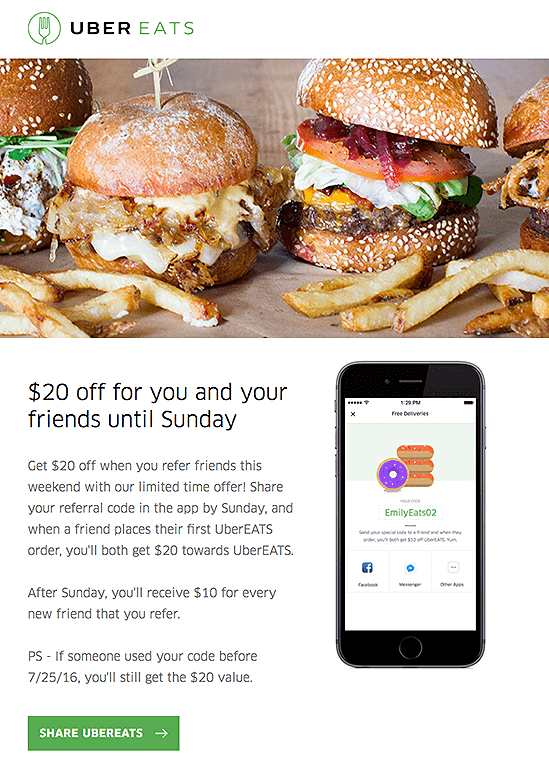
Uber Eats effectively uses email to promote its referral program with a clear call-to-action and benefit-driven copy.
8 examples of a great referral program with gamification
TL;DR: In 2026, a referral program with gamification is no longer optional, it's a performance driver. Recent data shows that gamified engagement can trigger a 54% increase in trial usage and a 3x boost in purchase frequency. By using badges, progress bars, and leaderboards, brands like Bake and Harry’s transform standard word-of-mouth into a high-conversion engine that increases monthly active users by up to 62%.
Badges and achievements
Integrating badges into your referral program with gamification is a proven way to boost long-term retention. In our experience, these digital markers of status do more than just look good; they provide the dopamine hits necessary to sustain user interest. According to 2025 industry reports from dacadoo, implementing achievement-triggered campaigns and digital wallets can lead to a 62% increase in monthly active users and a 71% boost in monthly engagement.
Badges can be used in multiple ways. They motivate users to reach referral milestones and can be combined with other rewards, like discounts or coupons, creating a tiered sense of accomplishment.
#1 Bake’s badge system fuels engagement and motivates customers with growing commissions
A crypto exchange and investment platform Bake (known as Cake in the past), boasts a great referral program with gamification. Bake incorporates four referral progress badges, based on the amount of friends that were referred by the customer. This boosts user motivation and enhances the visual appeal of achieving these milestones. What’s more, with each badge, users receive a larger percentage of Bake's commission from their friends' investments they receive!

Bake's referral program uses a badge system to visually represent a user's progress and increase their commission rate with each milestone.
#2 Mailchimp's badge offers broader access to connections
The process of Mailchimp’s customer referral program with gamification is elegantly simple: all their customers have to do is flaunt a referral badge in their emails! When someone clicks on the badge and signs up for the service, both the advocate and the new subscriber receive account credits or discounts. This CMS uniquely integrates badges into the product's core utility, streamlining the user acquisition process and strengthening brand advocacy through passive discovery.

Mailchimp's simple badge system turns every email into a potential referral, rewarding both the sender and the new subscriber.
Want to implement badges to your referral program today? Book a session with StriveCloud, and ensure a smooth gamification integration!
Referral progress bars
A progress bar in a referral program with gamification provides the "Goal Gradient Effect," where users accelerate their efforts as they get closer to a reward. Research shows that this type of visual engagement is highly effective; companies that integrate these mechanics into customer engagement efforts see a 54% increase in trial usage and a 15% uptick in buy clicks. This illusion of growth nudges users to participate more frequently to "complete" their journey.
#3 Harry's referral progress bar visualizes rewards and encourages user engagement
Harry’s, the New York-based grooming company, redefined the referral program with gamification by using a progress bar to visualize tiered rewards. From receiving shave cream at five referrals to unlocking a year's supply of free blades at 50 referrals, users saw exactly how close they were to the next "level." By launching this visually driven program, the company successfully gathered 100,000 referrals in the first week!

Harry's famous referral campaign used a progress bar to clearly visualize the tiered rewards, motivating users to reach the next milestone.
#4 Morning Brew’s progress bar motivates users with small nudges
Morning Brew used a referral program with gamification to turn a daily newsletter into a community. Their progress bar incentivized readers to share the Brew by providing constant nudges toward becoming a "Morning Brew Insider." In our experience, this "loyalty proof" mechanic is vital for community building. It contributed significantly to Morning Brew reaching an audience of over 1.5 million loyal subscribers.

This example from Morning Brew shows how a progress bar can motivate loyal users to share content and earn exclusive status.
Leaderboards
Adding a leaderboard to your referral program with gamification is the fastest way to instill a sense of healthy competition. Recent data indicates that competitive gamification banners can achieve an 18% higher sales conversion compared to standard control groups. Furthermore, gamified campaigns tied to major events have seen a 44% increase in sales conversions, proving that the desire to "win" is a powerful purchase driver.
Customers love to see where they stand on a referral leaderboard. The social proof and desire to be at the top of the game motivates them to acquire as many referrals as possible to secure their rank.
#5 Swissborg raized funds and motivated users to participate in their referral program through leaderboards
Swissborg, a Swiss fintech platform, utilized a referral program with gamification to amplify their Series A funding. The company offered tiered rewards including luxury watches to those at the top of the leaderboard. This competitive structure was highly effective: Swissborg’s campaign attracted 16,660 investors and generated over 1 million app users through viral social competition.

Swissborg structured its referral program around a competitive leaderboard, offering significant rewards for top performers to drive massive participation.
#6 Prezi launched a leaderboard referral program to expand its community
The presentation software Prezi created a high-stakes tournament to expand its audience using a referral program with gamification. While every referee got a free month, the top referrers on the leaderboard competed for cash prizes of up to $5,000. This campaign successfully incentivized power users to become brand ambassadors, helping Prezi advance its market share against established competitors like PowerPoint by leveraging the community's competitive spirit.

Prezi's referral leaderboard offered substantial cash prizes to the top referrers, creating a high-stakes competition to drive community growth.
Points
In a modern referral program with gamification, points serve as a versatile internal currency that drives repeat behavior. According to research by limango, purchase frequency challenges within points-based programs can lead to a 3x increase in purchase frequency. Furthermore, brands are seeing an 11% growth in average transaction value and a 21% increase in total transactions when points are tied to specific referral milestones.
#7 Automotive company Lucid gives users points to exchange for high-end rewards
Lucid, the luxury electric car company, employs a referral program with gamification to bridge the gap between digital engagement and physical luxury. By referring friends, users earn points redeemable for high-end rewards like factory visits or branded leather goods. Because a vehicle purchase is a high-consideration event, Lucid uses these points to keep the brand top-of-mind, demonstrating how gamification can work even for premium, high-ticket items.

Lucid's referral program uses a points system that allows users to redeem high-value, exclusive rewards, fitting its luxury brand identity.
#8 PC Financial has exchangeable points that can be used for groceries or even pharmacy products
PC Financial, a Canadian financial service, integrates its referral program with gamification into the everyday lives of its users. By rewarding referrals with points that can be spent on groceries or retail items via the President’s Choice brand, they make the rewards feel immediate and practical. This integration ensures that the referral program remains relevant to a broad audience, turning everyday spending into a gamified opportunity for savings.

This example from PC Financial shows how points can be tied to everyday spending, making the rewards feel practical and accessible.
We envision what your gamified referral program needs. Start with our free demo!
FAQs: Mastering Your Referral Program with Gamification
TL;DR: A referral program with gamification transforms passive sharing into an active competition. By 2026, data-driven brands are seeing a 54% increase in trial usage and a 15% uptick in buy clicks by integrating game mechanics into their customer engagement efforts. Success requires clear KPIs, tiered rewards, and seamless automation to keep users motivated and moving through the referral funnel.
What is gamification exactly?
Gamification is the strategic integration of game-design elements and psychological principles into non-game environments, such as your referral program with gamification. In our experience, it goes far beyond simple points; it taps into human desires for status and achievement. High-performing platforms in 2026 now leverage achievement-triggered campaigns and digital wallets to drive a 62% increase in monthly active users and a 71% boost in monthly engagement.
How does gamification improve your customer referral program?
Gamification significantly boosts the ROI of a referral program with gamification by reducing friction and increasing the "fun" factor of advocacy. Recent A/B testing reveals that gamified banners achieve an 18% higher sales conversion compared to traditional static referral prompts. By turning the act of sharing into a challenge such as a "European Championship" themed campaign businesses have seen sales conversions spike by 44% during the promotional period compared to baseline months.
What are the steps to crafting a great referral program?
To build a high-converting referral program with gamification, we recommend a data-first approach. Companies that implement purchase frequency challenges within their programs have seen a 3x increase in purchase frequency. Follow these updated steps for 2026:
- Identify which KPIs are going to determine your progress: Focus on referral velocity and viral coefficient.
- Establish the rewards structure: Use tiers to encourage long-term participation.
- Decide on your referral program type and design: Incorporate progress bars and leaderboards to drive urgency.
- Get a versatile referral program software: Ensure it supports real-time achievement triggers and digital wallets.
- Advertize your referral system: Use gamified banners to achieve that 18% conversion lift seen in leading industry benchmarks.
Keep reading
.avif)
Related Posts

Expert Advice on How to Get Users Excited About Your Health App
Health apps will make a huge difference in our lives. Next to giving patients more autonomous treatment, it will help to improve general health. With fitness trackers, calorie trackers, or even medication reminders, everyone will get a personal health assistant on their phone. The only problem? Low user motivation and a shortage of data. When people aren't engaged enough, they won't get as much value from the app. Luckily, gamification can shift the tides. Check out the full post to find out how!
How Better Experiences Will Be the Most Powerful Move for Banks
The sudden uptick in app engagement and digital adoption forced banks to quickly adapt in a world with few physical interactions. With digital transactions up by 20%, banks needed to step up their game to create a better digital customer experience. That's where gamification for apps helps to build a cohesive customer experience that drives customer loyalty. Check out the full article to discover how gamification will turn the banking industry upside down.