
The Truth About Killed Apps and How to Avoid Their Mistakes



What is the main blocker inhibiting your app from becoming successful? Low user app engagement. This remains the primary reason behind killed apps, ending every product manager’s dream: to build a product that gets users hooked. TL;DR: In 2026, the threshold for survival is incredibly high. With approximately 120,000 apps released monthly across major app stores, avoiding the graveyard requires a shift from broad acquisition to hyper-focused early-stage retention and solving a friction point within the first session.
Unfortunately, the reality behind killed apps is that it’s harder than ever to captivate user attention. In 2026, the global mobile application market reached $378 billion, indicating strong overall market growth despite individual app failures. However, this masks a critical reality: daily app downloads average roughly 860 million worldwide, with significant concentration among top performers. People are simply not actively using your products if they don't immediately see value. There are too many options out there, and if your user isn’t satisfied immediately, they won’t hesitate long before they leave your app for good.

This graph illustrates the typical steep drop-off in user retention that leads to killed apps, highlighting the 2026 reality where a substantial percentage of users uninstall an app within just 30 days of the first download. In our experience, failing to bridge the gap between "first open" and "habitual use" is where most products lose their momentum, leading to app failures.
In 2026, you need to differentiate more than ever to survive market consolidation. More tellingly, the Apple App Store saw 557,000 new apps in 2025, a 24% increase from the previous year, while Google Play experienced a 75% decline in monthly releases since 2022 due to aggressive removal of "low-utility" apps. This indicates that app failure (removal from stores) remains a significant phenomenon. To help you create a better vision for your product, we have analyzed the common patterns that lead to killed apps and why they failed.
Here’s what you will learn more about:
- Lack of engagement
- Focus on features VS users
- Prioritizing growth over retention
- Confusing the customer with poor UX
- Falling in love with the product instead of the problem
- Lack of promotion
- How to build an app that hooks people instantly
- Wrap-up
Lack of engagement
Google remains a dominant force among the big five technology companies, but its history is littered with "killed apps" that failed to capture the market's attention. In our experience, even a massive parent company cannot save a product if it fails to convert downloads into daily habits—a challenge that has intensified as of 2026. TL;DR: Apps (a primary keyword here) are most frequently discontinued when they fail to solve a core problem, leading to terminal low engagement; currently, 71% of users churn within 90 days if the value proposition isn't immediate.
The most famous example of an app Killed by Google is their attempt to build a social media platform with Google+. Despite the massive integration with other services, it serves as a cautionary tale for modern developers regarding the "ghost town" effect.
Many factors led to the project’s decline, but the root cause was a fundamental lack of engagement. Google+ had almost no active users; in fact, 90% of the users spent less than five seconds on the platform. This struggle mirrors broader market trends seen in 2025, where the phenomenon of "low-utility" apps is leading to a significant market correction, with Google Play experiencing a 75% decline in monthly app releases since 2022 due to aggressive removals of underperforming applications.
Even with over 200 million registered users, the app engagement was simply too low to justify continued investment. This lack of stickiness is fatal in the current landscape: 2026 data indicates that approximately 120,000 apps are released monthly across Google Play and Apple App Store combined, intensifying the competition for user attention and making sustained engagement incredibly difficult. After eight years of attempting to pivot and increase retention, Google officially closed the platform, proving that even the largest marketing budgets cannot overcome a lack of meaningful user activity.
Focus on features VS users in killed apps
TL;DR: Many killed apps fail because they prioritize experimental feature pivots over the core value that initially attracted their audience. In our experience, failing to stabilize the user experience leads to a significant churn rate, highlighted by the fact that approximately 120,000 apps are released monthly across major app stores, yet very few achieve lasting success. The market demands a clear, consistent value proposition.
Yik Yak was a social app where you could post an anonymous message to anyone within a 5-mile radius. The app quickly became popular in schools and colleges to share gossip, updates, or events. However, it eventually joined the ranks of killed apps after failing to balance platform safety with the original appeal of its service.
After strong user growth, the app faced significant legal pressure due to cyberbullying. In an attempt to save the brand, the startup was forced to make changes that alienated its base. According to recent 2026 industry benchmarks from retention studies, a staggering 28% of users uninstall apps within the first 30 days. By cutting off its core underage demographic and adding friction, Yik Yak saw these churn numbers reach unsustainable levels.
The final blow came when Yik Yak abandoned their core feature of anonymity. This pivot led to a rapid user exodus, a trend mirrored in current 2026 data where the average app sees a significant drop-off if its primary utility is diluted. This reflects a broader trend: despite the global mobile application market reaching $378 billion in 2026, success is highly concentrated among apps that maintain their core value and user experience, rather than chasing elusive feature pivots.
The truth about killed apps: Prioritizing growth over retention
TL;DR: The truth about killed apps is that rapid user acquisition is meaningless without long-term retention. In 2026, data shows that app developers failing to stabilize churn before scaling leads to an "app death spiral" where acquisition costs permanently outweigh user value.
Once upon a time, there was a crowdfunding platform named Tilt, designed to help users gather funds for projects or events like book launches or birthday celebrations. Its operational model was straightforward: money would only be collected and distributed if a predetermined financial goal set by the community was achieved.
Launched in 2012 as part of the esteemed Silicon Valley accelerator Y Combinator, Tilt rapidly garnered attention. However, looking at the app market in 2026, Tilt’s journey serves as a stark warning. While they initially captured user attention, they ultimately lost the battle for long-term sustainability. This story is particularly relevant today when approximately 120,000 apps are released monthly across Google Play and Apple App Store combined, intensifying the competition for user retention.

Tilt's intense focus on user acquisition without an equivalent emphasis on retention is a critical lesson for any app looking to avoid the fate of killed apps; even with a clean interface, a sustainable model requires keeping users engaged long-term. In our experience, many founders mistake "virality" for "product-market fit." Current 2026 industry benchmarks from authoritative mobile reports indicate that a significant percentage of users now churn within 90 days of download, highlighting the challenges apps face in retaining their audience. Tilt encountered this challenge early, expending considerable capital to acquire users who ultimately lacked a long-term incentive to remain with the platform. This echoes the broader trend that while the global mobile application market reached $378 billion in 2026, success is increasingly concentrated among top performers, making retention more crucial than ever.
The management team at Tilt eventually revealed a lack of focus on revenue. Operating with a predominantly free user experience, Tilt soon faced mounting payment processing fees. They also heavily invested in paid acquisition, a strategy that rewarded new customers at a cost greater than the profit they generated. Their failing was not prioritizing an enhanced user experience that would foster long-term engagement. This situation reflects a 2025-2026 trend where, even with daily app downloads averaging roughly 860 million worldwide, the market no longer rewards "growth at all costs." Instead, long-term success hinges on robust engagement and sustainable monetization strategies.
Ultimately, Tilt struggled to compete with established players like Venmo, GoFundMe, Kickstarter, and Eventbrite. In an "acquire-hire" deal that saw Airbnb acquire Tilt for approximately $12 million, investors faced an estimated 80% loss on their initial investment, solidifying Tilt's place in the history of killed apps and serving as a poignant reminder of the importance of sustainable business models over pure growth.
How confusing UX creates killed apps
TL;DR: Many killed apps fail due to "market-parity delusion"—the mistake of exporting a successful model without adjusting for local UX friction. With 2026 churn rates reaching 71% by day 90 for many apps, failing to align supply-side tools with regional user behavior is a fatal error.
Hailo is a prime example of how even high-growth platforms join the graveyard of killed apps. Their platform matched passengers and drivers via a mobile interface. After facilitating over 3 million rides in London and gaining 2.5 million users, they expanded to New York expecting to replicate those numbers instantly.
The problem, however, is that New York and London are two entirely different cities. In an attempt to capture the lower-end market, Hailo failed on the supply side. They partnered with yellow cab drivers in New York, assuming their driving needs and digital habits mirrored those of London’s black cab drivers.
This assumption was false. An oversimplified UX and technical payment issues led to a quick demise. In our experience, failing to localize the supply-side workflow results in massive service failure. Hailo experienced an 80% rejection rate on orders within the app.
Current market data confirms this risk: 2026 research indicates that approximately 28% of users uninstall apps within 30 days when the core utility is blocked by UX friction. Ultimately, Hailo abandoned North America to focus on other regions, highlighting that even significant capital cannot save a product from poor localization and supply-side neglect.
Falling in love with the product instead of the problem: A recipe for killed apps
TL;DR: Many killed apps are the result of "feature-blindness," where founders prioritize engineering and product development over understanding genuine market demand and aggressive user acquisition. To succeed in 2026, avoiding app failure requires a fundamental shift from product-centricity to a deep understanding of user problems and robust go-to-market strategies. With approximately 120,000 new apps released monthly across major app stores, "build it and they will come" is a dangerous fallacy, and securing user adoption is more challenging than ever.
Consider the cautionary tale of many early-era apps that focused heavily on innovative technology without matching market needs. These apps, much like the original story of Everpix attempting to organize muddled photo albums, often stumbled because their brilliant engineering wasn't met with sufficient user acquisition or a viable business model.
A significant reason for app failure is poor budget management and an overemphasis on product development at the expense of user acquisition and marketing. The team invests almost all efforts in building the perfect product, neglecting to acquire new users and build traction necessary for sustained growth. In our experience working with countless startups, this is frequently the primary reason avoiding app failure becomes such a challenge; founders fall in love with the solution rather than deeply understanding and responding to the user’s evolving habits and market demands.
In today's landscape, the stakes are even higher. The global mobile application market reached an impressive $378 billion in 2026, indicating strong overall market growth. However, this success is heavily concentrated among top performers. Daily app downloads average roughly 860 million worldwide, yet only a small percentage of apps capture the lion's share of these downloads. This intensifying competition means that killed apps in 2026 are rarely "bad" products in terms of functionality; they are simply products that ran out of capital or momentum before they could break through the immense noise of saturated app stores.
Lack of promotion: Why even innovative apps become killed apps
TL;DR: Even the most innovative software becomes one of many killed apps if it lacks a clear promotional strategy and accessible onboarding. In 2026, with an average of 860 million app downloads daily worldwide, competition for user attention is intense. A lack of promotion is no longer just a marketing hurdle; it’s a death sentence for product growth.
Let’s examine a classic Google example. Google Wave was a real-time collaboration tool that was eventually shuttered because it failed to bridge the gap between "cool tech" and "useful product." The primary reason for its failure was a fundamental lack of promotion tailored to the average user. By keeping the service invite-only and featuring an onboarding video over an hour long, Google effectively locked out the non-techies who drive mass-market adoption. This poor positioning makes it impossible to scale.
In our experience, an effective promotional strategy isn't just about getting downloads, but about securing active, engaged users. While the global mobile application market reached $378 billion in 2026, signaling vast potential, capturing a share requires deliberate outreach beyond initial release. Without "power users" or a robust notification system to sustain engagement, Google Wave was disbanded after just three years—a victim of its own complexity and a lack of promotion to the right audience, demonstrating a common mistake that leads to killed apps.
How to avoid being one of the killed apps: Building a product that hooks people instantly
To prevent your product from joining the growing graveyard of killed apps, you must secure user loyalty within the first session. TL;DR: Success in 2026 requires slashing the 71% average 90-day churn rate by implementing behavior-driven loops that prioritize engagement over simple acquisition. In our experience, high-growth products fail not because of poor ideas, but because they lack a cohesive user journey that provides immediate, repeatable value.
The global mobile application market reached $378 billion in 2026, indicating strong overall growth despite individual failures. However, this masks a critical reality: approximately 120,000 apps are released monthly across Google Play and Apple App Store combined, intensifying the battle for user attention. While the market grows, success becomes increasingly concentrated. Many killed apps lose momentum because they don't bridge the gap between a download and a habit. StriveCloud’s plug-in gamification tool is specifically built to solve this. Customers using our platform have seen a 58% increase in daily active users (DAU) by transforming stagnant interfaces into interactive experiences.
With our tool, you can gamify any data point to influence user behavior and slash churn before it settles in. In StriveCloud’s partnership with the esports platform Kayzr, for example, we addressed the engagement gaps that lead to killed apps. By implementing milestone-based rewards, churn dropped by 23% without any increase in retention costs. This strategy ensures your product doesn't just guide users to the next step, but actively motivates them to return daily.
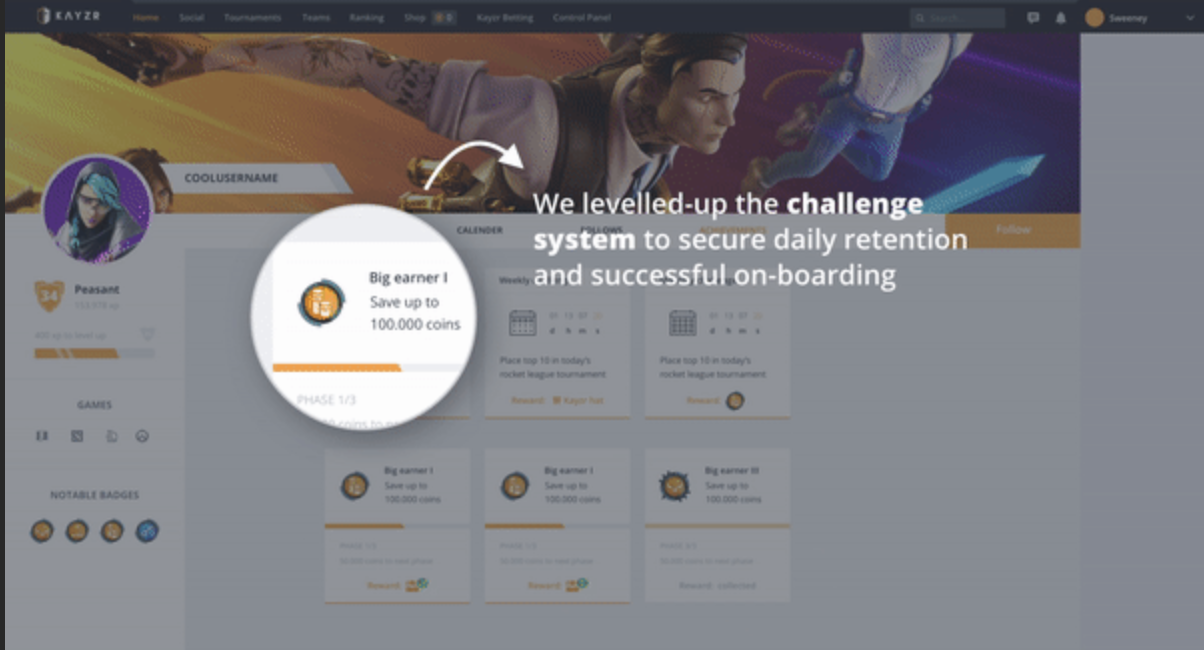
This animated example from the Kayzr platform demonstrates how gamification elements like progress bars and rewards can effectively increase user activity and prevent the engagement death spiral common among killed apps.
Case Study: How our gamification tool helped Kayzr grow its userbase by 350% and avoid the fate of killed apps!
Wrap-up: Avoiding the Fate of Killed Apps
TL;DR: The history of killed apps shows that high acquisition never compensates for poor retention. In 2026, the benchmark for success has shifted from total downloads to long-term "stickiness." To avoid closure, developers must bridge the gap between initial install and the critical 90-day churn window, where 71% of users are typically lost. Daily app downloads average roughly 860 million worldwide, yet success is highly concentrated, making retention an even greater challenge.
Low app engagement is not just a challenge for startup apps. What we learned today is: even the great apps can fall if they can’t engage users with a cohesive and ‘sticky’ experience. In our experience, failing to adapt to shifting market saturation is a death sentence; notably, while the global mobile application market reached $378 billion in 2026, approximately 120,000 apps are released monthly across Google Play and Apple App Store combined, underscoring intense competition and increasing user selectivity.
Companies like Google actively seek out failure to learn from. So let’s do the same to ensure your project doesn't join the list of killed app
There are tons of other lessons to learn from these killed apps. In our experience, the most resilient products in 2026 are those that treat retention as a product feature rather than a marketing goal. If you would like to see more content like this, let us know!
How to build products people want to use, over and over again? Learn how we help global brands hook users!
.avif)
Related Posts

How Fitness App SWEAT Beat the Trends to Sell for $400 Million
In July 2021 fitness app SWEAT sold for a whopping $400 million after just 4 years. How did two fitness influencers manage to do this? The SWEAT app is built to drive up user motivation to keep fitness fun and engaging. They leverage gamification tactics like leaderboards, trophies, and a progress tracker with a unique twist. Find out more inside the article!