

How Does Gamification Drive Engagement?



This graphic illustrates how gamification principles can be applied to drive user engagement and achieve business goals.
In this article you will learn about:
- How organizations with gamified loyalty programs see a 22% increase in customer retention, driving repeat purchases and strengthening brand loyalty.
- How gamified platforms in finance use predictive analytics and game design to create engaging user journeys that align with business outcomes like increased product adoption and retention.
- How companies integrating gamification into customer engagement achieved a 54% increase in trial usage and 15% uptick in buy clicks, applicable to consumer-facing sectors like electronics.
- How PUMA saw a 231% uplift in lead submissions with gamified onsite engagement, demonstrating amplified interactions like sharing and discovery in branded campaigns.
- How limango's gamified loyalty program achieved a 3x increase in purchase frequency through challenges, boosting overall customer engagement.
Why is engagement so important?
On the opposite side customer engagement leads to more sales, higher retention and referrals. An analysis found that organizations with gamified loyalty programs see a 22% increase in customer retention, driving repeat purchases and strengthening brand loyalty. Gamification boosts user engagement by 100%-150% compared to traditional approaches, leading to higher profits and improved sales performance. The power of fully engaged customers show an array of positive results across different industries.
- In retail banking, gamified platforms use predictive analytics and game design to create engaging user journeys that align with business outcomes like increased product adoption and retention.
- The consumer electronics industry showed a 54% increase in trial usage and a 15% uptick in buy clicks through companies integrating gamification into customer engagement.
Customer engagement strategies have a big impact on apps and digital products as well. Nir Eyal, author of the book Hooked How to build habit-forming products created the Hook Model to show how successful platforms such as Facebook succeeded into making their product a part of our daily lives. Illustrating a similar pattern in gamification for apps.
User engagement for apps is important because it is directly linked to overall revenue and profitability. Highly engaged users are more likely to return and share your app with friends. Thus, the right user engagement strategies can lead to a reduced mobile app churn rate, an increase in the number of active users or time spent on your app, and user growth through referrals.
How can gamification drive engagement?
Gamification can be implemented in customer and employee engagement strategies to solve the key challenge of acquisition and retention. Gamifying an experience does not equal creating a game to engage customers. It is about applying game-like mechanisms to a non-game context, to encourage your target audience to carry out certain behaviors and can be used in customer and employee engagement strategies.
Businesses use gamification to work toward their business goals. By integrating gamification and engagement strategies, companies create a captivating user journey that drives desired behaviors and supports key business goals. Game mechanics can be leveraged to encourage users to stay engaged and motivated, making it easier to achieve success at every stage of the journey. Certainly, the best plan for behavior change includes gamification. When companies implement gamification features such as badges and prizes, they nudge customers toward positive behaviors, due to the expectation of an award at the end. Eventually these behaviors become habits, resulting in sustainable engagement.
How to get started with gamification? Get a free consultation today and we’ll show you what steps to take!
#1 Gamification for training
Enterprises like Salesforce and Deloitte employ gamification in their employee engagement strategies to tackle the challenge of engagement. Deloitte gamified their leadership training program with a series of gamified elements such as an employee badge, leaderboards and status symbols. By doing this time to certification for participants reduced by 50 percent.
#2 Gamification for marketing
Luckily these game mechanisms also serve marketing goals for all kinds of industries. This can be proven by several examples of company digital marketing strategies that employ gamification in their media. According to recent results from brands like PUMA, gamifying onsite engagement boosted lead submissions by 231%, demonstrating amplified interactions like sharing and discovery in branded campaigns! Research also shows that gamification boosts user engagement by 100% to 150% compared to traditional approaches, leading to higher profits and improved sales performance.
#3 Gamification for apps
Gamification is used to attract new potential customers and retain existing customers by keeping them actively engaged. Using gamification for customer engagement strategies resulted in a 54% increase in trial usage and a 15% uptick in buy clicks.
So customer engagement impacts profitability, and if done right, it drives revenue.
Add a little fun to your mobile app, without all the development struggles? Check out StriveCloud's App Gamification Software!
The psychology behind gamification and engagement strategies
What is it about games or gamified apps that makes us want to keep using them? Multiple reasons are given for this technology craze. In a way, we are addicted to dopamine hits and are using our phones to satisfy our constant need for instant gratification. That is partially correct, although other neurotransmitters such as oxytocin, serotonin and endorphins also come into play when implementing gamification in your employee or customer engagement strategies.
In regards to engagement people get motivated on two different levels. On one hand, we have extrinsic motivation, where we are motivated to do something because of the external reward we will be achieving. Extrinsic motivators are often established through gamification in the form of points, milestones, achievements, rewards or notifications.
Most existing reward systems today are built on extrinsic motivators. For example when you need to complete a task in order to get paid. External rewards are a good initial motivator however, once it is overused the effects tend to be lost. Once someone starts to focus too much on the external rewards they often lose initial engagement, this is called the Overjustification effect.
Where does true motivation come from?
On the other hand, we have intrinsic motivation. This is when we gain rewards internally because the activity in itself is rewarding and fun. The self-determination theory by Deci and Ryan is a theory concerning innate psychological needs. It shows the motivations behind choices we make. Our three most basic psychological needs are:
#1 Competence
This recognizes our need of wanting to be in control of things. It also explains why we enjoy discovering new skills and practicing them to eventually achieve mastery.
#2 Relatability
Humans are social animals! We like interactions with each other and to feel and be connected with others, showing and experiencing genuine care.
#3 Autonomy
Again showcasing our strong will to be in control of our own journey and life decisions.
Intrinsic motivators include relationships such as competition, collaboration and community feeling, the feeling of accomplishment through progress, achievement and collection, empowerment through autonomy and feedback, unpredictability through surprise, exploration and scarcity and lastly constraints through scarcity, loss and avoidance.
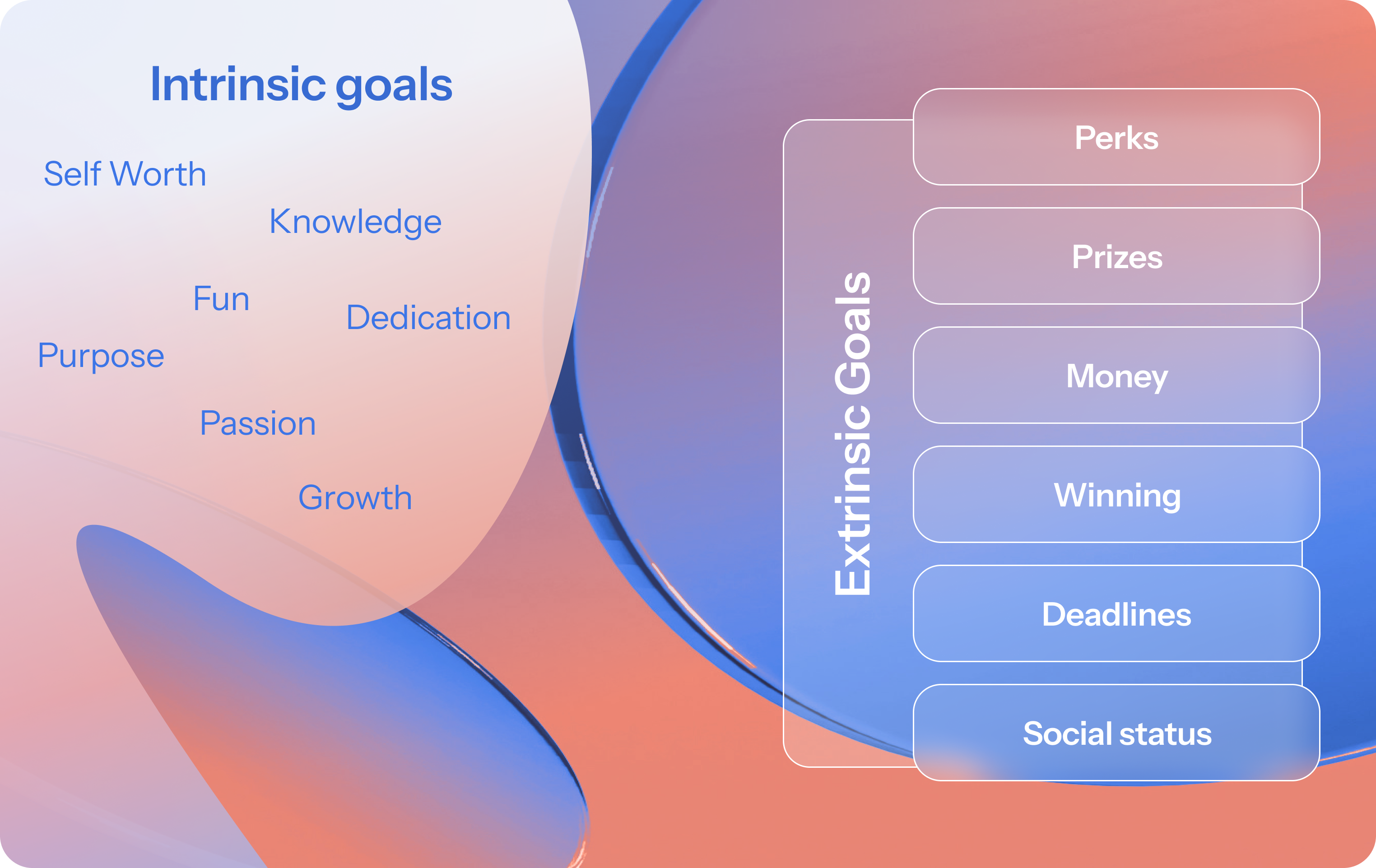
This diagram contrasts intrinsic motivators like passion and purpose with extrinsic motivators like money and social status, both of which are key in gamification design.
Looking to drive user motivation on your app? Check out our App Gamification Platform!
Measuring the impact of gamification on employee and customer engagement strategies
Before you are trying to add gamification to your business strategy, you need to be clear on what your business goals are and how adding game mechanisms will help you achieve those goals. You can do this by identifying the actions and behaviors you want your target audience to take.
Think about how their actions might affect you. If you want to get more organic traffic to your website you might want existing customers to share your social posts more. If you want to foster brand affinity, you might want customers to refer their friends and repeatedly interact with your product.
The same principles also help for retaining customers. Let’s say you want to increase the retention rate after your free trial. In the case of customer engagement strategies you will probably want to motivate actions such as:
- Number of sign-ups after trial
- Sharing your social media posts
- Liking your social media posts
- Following your pages
Engagement metrics to help you track your efforts
Along with the right goals it’s important to have the right metrics in place. Therefore you need KPI’s (Key Performance Indicators) to help you measure success. These indicators refer back to the previously stated goals, for example:
- Retention rate after trial
- Retention rate per cohort
- Number of shares
- The amount of likes
- Total number of followers
Examples of gamification in employee and customer engagement strategies
#1 SAP’s Roadwarrior sales training game
The gamification market is valued at $19.42 billion and is projected to reach $92.5 billion by 2030, driven by organizations adopting gamification for training and incentive programs to transform business operations. SAP already put this to practice in multiple internal programs such as their SAP’s Roadwarrior sales training game (a program based on Who Wants to be a Millionaire). It was developed to help sales people study new product offerings so that they could better serve customers with their knowledge.
Their program utilizes multiple game mechanisms like badges, leaderboards and even battles on who has the most product knowledge among sales people. This interactive and gamified system sparks employee engagement and helps ensure that 83% of employees feel motivated by their training, compared to only 39% in traditional methods.
#2 LinkedIn progress bar
Apps often use gamification elements to create a more playful experience for users. Mobile advertizing platform App Samurai states that gamification in apps encourages users to share information about the product with others. A great example on how gamification inspires app usage is the progress bar LinkedIn uses to show your profile strength. It reinforces feedback to the user who might enjoy seeing the bar being completed and therefore will put more work into polishing off his or her profile.

The LinkedIn profile strength bar is a classic example of using a progress tracker to motivate users to complete their profiles.
#3 OpenText leaderboard
Well designed gamification experiences increase user acquisition and drive loyalty. Gamification enables word of mouth promotion and encourages social sharing by offering new experiences. OpenText, a company operating in Enterprise Information Management, achieved a 100%-150% boost in user engagement compared to traditional approaches only by implementing a leaderboard. After a couple of weeks of beta testing the IT level of active participation was well above 60%.
The 4 stages of a gamified experience
In every gamified experience you will go through these 4 stages. Every stage represents a different point in the decision making process and thus will have different content needs. The way you design the experience depends on your business goals. For instance implementing gamification for apps, using gamification for marketing or leveraging gamification for training have different goals and uses.
#1 Discovery
In the discovery phase people come across your offering for the first time. When you first hear about a product you want to understand the core value proposition to see what’s in it for you. That way you can decide if it’s something worth checking out.
#2 Onboarding
During the onboarding stage you are first getting to know the system. The goal of your users here is to feel welcome, to learn how everything works and to achieve small goals. It’s important to have a great first experience so that you will want to keep coming back.
#3 Habit building
In the habit building stage you are a regular user of the game. You want to see new content, try out new activities and expand on your previous actions. As a habit builder you want to get satisfaction out of your game by achieving a desired goal.
#4 Mastery
In the last stage of the process you mastered the gamified system meaning you learned everything there is to do in the app. Your goal is to earn more privileges and rewards or get through to limited access facilities. To keep your masters, which are also your biggest fans you need to include exclusive triggers.
FAQ
Why should you use gamification for your app?
Using gamification for apps increases user usage and adoption rate and often makes your product more habit-forming.
How does psychology explain the effectiveness of gamification?
Games and gamified apps keep us engaged by providing instant gratification and frequent dopamine hits, along with other neurotransmitters like oxytocin, serotonin, and endorphins. They leverage both extrinsic motivation through rewards like points and achievements, and intrinsic motivation by fulfilling our internal desires for mastery, autonomy, and purpose.
Which engagement metrics are best for tracking results?
That depends on your goal. If, say, you wish the user would spend more time on your app, session length is appropriate. Always look at your objective first and then start from there.
Keep reading
.avif)
Related Posts


How to Retain the Gen Z Users and What Every Fintech App Needs to Know
1 in 3 Gen Z members will not purchase a product or service without being personally recommended it by a friend. Knowing this, user retention among young customers has never been so important! Fintech is turning to gamification examples like leaderboards and point systems to keep young people involved, and for many apps it is working.