

The Promo-Ride Problem: Why Mobility Apps Pay Twice for the Same Rider


Every mobility operator knows this rider. They download the app because of a free first ride, take the trip, and it goes fine. Then they never open the app again.
A few weeks later, a new campaign brings them back in, and the operator pays to acquire the same person a second time. Multiply that across a city and you get the promo-ride problem: an acquisition budget that keeps buying first rides, and a retention strategy that never makes the second one happen.
Below: why it happens, why the second ride is the number that decides rider retention in a mobility app, and five mechanics that make it happen.
The math behind paying twice
Ride-hailing and micromobility apps lose new users fast. Similarweb's analysis of US Android usage put the 30-day retention of Uber at 5.8% and Lyft at 5.2% (Similarweb, July 2023). Those are the two best-known names in US ride-hailing. For some operators, the drop-off starts even earlier: a study of an e-moped sharing service in Stuttgart found that one in five customers abandoned the registration process before they could ride at all (Trautwein et al., 2025).
Now add the promo. A worked example, with round numbers:
- You pay €10 to acquire a rider, plus a €5 free first ride.
- Of 1,000 promo riders, 300 take a second ride within a month.
- That's €15,000 spent, and your real acquisition cost comes to €50 per rider who comes back, because 700 of those first rides bought nothing.
Raise the second-ride rate from 30% to 45% and the cost per returning rider drops to about €33, without changing a single ad. That's why rider retention belongs in the same conversation as CAC. Every rider who leaves after the promo has to be bought again, and acquisition costs climb even when your ad prices stay flat.
Why the second ride doesn't happen
The first ride is rarely the problem. The app works, the vehicle shows up, the trip is fine. What fails is everything around it.
Nothing continues after ride one. The trip ends, the receipt arrives, and the relationship is over. There's no progress to pick up, no goal half finished, nothing that makes the next trip part of something.
The promo trains price sensitivity. A free ride teaches people that this app is worth opening when it's free. When the promo ends, so does the reason. Riders who came for a discount leave for the next discount, often on the competitor's app parked on the same corner.
Every app looks the same between rides. A mobility app only gets opened when someone needs to go somewhere. On the days in between, it sits on the home screen next to three others with the same vehicles and similar prices. The operator that's remembered is the one that gave people a reason to open it when they weren't going anywhere.
Nobody's watching week one. Retention is often reviewed in a monthly cohort report. By the time that report shows the promo riders didn't come back, they decided weeks earlier.
The second ride is the real conversion
Marketing solves the first ride. The second ride is where a promo user turns into a regular, where the acquisition spend starts paying back, and where a habit either forms or doesn't.
That makes it a metric to manage week by week. Three numbers matter most:
- Second-ride rate: the share of new riders who take a second trip within 7 or 14 days.
- Time to second ride: how many days pass between trip one and trip two. The longer it gets, the less likely trip three becomes.
- Promo vs organic cohort: how riders acquired through a free ride compare with riders who paid for their first trip. If the promo cohort's second-ride rate is far lower, the promo is buying trials, not customers.
What a mobility app knows by ride three
Operators already have the data to tell a future regular from a one-off. By the third ride, the event data shows:
- When they ride: weekday mornings and evenings point to a commute; Saturday afternoons point to leisure.
- Where they ride: the same start and end points twice in one week is a route forming.
- How they came in: promo, referral or organic.
- How fast they came back: a second ride within two days after the promo ended is a very different signal from one after three weeks.
That's enough to make a decision per rider. If a new rider takes the same route twice in their first week, then offer them a commuter tier. If a rider only ever rides on a promo code, then stop spending retention budget on them. The data already exists in most mobility apps. What's usually missing is the system that acts on it while the rider is still in their first week.
Five mechanics that make the second ride happen
1. Start something on ride one that only ride two can finish
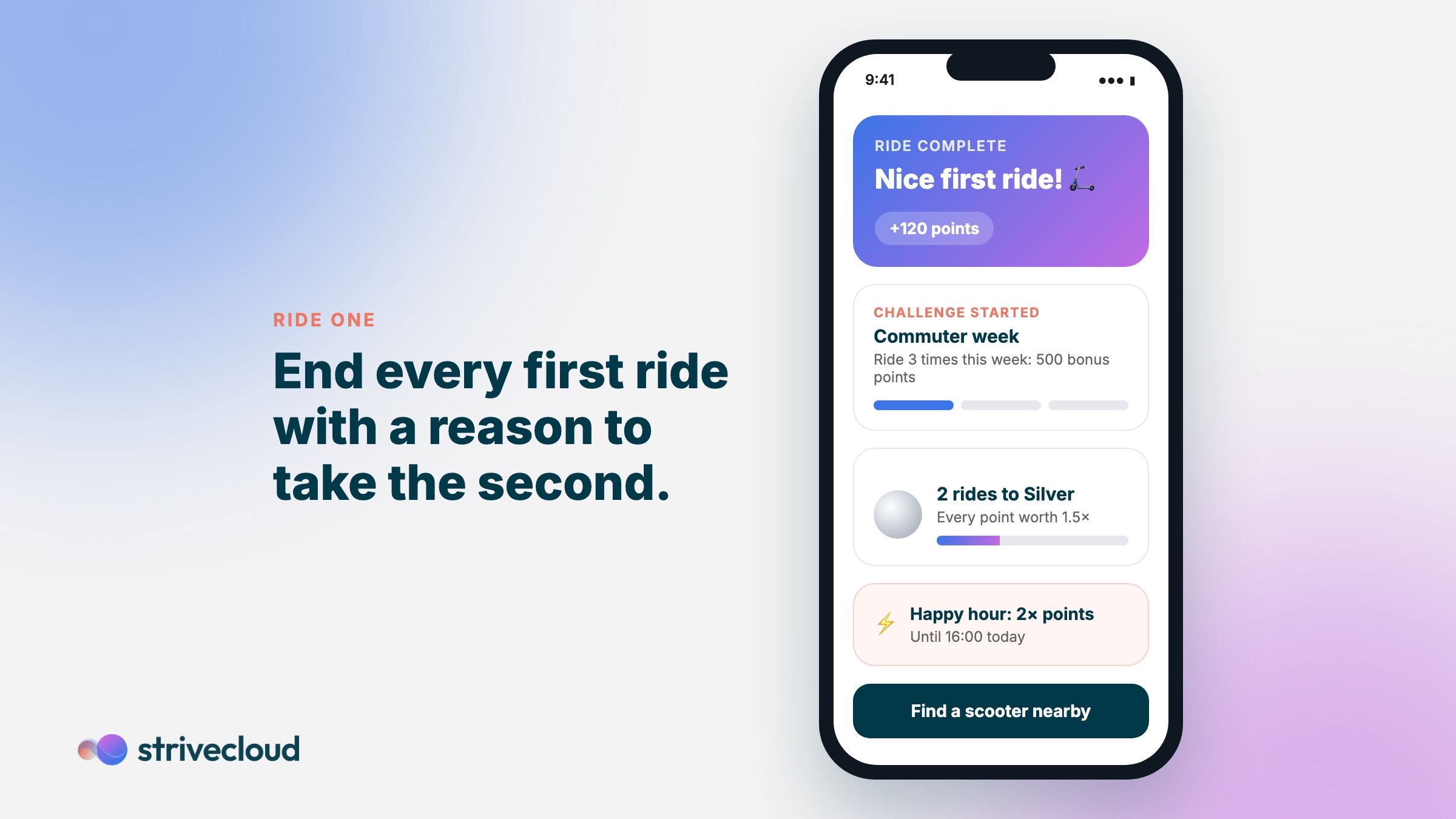
The simplest fix is continuity. Give the first trip a goal that carries over: a three-ride challenge, a distance milestone, a badge that unlocks on the second trip. The first ride should end with a reason to take another one.
2. Put a tier within reach
Loyalty tiers work best when the next level is close. A tier two rides away is a concrete reason to book; a tier fifty rides away is decoration. Make each step up raise the value of everything the rider earns after it, so the reward grows exactly when someone is turning from a trial user into a regular.
3. Reward the hours you need to fill
A shared vehicle only earns while it moves. Off-peak "happy hours", where every point counts double between the rush hours, push demand into the quiet parts of the day. Riders get more value, and the fleet gets used when it would otherwise stand still. It also gives a lapsed rider a timely reason to come back that isn't a discount.
4. Make rewards worth more than a discount
Discounts cost money on every ride, go to people who would have ridden anyway, and stop working the day they end. Rewards built on an in-app currency work differently. EVO Sharing introduced EvoCoins, earned for kilometres driven and ride packages purchased and redeemable for free driving minutes, alongside levels based on kilometres driven (EVO Sharing playbook). Unlike a lower rate, free minutes only pay out to people who keep riding.
Status works the same way. Waze doesn't pay drivers to report a crash, yet its map runs on driver reports, and every report earns points and a visible rank (Waze playbook). Status costs nothing to hand out and can't be bought, which is exactly what makes it worth protecting.
5. Give people a reason to open the app between rides
The days without a trip decide which app gets opened on the day with one. A branded mini-game, a weekly challenge or a community leaderboard keeps the app in use when nobody needs a ride, and every one of those sessions feeds the same rider profile and segments as a real trip.
Catch the riders who start to drift
Even with the right mechanics, some riders will slow down. The difference is whether you notice in time.
A rider whose trips go from four a week to one, who stopped opening notifications and hasn't claimed a reward they earned, is telling you something. Read separately, each signal looks like noise. Combined, they're a clear churn risk. Scoring every rider on signals like these, and triggering a win-back the moment the score climbs, turns retention from a monthly report into something you act on. The win-back works best when it uses the mechanic that rider has responded to before: a challenge for the one who finishes challenges, a tier nudge for the one who's two rides from the next level.
How to measure whether it's working
Track these per acquisition cohort, monthly:
- Second-ride rate (7 and 14 days): Whether ride one leads anywhere
- Median time to second ride: How fast the habit is forming
- Rides per rider in months 1, 2 and 3: Whether the habit holds after the novelty
- Cost per returning rider: The real CAC, after promo waste
- Off-peak share of rides: Whether incentives are moving demand where you need it
If second-ride rate goes up and cost per returning rider goes down, the acquisition budget is finally buying customers instead of trips.
Where StriveCloud fits
StriveCloud is retention infrastructure for B2C apps, including mobility operators. It runs the mechanics above as rules on live behavior: challenges, tiers, in-app currencies, rewards, happy hours and branded games, all triggered by what each rider actually does. Churn Predictor scores every user from 0 to 100 on 15 weighted behavioral signals, places them in one of 8 lifecycle stages, and starts the win-back automatically when risk climbs.
Your team sets the rules once. From there they run on every rider, and changing a campaign doesn't need a dev sprint.
See how it works for mobility apps: Gamification for mobility apps.
FAQ
What is the promo-ride problem?
The promo-ride problem is when a mobility app acquires riders with a free or discounted first ride, but most of them never take a second one. The operator pays full acquisition cost for a single trip and has to pay again to win the same rider back later.
What is a good second-ride rate for a mobility app?
There is no public benchmark that applies to every operator; it depends on city, vehicle type and promo design. The useful comparison is internal: track second-ride rate per acquisition cohort, and compare promo cohorts with organic ones. If the promo cohort returns far less often, the promo needs a follow-up mechanic, not a bigger budget.
How do you increase rider retention without discounts?
Give riders something to continue: challenges that start on the first ride, loyalty tiers within reach, in-app currency redeemable for free minutes, off-peak bonus hours and status that can't be bought. Then score riders on their behavior and trigger a win-back with the mechanic each rider has responded to before.
Why do riders churn after the first ride?
Usually because nothing connects the first trip to the next one. The promo ends, there's no progress to continue, and on the days in between the app looks the same as its competitors. Riders who came for a discount leave for the next discount.
Related Posts


The Truth About Consumer Decisions and How to Influence Them
Consumers shop differently in the 21st century. That's not a surprise, since there has never been more information available to base decisions on. Think With Google, the marketing insights institute from Google, carried out over 300,000 purchase simulations to to map out this decision-making journey. We'll take it a step further and show you how to guide the consumer journey, or as Google calls it "the messy middle" forward using gamification.