
Drive Product Adoption in 2026: 10+ Expert Tactics



Product adoption drives revenue, but in 2026, it is the ultimate boss fight for SaaS leaders. To drive product adoption effectively, you must reduce "time-to-value" through hyper-personalization. In our experience building engagement engines for over 400 companies, the most successful products bridge the gap between the initial "Aha!" moment and habit loops. As organizations now manage an average of 305 SaaS applications, with software costs rising 8% year-over-year, proving immediate utility is the only way to survive portfolio audits.
What is product adoption? It is the process of users discovering and fully embracing your product. Research shows 85% of organisations now automate at least one SaaS process to combat app complexity. At StriveCloud, we’ve found that using an engagement engine to create interactive user journeys can increase DAU by an average of 58%. Read on for our playbook of gamified user engagement tactics.
- What is product adoption?
- Why SaaS needs to drive product adoption
- What is the product adoption curve?
- 6 stages of every product adoption journey
- What drives product adoption? 4 biggest factors
- How do you measure product adoption?
- How to drive product adoption like a pro
- Kayzr Case Study: Gamified UX
- Build your gamified user journey
- FAQ
What is product adoption?
TL;DR: Product adoption is the transition from initial discovery to habitual usage. In a market where 85% of firms prioritize automation, success means moving users to a 35% activation rate within the first 14 days.
Product adoption tracks the lifecycle of a user from their first login to the moment they become a power user. To drive product adoption today, you must navigate a crowded ecosystem where the average enterprise manages 106 apps. In our experience, adoption isn't just a sign-up; it's the moment your product becomes a non-negotiable habit loop in the user's daily digital workflow.
Why SaaS needs to drive product adoption
TL;DR: With SaaS costs rising 8% annually, your product must automate workflows to avoid being flagged as redundant "shelfware" during procurement audits.
In 2026, the average organization manages 305 SaaS applications. App fatigue is real. If your product doesn't provide instant utility, it is deleted. At StriveCloud, we’ve seen that companies focusing on user retention examples from market leaders can justify their recurring seat by proving ROI through automated value delivery.
What is the product adoption curve?
TL;DR: Map your features to five user segments—Innovators to Laggards—to ensure your product resonates with the Early Majority, who control the bulk of enterprise budgets.
Knowing your position on the curve makes it easier to define your retention strategy. As costs rise, the Early Majority looks for consolidation. If 85% of companies prioritize automation, your curve-jumping strategy must highlight how your tool simplifies their existing stack.

6 stages of every product adoption journey
TL;DR: Guide users through a 6-stage funnel prioritizing immediate value. Shortening Time-to-Value (TTV) can decrease early churn by up to 23% based on our client data.
- Awareness: Stand out among 305 competing apps.
- Interest: Create a quest that leads to an "Aha!" moment.
- Evaluation: Prove ROI against 8% rising software costs.
- Trial: Demonstrate interoperability within an automated ecosystem.
- Activation: Speed is everything. Get the user to their first win fast.
- Adoption: Transition from tool to essential habit.
How to increase product adoption? Start with our guide for User Activation!
What drives product adoption? 4 of the biggest factors
TL;DR: Frictionless automation and transparent pricing are the primary pull factors. 85% of companies won't adopt a tool that doesn't easily integrate into their automated workflows.
- Ease of use: A superior UX reduces friction. If it's hard to automate, it's hard to adopt.
- Product visibility: In a world of 305 apps, niche integrations are your best friend.
- Pricing: Costs are rising 8% annually. Your price must reflect consolidation value.
- Product quality: Quality in 2026 is measured by 99.9% uptime and data integrity.
How do you measure product adoption?
TL;DR: Track breadth, depth, and frequency. Teams that prioritize engagement depth see 22% higher renewal rates because the product becomes central to daily work.
The essential product adoption metrics
- Time to Value (TTV): Needs to be near-instant.
- Product Qualified Leads (PQLs): These users are 5x more likely to convert.
- Activation Rate: Healthy 2026 benchmarks sit between 25% and 35%.
- Feature Adoption Rate: High rates indicate deep value; unused features invite budget cuts.
- Customer Lifetime Value (CLV): Defend your footprint against 305 other applications.
- Customer Engagement Score (CES): Assign weights to key actions (quests completed, streaks maintained).

How to drive product adoption like a pro
TL;DR: Combat app fatigue by automating user journeys. Leverage behavioral triggers to turn a boring onboarding into a rewarding quest.
1. Identify Power User Segments
In our experience at StriveCloud, identifying your power users through cohort analysis is vital when users are auditing 300+ apps. Use this data to double down on what makes them stay.
2. Prioritize Retargeting Campaigns
Lapsed users are a goldmine. Personalized sequences for dormant users can double engagement rates by Day 30 compared to organic exploration.
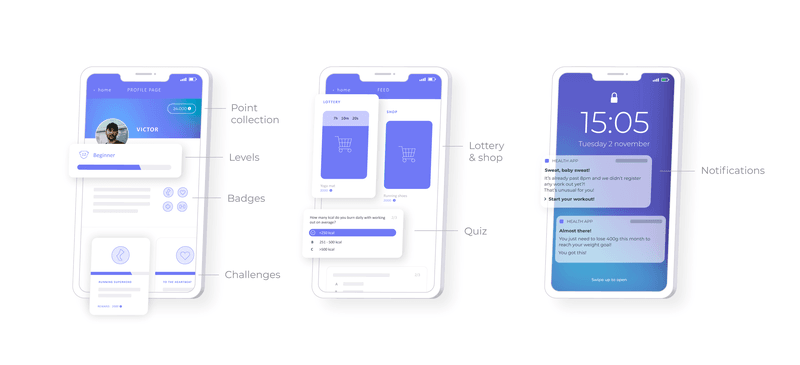
3. Gamify the Onboarding Quest
Use psychological triggers to boost motivation:
- Checklists: Trigger the Zeigarnik effect where incomplete tasks haunt the user’s memory.
- Progress Bars: Leverage the endowed progress effect to keep them moving.
- Levels & XP: Reward engagement with social status and intrinsic rewards.

Learn how a gamified user experience can drive product adoption in our expert-led workshop!
The key to support and data
Invisible yet omnipresent support is the goal. AI-powered FAQs are great, but live chat still commands an 82% satisfaction rate. Use behavioral markers to spot at-risk users. If they haven't logged in for 48 hours, they are fighting a losing battle; intervene with a nudge or a help offer immediately.
Data is your compass. Validate every product tweak with A/B testing. At StriveCloud, we help you build, measure, and learn using modular blocks so you can pivot your engagement strategy in real-time.
How a gamified UX helped Kayzr drive product adoption
TL;DR: Kayzr achieved a 350% increase in users by shifting from manual moderation to an automated, gamified tournament system. This automation tactic is used by 85% of organizations to manage complexity and drive scale.
Kayzr came to StriveCloud to supercharge engagement without ballooning costs. We built an automated quest system that enabled 24/7 engagement. The results:
- 📈 350% user growth
- 💪 60% more Daily Active Users
- 🕒 1.5h average daily session time per user
We swapped cash prizes for intrinsic rewards—badges, XP, and streaks. This self-determined motivation leads to longer-lasting engagement that doesn't drain your marketing budget.
Build your own gamified user journey with StriveCloud
To drive product adoption in 2026, you must stand out from the 305 other tools on your customer's dashboard. StriveCloud’s modular software delivers proven results by making your UX feel like an achievement rather than a chore. We help you navigate a landscape where efficiency is the top priority for 85% of organizations.
- 👉 58% increase in Daily Active Users
- 👉 23% decrease in churn rates
Ready to level up? Get in touch with our expert team to start building your habit-forming experience.
FAQ: How to drive product adoption in 2026
What is product adoption?
It's a behavioral shift where a user realizes the "Aha! moment" and makes your tool a habitual part of their routine. The shorter the gap between first click and first win, the higher the retention.
Why SaaS needs to drive product adoption
With costs rising 8% annually and companies managing 305 apps, underutilized tools are the first to be cut. Adoption proves your economic value.
How do you measure product adoption?
Measure breadth (features used), frequency (stickiness), and depth (advanced usage). In 2026, a key metric is "automation adoption"—measuring how many users have set up workflows that run without manual intervention.
References:
- Zylo, 2026 SaaS Management Index
- BetterCloud, The Big List of 2026 SaaS Statistics
- SuperOffice, Live Chat Statistics for 2026
.avif)
Related Posts

How the Hook Model can give you the benefits of better user retention
User retention continues to be a challenge across the app market. In mHealth, just 4% of customers stick around after 30 days, and in digital banking that number is 10%. That's not much better! But there is an answer to improving those numbers: a habit formation strategy led by gamification examples like challenges and rewards that can make your app fun and gratifying.