
Mastering the Hook Model & User Retention in 2026


The Hook Model: A 2026 Playbook for App User Retention
Most apps lose more than three out of four users on day one. The fix is not a louder push notification or a slicker onboarding tour. It is behavior design. For me, the cleanest blueprint for this is still Nir Eyal's Hook Model.
At StriveCloud, we've helped over 400 apps in mobility, fintech, mHealth and fan engagement turn the Hook Model from a thought-leadership poster into running code. This guide is the version we wish we'd had when we shipped our first habit loops. It covers what the four phases actually mean for a 2026 product team, the retention numbers you are really competing against, and three live examples of habit loops that we actually shipped.
What is the Hook Model?
The Hook Model is a four-phase behavioral design framework created by Stanford lecturer and author Nir Eyal. It explains how habit-forming products move users through a repeating cycle of Trigger, Action, Variable Reward, and Investment. This cycle repeats until opening the app stops being a decision and starts being a reflex.
Used well, it is the difference between an app that wins a download and an app that wins a daily slot on the home screen.
User retention remains the make-or-break metric in 2026. Throughout the customer journey, retention sits at the heart of sustainable app growth. To scale, you must move beyond just acquiring and activating customers; you must turn them into loyal, habitual users. In my experience building StriveCloud, the most resilient apps achieve this by combining successful gamification examples with the psychological rigor of Nir Eyal's Hook Model.
The challenge is steeper than ever. User retention data from 2026 shows that the current benchmark for Day 1 retention has stabilized at a global average of around 24% across all categories. This means first impressions are definitive — users who don't find value on Day 1 are statistically unlikely to return. Below, I'll break down the specific challenges of the retention stage and how the Hook Model and gamification work as a strategic lever to boost your numbers.
- Why the Hook Model and user retention are such a challenge
- 3 ways to tackle low user retention rates
- How the Hook Model forms habits (and creates a sticky UX)
- 3 gamification examples that enhance the Hook Model
- Common pitfalls in habit formation
- How you can get started on boosting user retention
Why the Hook Model and user retention are such a challenge
TL;DR: In 2026, the benchmark for Day 1 retention has stabilized around 24%. To survive the retention cliff, apps must use behavioral frameworks to turn one-time installs into automatic habits. Without a Day 1 strategy, you are just paying for churn.
To win in the current market, mastering user retention is non-negotiable. High retention rates are the single greatest predictor of long-term profitability. Having worked with hundreds of product teams, we have seen first-hand that if you do not nail the habit loop within 14 days, your acquisition budget is effectively a donation to the platform giants.
To give you an idea of the numbers you are competing against, here are the 2026 retention benchmarks based on data from AppsFlyer and Business of Apps:
- Fintech and Banking apps typically see steep drop-offs after Day 1, with elite apps targeting around 15% retention by Day 30.
- mHealth and Fitness apps often struggle to keep users active past the first week, making single-digit Day 30 retention the norm.
- Mobility and Transport apps see strong initial utility but plunge heavily by Day 30, requiring deep habit loops to stay on the home screen.
Improving these metrics is harder than it looks. The retention cliff exists because most users have no reason to come back. They installed because of a Facebook ad or a friend's recommendation. That is an external trigger. If nothing inside the product converts that into an internal trigger, the app becomes just another icon on the third page of their home screen.
Habit research backs this up. The often-cited myth that it takes 21 days to form a habit is simply not true. The actual study published by UCL found that behaviors took a median of 66 days to reach automaticity. Apps simply do not have 66 days of patience from a new user. You have to bridge the gap with structure. You need triggers that fire on the right emotion, actions that take a single tap, rewards that vary, and an investment that makes the next session better than the last.
That structure is the Hook Model.
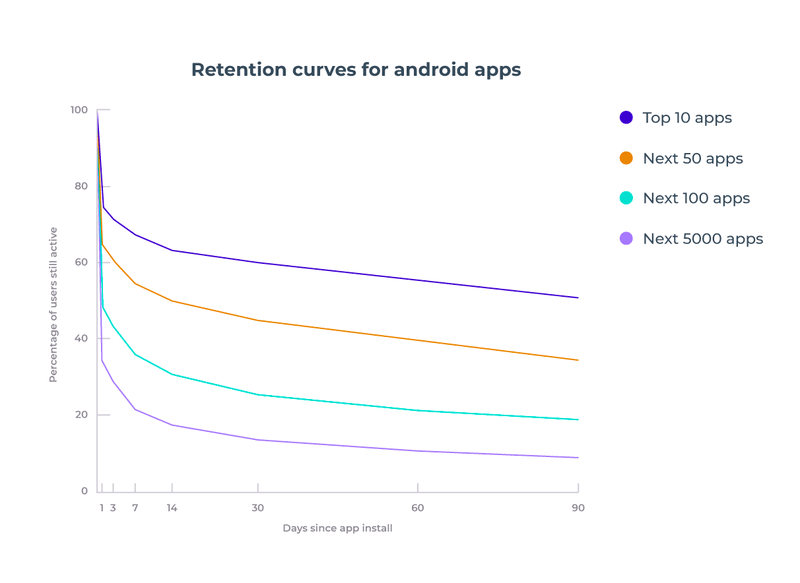
This graph illustrates the typical "retention cliff." Most users drop off within the first 72 hours if a habit loop isn't established immediately. To fix this, you need more than a widget vendor; you need a strategy for intrinsic rewards and quests that keep the anticipation loop active. Our typical clients see a retention lift within 90 days by deploying these precise behavioral mechanics early in the user lifecycle.
3 ways to tackle low user retention rates
TL;DR: High user retention in 2026 depends on mastering the conversion from external prompts to internal habits. By hitting the Day 1 benchmark through a low-friction gamified onboarding flow, you can transform a leaking bucket into an engagement engine.
Low user retention remains the ultimate boss fight for product growth. In my experience, these low numbers are signs that the "Hook" hasn't been set early enough. To scale an app to 100K+ MAU, you need a reproducible framework. Here are 3 ways to boost user retention:
1. A clear onboarding flow with a demonstrable value proposition
Your user retention strategy starts at second one! Pushing past the average and achieving an elite 30%+ Day 1 retention stretch goal requires a low-friction "Aha!" moment. Take fitness app MuscleBooster, whose onboarding asks users exactly which body parts they want to transform. This creates an "internal trigger" within the Hook Model—the user sees a personalized path, increasing the odds they return for their first quest tomorrow. By personalizing the challenge early, you decrease cognitive load and increase the perceived value of the first session.
2. Personalization features that grant psychological ownership
Personalization is the bridge between a utility and a habit. By allowing users to invest "work" into the app — triggering the IKEA effect — you make it much harder for them to leave. At StriveCloud, we've seen proven user retention examples where personalized triggers materially increase session frequency. When a user customizes their dashboard or earns their first XP, they begin to feel ownership. This psychological sunk cost is a powerful strategic lever that keeps them coming back long after the initial novelty of the install has worn off.
3. Introduce unpredictability through Variable Rewards
To maximize user retention and make your app truly "sticky," you must apply the "Variable Reward" phase. Humans are neurologically wired to crave unpredictability. Static apps are boring. Dynamic challenges and tiered leaderboards solve this by introducing loot and the "rewards of the hunt." When users don't know exactly what to expect, they stay engaged longer. Whether you drop in a mystery box or a surprise badge for completing a 7-day streak, this unpredictability helps you battle mobile app churn with gamification.
How the Hook Model forms habits (and creates a sticky UX)
TL;DR: The Hook Model drives user retention by converting external prompts into internal habits through Trigger, Action, Reward, and Investment. Mastering this loop is critical to hit the 2026 top app retention strategy benchmarks.
The science-based Hook Model developed by Nir Eyal consists of 4 elements. At StriveCloud, we help developers deploy their first habit loop in under 14 days, specifically targeting these phases:
#1 Trigger
The spark plug of the habit loop. In 2026, external triggers have evolved into hyper-personalized AI nudges. However, user retention only stabilizes when you reach the internal trigger: the user feeling a specific emotion (boredom, stress, or the need for growth) that leads them back to your engagement engine automatically. External triggers get them in; internal triggers keep them there.
#2 Action
The simplest behavior done in anticipation of a reward. Our data at StriveCloud shows that for an action to stick, it must require minimal cognitive load. Integrating XP or leaderboard mechanics into these actions can drive a noticeable lift in daily active usage. If the action is too hard, the loop breaks. We focus on making the core action as easy as a single swipe or tap.
#3 Reward
The Hook Model relies on "variable rewards." This could be earned points, a new badge, or a surprise insight. Unlike static rewards, variable rewards create a schedule of reinforcement that ensures user retention remains high even as the novelty of the app fades. This is where intrinsic rewards like social validation or personal mastery play a massive role.
#4 Investment
This is the most neglected stage. Users must put something back into the product — data, preferences, or a streak. A peer-reviewed study shows that users who reach the investment phase are meaningfully more likely to remain active long-term. This is where you lock in the user's lifetime value, which for our top clients ranges between €150-300K over a 5-10 year relationship.

3 gamification examples that enhance the Hook Model
TL;DR: Successful Hook Model implementation relies on gamification to transform variable rewards into intrinsic rewards. Research indicates that apps with gamified loops outperform static alternatives on 30-day retention.
At StriveCloud, we've found that an app gamification strategy is often more cost-effective than discounts. Users value personal mastery and streaks more than a $5 coupon. This mastery creates a sense of achievement that external incentives simply cannot match.
1. Calm: The Streak King
Calm achieved a massive boost to user retention by mastering the "Trigger" and "Investment" phases. By letting users set their own push notifications, they create a personalized trigger. By tracking streaks, they force users to invest. This approach sustains a paid subscriber base in the millions. It's a masterclass in using psychological ownership to drive daily usage.

2. Banx: Gamifying Sustainability
While typical fintech apps struggle with low engagement, Banx uses gamified environmental feedback to keep users returning. When users spend, they see CO2 savings. This acts as a variable reward, while the desire to be sustainable acts as the internal trigger. By aligning the product with the user's personal values, Banx creates a powerful emotional hook.

3. HumanForest: Building Virtual Forests
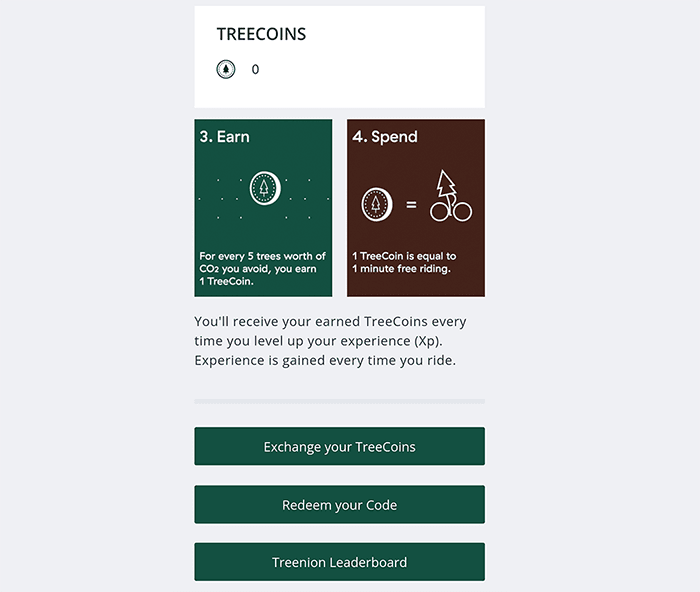
Shared mobility app HumanForest uses an in-app currency, TreeCoins, to drive habit formation. By riding, users earn coins, creating a "sunk cost" of effort. Shifting the reward from "saving money" to "earning impact" is the most effective way to build long-term user retention in the 2026 app economy. This social impact turns a commodity service into a mission-driven community.
Common Pitfalls in Habit Formation
Avoiding the "retention cliff" requires precision. In my time building engagement engines, I've seen three major mistakes that kill user retention before it even starts. If you can sidestep these, you're already ahead of most apps competing for the same screen real estate. Most companies treat gamification as a veneer rather than a core product layer, which is the fastest way to burn your LTV.
- The Empty-Points Trap: This is the cardinal sin of behavioral design. It involves adding points for the sake of points. If the points don't lead to a meaningful reward, a new level, or social status, users will quickly see through the gimmick and churn. Points must be a currency of achievement, not just a digital counter. Without utility, points are just noise.
- Push-Blast Fatigue: Sending generic, non-contextual notifications is the easiest way to get your app deleted. If you don't use triggers based on real-time behavior, you're not helping; you're spamming. Effective triggers must be timely and relevant to the user's current state.
- Ignoring the Investment Phase: This is where most developers leave money on the table. If users don't put effort into your app — like building a profile, accumulating XP, or setting a goal — they have no reason to stay when a competitor launches. High-retention apps make the user's data work for them, creating a tailored experience that is too valuable to leave.
By avoiding these traps, our clients typically see a retention lift within the first few months. Engagement isn't about adding noise—it's about building an experience that respects the user's time and effort.
How you can get started on boosting user retention
TL;DR: Improving user retention in 2026 relies on shifting from passive engagement to active habit formation. With global benchmarks around 24%, StriveCloud helps you implement these behavioral strategies to turn one-time users into daily advocates.
Every app requires a unique user retention strategy. At StriveCloud, we specialize in engagement engines for apps that focus on habit formation. We've worked with over 400 companies from mobility to fintech to hit high-performance metrics. For instance, our work with Club Brugge led to a 3x increase in return visits by focusing on fan levels and XP. We don't just provide tools; we provide a strategic lever for growth.
In our gamification workshops, we help you identify the biggest levers for growth. Experience shows that users who encounter a well-timed variable reward early in their journey show a marked increase in Day 1 return rates. Our platform is designed to scale with you. That's why our two-speed engine matters: we use no-code widgets to launch in days, and the same SDK and API are ready when you scale past 100K MAU. Based on results we've seen across recent client deployments, teams applying these mechanics benefit from:
- 3× more return visits (Club Brugge case)
- 40% activation lift in fintech betas
- A majority share of repeat-trip riders (HumanForest)
Ready to design your first habit loop? Book a Workshop: Walk out with a 4-phase audit of your app and a roadmap to ship your first loop in under 14 days.
Related Reading:
- 11 Onboarding Gamification Examples That Work
- How Duolingo Mastered the Hook Model
- Boosting Retention with Gamified Experiences
References & Sources
- AppsFlyer: Retention Rate Glossary
- AppsFlyer: Benchmarks FAQ
- Business of Apps: Mobile App Retention
- UCL: How long does it take to form a habit?
- Sage Journals: Gamification vs Monetary Rewards Study
- Business of Apps: Calm Statistics
- ITS International: HumanForest Rewards Each Mile Cycling
- StriveCloud: HumanForest Gamification Case
- Proximus: First Details of Banx Unveiled
- Nir & Far: The Hooked Workshop
.avif)
Related Posts

Top 5 Gamification Examples From Exciting Fintech Apps Across the World
With physical visits to the bank are expected to decrease by 36% in 2022 and online transactions to jump by 121% the financial industry is in a race for disruption. However, 75% of all venture-backed fintech startups fail. Why? Because they are missing a crucial element: customer motivation. Here's how these 5 leading apps are tackling it!