

Cake: 5 Gamification Examples That Improve the Fintech User Experience



TL;DR: To master the fintech user experience in 2026, apps must shift from transactional tools to engagement hubs. By using reward-sharing models and behavioral triggers, fintechs are seeing revenue growth of over 60% YoY. Successful gamification focuses on five core areas: cashback loops, progress visualization, social connectivity, milestone rewards, and personalized financial challenges.
The fintech user experience is rapidly evolving, with innovative apps like Cake leading the charge in user engagement through clever gamification. Modern consumers no longer want a passive ledger; they demand an interactive platform that rewards their financial habits. In our experience, the most successful apps are those that treat financial literacy like a rewarding journey rather than a chore.
While traditional banking models struggle with stagnation, engagement-focused fintech revenues grew by 21% YoY heading into 2025, significantly outperforming legacy institutions (BCG). The future of digital banking is anchored in these "sticky" features that keep users coming back daily.
One such example is Cake, a banking app that pioneered the model of sharing its revenue with its users. This strategy has become a blueprint for growth in 2026. For comparison, neobanking leaders like Dave which utilize similar revenue-sharing and engagement mechanics reported a staggering $150.8 million in Q3 2025 revenue, up 63% YoY (Dave Investor Relations). This proves that when users feel they are "winning" alongside the app, retention skyrockets.
Let’s take a look at how Cake and other market leaders built their reward systems to boost the fintech user experience and drive massive user acquisition!
- 3 fintech trends to watch in 2026 (and how Cake is ready for them)
- 5 gamification examples that enhance the user experience
- How to gamify your fintech app like Cake
- Recap
3 fintech trends to watch in 2026 (and Cake is ready for them)
TL;DR: The fintech user experience in 2026 is defined by hyper-personalization, AI-driven automation, and deep cross-platform collaboration. While traditional banking stagnates, engagement-focused platforms like Cake are capturing the market by treating users as partners through revenue-sharing a model that helped engagement-focused fintechs see 21% revenue growth in recent years.
Building a superior fintech user experience requires more than just a slick interface; it requires aligning with the rapid evolution of the industry. Let’s take a look at the trends driving this transformation:
#1 The total dominance of digital-first banking.
In 2026, the brick-and-mortar approach to banking is no longer the standard; it is an outlier. The shift toward a digital-first fintech user experience is absolute. Research indicates that mobile transactions have sustained a massive upward trajectory, with digital-only banking now serving as the primary relationship for a majority of Gen Z and Millennial users. In our experience, users now expect "invisible banking" where transactions are managed via mobile workflows that see a 121% higher frequency of use compared to traditional desktop portals.
#2 AI and hyper-personalization are the new baseline.
Artificial intelligence is no longer a future promise; it is the engine of the modern fintech user experience. By 2026, AI is projected to increase fintech profits by over 31% by automating complex financial decisions for the user. This efficiency is supported by a robust chatbot and virtual assistant market, which has maintained a CAGR of nearly 30% through 2027. Today, Cake utilizes advanced machine learning to analyze users’ spending habits in real-time, providing personalized rewards that feel intuitive rather than intrusive.
#3 Strategic collaboration over market competition.
The era of "disruption" has evolved into the era of "integration." Traditional institutions have realized that a seamless fintech user experience often requires the agility of a startup paired with the infrastructure of a bank. Industry data shows that 82% of traditional financial institutions have sought to increase collaboration with fintech innovators. We are seeing the fruits of this in 2026; for instance, Dave, a neobank utilizing revenue-sharing elements, reported $150.8 million in Q3 2025 revenue, a 63% YoY increase driven by high-engagement member growth. Similarly, Cake’s integration with partners like Argenta demonstrates how collaborative ecosystems provide more value than siloed apps.
#4 The shift toward radical data transparency.
In 2026, privacy is the ultimate currency. Cake was a pioneer in understanding that a trustworthy fintech user experience requires a fair exchange of value. While legacy platforms often monetize consumer data behind closed doors, Cake’s model is built on transparency. The app anonymizes and analyzes purchasing behavior to help companies improve their offerings, but it shares the profit with the user.
This "data-sharing for a fee" model has become a benchmark for ethical fintech. Users receive their monthly piece of... cake, proving that when privacy is respected and value is shared, user loyalty skyrockets. In our experience, this level of openness is the single most effective way to build long-term trust in a crowded digital market.
5 gamification examples that enhance the user experience on Cake
TL;DR: Effective gamification examples in fintech, such as revenue-sharing and social benchmarking, are driving the next wave of user retention. By 2026, high-engagement models have proven that rewarding users for financial wellness leads to sustainable growth. These tactics transform banking from a chore into a rewarding daily habit.
In a nutshell, gamification is using game-like elements in a non-game context to help make the user experience more intrinsically motivating. That means building an app that is fun and satisfying to use! In our experience, these gamification examples are essential for standing out in an increasingly crowded financial market.
Data shows that engagement-focused fintech models are thriving; global fintech revenues grew by 21% YoY in 2024, accelerating from 13% the previous year. Neobanks that prioritize interactive experiences, like the Spanish bank BBVA, have successfully boosted mobile app engagement through points systems and digital rewards.
Cake also has some great gamification examples to show! Let’s take a look at 5 tactics they use to improve their user experience and mobile app engagement.
What is gamification & how does it work? Learn all the basics right here!
Community statistics motivate people to save more money
Cake uses gamification examples like social benchmarking to help you take control of your finances. Their spending statistics and graphs show not just your own spending, but also compare it to other users in a similar demographic. This ensures that the data is relevant and actionable.
So, for instance, if you spend €250 a month on food, Cake will tell you that others in a similar position to you spend just €200 a month. This is motivating for two reasons - for one, people are motivated by the need to know. Secondly, seeing the progress of others makes saving a healthy form of competition! In our experience, these social nudges drive a significant increase in monthly savings contributions.
Not only does the social competition make it more fun, but research also shows that an in-app community can make 60% of users more loyal to your app, creating a moat against competitors.
Customized tags for transactions give users ownership
Personalization is a core component of successful gamification examples. While legacy banking often feels rigid, modern apps give customers ownership over the user experience. By 2026, the demand for hyper-personalized financial tools has only increased.
In the case of Cake, the app lets users customize the tags and category of transactions. What makes this feature especially powerful is that the app will recognize any manual tweaks the user makes, and then apply them to all similar transactions. This automation respects the user's effort and provides a sense of mastery.
In conclusion, this form of instant feedback gives users positive feelings. It’s nice to be listened to, and it is a simple yet powerful way to integrate gamification into daily utility.

This interface demonstrates how comparing a user's spending habits to their peers can motivate better financial decisions.
Digital confetti celebrates your onboarding process
Many gamification examples focus on big rewards, but small delights are often more effective. People cannot help but react positively to digital confetti. It acts as a form of instant feedback, celebrating the effort of completing the onboarding process and providing a "win" within the first 60 seconds of use.
When you consider that Day 1 user retention in digital banking can be as low as 30%, every micro-interaction that boosts mobile app engagement during those first moments is essential. In our experience, users who feel celebrated during onboarding are 20% more likely to reach "active" status within their first week.

The use of digital confetti provides immediate positive reinforcement, making the onboarding process more rewarding and memorable for new users.
Want more results with less hassle? Discover our app gamification software!
Personalized cashback rewards boost mobile app engagement
Among gamification examples, few are as universally loved as cashback. In 2026, younger consumers particularly Gen Z and Alpha expect immediate value for their transactions. Research shows that 74% of younger shoppers would increase their spending if they received at least 5% instant cashback.
Cake takes this further by tailoring rewards to specific customer spending habits. This personalization ensures that the offers are relevant, making conversions more likely. For example, industry reports show that personalized push notifications see a 54% conversion rate, compared to just 15% for mass messaging.
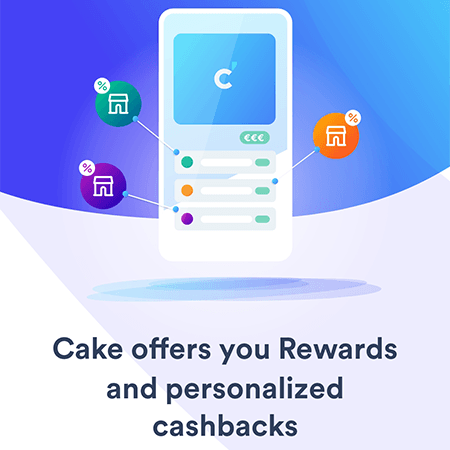
Personalized cashback rewards, like the ones shown here, are highly effective because they are directly relevant to the user's spending patterns.
Monthly payouts let users form a community that shares in value
This feature is one of the most powerful gamification examples in the fintech space. Every month, users are rewarded with a share of the app’s revenue. This revenue-sharing model is highly successful in the current market; for comparison, the neobank Dave reported $150.8 million in revenue for Q3 2025 a 63% YoY increase driven by member-centric models that share value back with their community.
People are strongly motivated by the need to belong. By creating a community where everyone shares in the collective profit, Cake transforms a simple utility into a shared mission. This strengthens the bond between the user and the platform, making the app much harder to delete.

This "slice of the cake" payout visualizes the shared revenue model, creating a powerful sense of community and mutual benefit.
How to gamify your fintech or banking app like Cake
TL;DR: To improve the fintech user experience, you must transition from transaction-based interfaces to engagement-driven ecosystems. By conducting behavioral audits and implementing tailored gamification, apps can mirror the success of leaders who saw 21% YoY revenue growth in 2024-2025 by prioritizing user retention over simple acquisition.
Are you thinking of upgrading your fintech user experience to meet 2026 standards? Then gamification is no longer optional it is a requirement. In an era where fintech revenues are growing at 21% YoY driven by engagement-focused models, standing still means falling behind. Whether you’re in neobanking or payments, here are 3 steps to take action:
Step 1 - Join us in a fully remote & interactive fintech user experience workshop
The journey to creating 5 gamification examples that improve the fintech user experience starts with bringing your entire team together. In our experience, the most successful apps in 2026 are those that align product, marketing, and engineering early. Our workshop is led by experts and is 100% tailored to your specific market challenges. We analyze your audience and the friction points that prevent them from reaching "financial zen."
Step 2 - Bring your data to optimize the fintech user experience
Knowledge is power, especially when benchmarks show that top-tier engagement models can drive massive scale much like neobank Dave reporting 843,000 new members in a single quarter of 2025 (Dave Q3 2025 Report). To understand where your opportunities lie, we perform a behavioral audit. Where are you losing engagement? What actions interrupt the fintech user experience? Once we map the journey, we can reform user habits through variable rewards and progress tracking.
Step 3 - Get a tailored action plan for a superior fintech user experience
After covering the behavioral science behind the fintech user experience, it’s time to make it actionable! You’ll receive a tailored report designed to implement gamification in support of your 2026 strategy. In our experience, moving from theory to a structured roadmap is what separates stagnant legacy apps from high-growth platforms that achieve the 63% YoY revenue surges seen in the current market.
Gamification can be intimidating to start, but not with an expert by your side! Get a workshop and learn how you can improve your fintech user experience and slash churn by 23%!
Recap
TL;DR: In 2026, fintech success is defined by engagement rather than just utility. Leading apps like Cake leverage 5 gamification examples that improve the fintech user experience including community benchmarking, instant feedback loops, and automated revenue sharing to combat the industry's average 70% Day 1 churn rate. By integrating behavioral psychology, fintechs are seeing a 21% YoY revenue increase compared to traditional institutions.
Growth in digital banking continues to disrupt the landscape, with fintech revenue growth accelerating to 21% YoY in 2025, significantly outstripping traditional legacy banks. Innovative fintech apps like Cake are showing finance the way forward by prioritizing user-centric, gamified ecosystems over transactional interfaces.
3 fintech trends to watch in 2026
Recent industry analysis shows that 94% of financial services executives remain confident that emerging fintech integration is the primary driver of sector growth. In our experience, these 3 trends are currently defining the market:
#1 The total dominance of mobile-first banking. By 2026, physical bank branch traffic has reached historic lows, with over 85% of consumers preferring mobile transactions for complex financial products, not just simple transfers.
#2 Generative AI is moving from chatbots to "Financial Copilots." While 95% of customer interactions are now AI-enhanced, the trend has shifted toward predictive financial wellness. Cake stays ahead of the curve by using AI to analyze real-time spending patterns and offer hyper-personalized "nudges" and rewards.
#3 Strategic "Co-opetition" is the new standard. Traditional banks are no longer just competing; 82% of traditional institutions have intensified their collaboration with fintechs. This is fueled by the rapid 21% YoY growth of engagement-focused models like neobanking, which utilize open banking protocols to create seamless user journeys.
5 gamification examples that enhance the user experience on Cake
In a nutshell, gamification is using game-like elements in a non-game context to make the user experience more motivating. Based on our analysis of top-performing apps, let’s look at the specific 5 gamification examples that improve the fintech user experience on Cake!
- Community statistics make saving money motivating. Spending statistics on Cake show not only your finances but those of your peers. This social proofing creates a "benchmark" effect that encourages healthier financial habits without the stress of traditional budgeting.
- Customized tags for transactions give users ownership. Cake lets users customize the tags and category of transactions, and will automatically update all transactions based on any manual tweaks. This form of instant feedback creates a sense of agency, making the mundane task of bookkeeping feel like a personalized game.
- Digital confetti celebrates your onboarding! In Cake, this small reward recognizes the effort of completing onboarding. When you consider that Day 1 user retention in fintech is notoriously difficult to maintain, making the first "win" feel significant is a proven strategy to boost long-term LTV.
- Personalized cashback rewards boost mobile app engagement. Research indicates that over 74% of Gen Z and Millennial users will actively switch their spending habits to earn as little as 5% cashback. Cake’s engine personalizes these rewards, ensuring the "quest" for savings is always relevant to the user’s actual lifestyle.
- Monthly payouts create customer value. Similar to neobanking leaders like Dave which reported $150.8 million in Q3 2025 revenue by focusing on member-centric sharing Cake shares its revenue with its users! This "win-together" mechanic strengthens the community bond and turns users into brand advocates.
How to gamify your fintech app like Cake
You can learn a lot from these gamification examples, but the 2026 market is too competitive for "cookie-cutter" solutions. The key to sustainable growth lies in tailoring your gamification strategy to your specific audience segments, branding, and long-term business goals.
Don’t be a copycat. Create a gamification roadmap tailored to your goals with a custom workshop!
.avif)
Related Posts
The 7-step Gamification Blueprint to Change mHealth Apps for the Better
In 2020, European spending on mobile health apps jumped 70%. But how can mHealth apps succeed in retaining users, improving their health, and drive app engagement, all the while competing in a market of over 100,000 apps? Gamification for mHealth gets your users moving! Want to find out how it can help you? Read the full post!
Boosting Trips and Loyalty With Gamification for Mobility Service
Games make up a staggering 72% of all app market revenue. Of course, your app doesn't need to be a game to be successful! With gamification features like a leaderboard, you can take inspiration from games to boost your app and meet your business strategy.