

10 Gamification Ideas That Show How to Create a Great User Experience


What features should a gamified user experience have? In practice, the answer depends on your business goals! Whether you choose to use challenges, points, or leaderboards, implementing the right gamification ideas can drive users toward your desired outcomes. TL;DR: Strategic gamification can boost user engagement by up to 150%, a critical factor in a global market projected to reach $19.42 billion by 2026. Success today requires moving beyond simple badges to create intrinsic motivation through social connectivity and personalization. In our experience, these 10 gamification ideas provide the blueprint for sustainable growth and long-term retention.

This image illustrates how various gamification ideas, such as progress tracking and rewards, can be combined to create a cohesive user experience that rivals top-performing wellness platforms. According to recent market research, the wellness and mHealth sectors are currently seeing the highest growth in gamified adoption, as users prioritize apps that offer tangible feedback and community competition.
- What is gamification?
- What is gamification for apps?
- Why are gamification ideas so successful?
- 3 key benefits of app gamification
- 10 gamification ideas for apps
- Challenges
- Leaderboards
- Points
- Personalization
- Daily streaks
- Try out gamification with StriveCloud!
- FAQs
What is gamification? Implementing effective gamification ideas
TL;DR: Gamification transforms the user journey by applying game mechanics to non-game apps, often boosting engagement by up to 150%. By leveraging strategic gamification ideas like progression loops and social competition, brands tap into core human psychology to drive long-term loyalty in a global market projected to exceed $19.42 billion by 2026.
Gamification uses game-like elements to motivate users in non-game contexts. Modern apps implement various gamification ideas, such as milestones, interactive challenges, and tiered levels, to enhance the value proposition. Essentially, a gamified app taps into human psychology by satisfying innate needs for autonomy, competence, and social relatedness. In our experience, this transformation of the user interface makes the overall experience feel more intuitive and rewarding rather than purely transactional.
This creates intrinsic motivation the internal drive to act because the activity itself is inherently satisfying. While extrinsic rewards like cashback are helpful, they often lead to "reward fatigue" over time. By contrast, well-executed gamification ideas encourage users to return habitually, leading to sustained app engagement and higher retention rates. According to 2025 industry reports, companies prioritizing these psychological triggers see significantly higher customer lifetime value (LTV) compared to those relying on traditional, static UX designs.
What are gamification ideas for apps?
TL;DR: In 2026, data-driven gamification is proven to increase user engagement by up to 150%. By implementing strategic gamification ideas, developers can transform routine digital interactions into high-retention, rewarding user experiences.
Simply put, gamification runs on data. With the global gamification market projected to reach $19.42 billion, apps are leveraging behavioral insights to build deeply satisfying user experiences. In our experience, successful gamification ideas turn mundane tasks into memorable activities by utilizing four fundamental mechanics:
Why are gamification ideas so successful?
Gamification ideas succeed because they align with fundamental behavioral psychology, transforming passive users into active participants. TL;DR: By leveraging loss aversion and positive reinforcement, these strategies reduce cognitive load and drive retention. Recent 2026 projections indicate that companies using gamified frameworks report up to a 150% increase in user engagement, fueling a global market now valued at over $19.4 billion.
In our experience, the most effective gamification ideas are those that feel invisible; they don't just add "games" to an app, but rather utilize decades of science to motivate people and drive specific behaviors. Because these principles are hardwired into our brains, any industry from fintech to healthcare can achieve significant growth by applying these psychological triggers to satisfy the human need for achievement and feedback.
Leverages the power of loss avoidance
Loss avoidance remains one of the most powerful psychological forces in UX design. In fact, the fear of losing progress or a "streak" is often more motivating than the prospect of winning a new reward. Modern gamification ideas thrive on this principle. Even a simple notification regarding a potential loss of status or a streak can motivate users to invest higher effort into the platform to maintain their standing!
Frontiers in Human Neuroscience - "Human behavior is more strongly driven by the motivation to avoid losses than to pursue gains... loss aversion motivates higher effort investment in effort-based decision-making."
People crave validation
Validation, or positive reinforcement, is a core human necessity. When you provide it through a badge, a social shout-out, or a filled progress bar, you unlock intrinsic drivers of growth and self-worth. This is why the gamified health and wellness sector is seeing such explosive growth heading into 2026. As the global gamification market reaches a $19.42 billion valuation, the focus has shifted toward emotional validation making a completed task feel like a personal victory, which encourages users to engage repeatedly.
Simplifies the user experience
The goal of any great interface is to reduce friction. Essentially, you perform a task, and you get rewarded for it. In scientific terms, this is called “reducing the cognitive load.” A simple narrative makes your app easier to navigate because it requires less mental effort for the user to understand the value proposition. This clarity is achieved through three specific gamification ideas:
- Clear goals and real-time progress tracking
- Immediate feedback loops and rewards
- Guided pathways that remove decision fatigue
3 key benefits of gamification ideas for app growth
TL;DR: Strategic gamification ideas transform passive users into active brand advocates, boosting engagement by up to 150% and securing a foothold in the projected $19.42 billion gamification market. In our experience, these mechanics are essential for maximizing retention and lifetime value in 2026. Because the average person now spends over a third of their day on mobile, they seek interactive environments rather than static interfaces. Utilizing gamification ideas results in three primary benefits:
The importance of user satisfaction cannot be overstated in today’s competitive landscape. Based on recent industry data, gamified wellness and learning apps are seeing unprecedented growth because satisfaction remains one of the most reliable predictors of loyalty. This loyalty is the ultimate revenue driver; even in 2026, the Pareto principle remains a vital metric, where the most engaged 20% of a user base frequently generates up to 80% of total app revenue. By prioritizing game-driven UX, brands ensure their users don't just download an app, but integrate it into their daily habits.
10 gamification ideas for apps
TL;DR: Implementing the right gamification ideas is no longer optional in 2026; it is a necessity for retention. Leading apps now use social competition and tangible reward loops to boost engagement by up to 150%. This guide explores how top brands like Google, Duolingo, and HumanForest leverage game mechanics to turn passive users into active, loyal advocates.
Challenges
#1 GooglePay’s stamp challenge enthralled India
How did GooglePay stimulate product adoption in India? With a challenge! For Diwali, one of India’s biggest festivals, the app utilized clever gamification ideas to challenge customers to earn 5 unique stamps. Users do this by completing transactions and earning randomized stamps. If you collected all 5 stamps within the 2-week deadline, you got a cash prize! In a way, this makes the challenge like a lottery, which makes it even more unpredictable and fun.
In the end, the campaign garnered over 37 million impressions and sparked 225,000 conversations on social media. Sounds good, right? Here’s why the challenge worked:
- Dopamine effect: getting the right stamp feels great!
- Effort/reward balance: Mmaking engagement easy is crucial
- Habit formation: repetitive actions and rewards hook customers in.
- Narrative: centered around a cultural festival, GooglePay put its spin on a widely shared and beloved story.

GooglePay's campaign demonstrates how a culturally relevant and lottery-like challenge can create viral engagement in a new market.
#2 Santander Cycles incentivizes users to achieve
Challenges are unpredictable and that’s exciting! These types of gamification ideas give users a fresh reason to return to the app daily. For instance, London’s Santander Cycles regularly challenges their customers. To make their challenges extra motivating, the app rewards successful customers with a lottery entry and the thrilling chance of winning a prize.
For one, this triggers customers to complete actions aligned with their business goals. It can be seen that Santander Cycles wants customers to take more rides. That’s why they create achievements such as “keep on pedaling” and “frequent flyer”, where riders have to ride every day or exceed 123 kilometers. And when riders pass these challenges, it increases their self-confidence and feeling of expertise!

This example from Santander Cycles shows how gamified challenges can drive specific user behaviors that align with business goals, like increased ride frequency.
Leaderboards
#3 Kazyr ranked their esports teams
Leaderboards help users compare their personal progress against their peers, which is one of the most effective gamification ideas for fostering community. For esports platform Kazyr, implementing a leaderboard was a core strategy they used when partnering with StriveCloud to gamify their experience. On the leaderboard, gamers are sorted by their skills, with the top-ranking players winning prizes like merchandise and experiences.
In our experience, leaderboards inspire a sense of healthy competition. Users should want to publicize their ranking after all, it’s a sign of social status and that’s motivating! In the current 2026 landscape, companies using these gamification frameworks report up to a 150% increase in engagement, leading to massive user base growth.
After implementing these gamification ideas, Kazyr achieved amazing results:
- 60% more daily active users1 year of 24/7 eyeball time in a day
- 1.5h average session time per user per day
Pieter Verheye, Community Manager @Kayzr - "By gamifying the user experience, StriveCloud helped us grow our user base significantly through competitive social features."
#4 Sweatcoin pays the board leaders
The fitness industry has been revolutionized by gamification ideas that reward physical movement with digital value. By 2026, the global gamification market is valued at approximately $19.42 billion, with mHealth apps like Sweatcoin leading the charge. Essentially, users get “Sweatcoins” for their daily steps, which they can then exchange for real-world products or currency in their digital wallets.
To further encourage users to earn Sweatcoins, the app places users on a leaderboard. This feature offers instant feedback and positive reinforcement while creating a community of users. When users compete for the top spot, they share the same goals and interests as others. As a result, you fulfill the powerful ‘need to belong,’ which is essential for boosting long-term loyalty and reducing churn.

The Sweatcoin leaderboard effectively combines competition with tangible rewards, fostering a strong sense of community and motivation.
Points
#5 Ready Telco One shows that gamification ideas are powerful
Gamification ideas are spreading far and wide, even to big telecommunications companies. Telco giants Orange and Microsoft partnered to create an experiment called Ready Telco One to explore the benefits of point-based systems. As a gamified marketplace, they rewarded points to users for engaging in quizzes and virtual testing of telco products. These points could then be redeemed for discounts at partner retailers.
Our analysis shows that the gamification ideas showcased in projects like Ready Telco One deliver massive financial outcomes by increasing the Average Revenue Per User (ARPU):
- €18 million increase to monthly revenue
- 1 million new app customers
- €0.55 increase in ARPU

Ready Telco One's point system illustrates how gamification can directly translate to significant financial outcomes like increased revenue and ARPU.
#6 HumanForest uses points to send a sustainable message
To encourage green travel, our team at StriveCloud helped the e-bike app HumanForest implement high-impact gamification ideas through 'TreeCoins.' More than a simple points system, this scheme rewards customers for riding with free minutes or discounts. In our experience, connecting digital rewards to environmental impact is one of the strongest drivers for Gen Z and Millennial users in 2026.
But here’s the best part TreeCoins actually show users how many trees worth of CO2 they save! For every 5 miles that users ride, they earn a TreeCoin, representing 1 tree in saved CO2. This progress visualization mechanic prompts users to return; recent data indicates that apps utilizing impact-based rewards see significantly higher repeat usage rates than traditional loyalty programs.
Michael Stewart @HumanForest - "StriveCloud really helped us fulfill our brand message. The TreeCoins explain our mission perfectly… the progress visualization mechanic prompts users to keep using HumanForest and rewards sustainable behavior with free minutes!"
Visualizing these real-life consequences makes the points feel tangible. This incentive gives users a reason to return to HumanForest, where over two-thirds of all trips are now made by repeat users seeking to increase their positive climate impact.

HumanForest's TreeCoin system effectively connects digital points to a tangible, real-world impact, powerfully reinforcing the brand's sustainable message.
Personalization
#7 Muscle Booster lets users customize their exercise
One of the most effective gamification ideas for onboarding is simply asking users what they want to achieve. However, you must keep it efficient. Industry data consistently shows that every unnecessary step in an onboarding flow can cost you up to 20% of your potential users. Muscle Booster avoids this by using a fast, goal-oriented onboarding process.
By setting a clear pathway for engagement, you simplify the user experience. Muscle Booster lets users select personal goals and customize workouts. This takes advantage of the ‘endowed progress effect,’ where personalized gamification makes people significantly more likely to complete the tasks they begin because they feel they have already started their journey.

Muscle Booster's personalized onboarding process shows how letting users set their own goals creates a sense of purpose and simplifies the user journey.
#8 Stitch Fix gets to know your preferences during onboarding
In the competitive 2026 e-commerce market, gamification ideas give brands a vital edge. Stitch Fix proves this with their “Style Shuffle.” Immediately upon joining, users are shown items of clothing and asked to thumb up or down. This simple, game-like interaction gathers massive amounts of data while keeping the user entertained during what would otherwise be a boring form-fill.
These answers are used to personalize a surprise clothes box delivered to the user's door. Since the game launched, millions of Stitch Fix customers have engaged with it, generating over a billion unique ratings. This shows that asking for feedback in a fun way builds brand trust and makes the data collection process feel like a reward rather than a chore.
Torunn Skrogstad, Principal Product Designer @Stitch Fix - "Style Shuffle was a huge unlock for the company. We had no idea this simple interaction would be such a massive driver for the business."
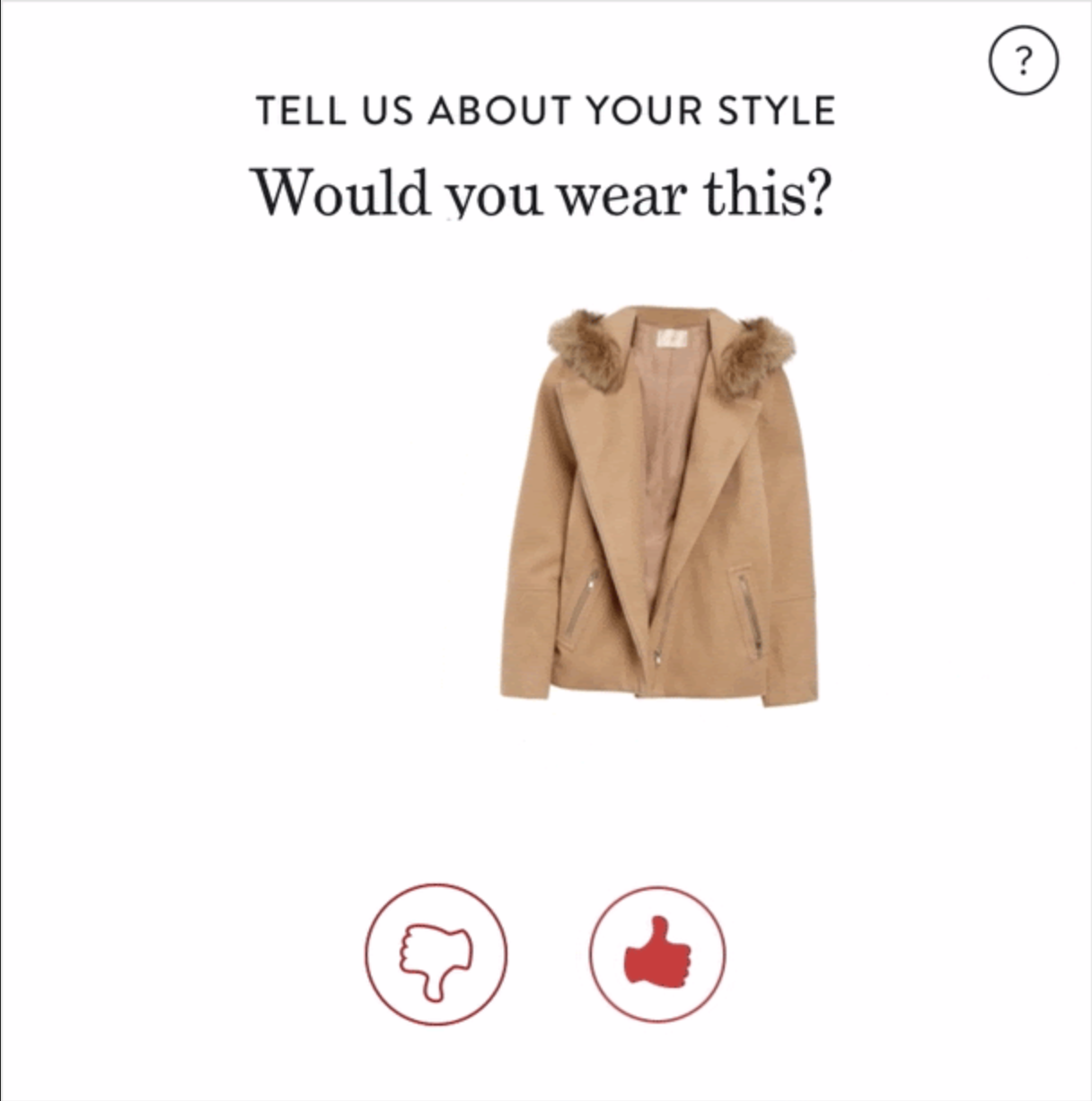
Stitch Fix's "Style Shuffle" is a brilliant example of using a simple, game-like interaction to gather valuable data for personalization at scale.
Daily streaks
#9 Duolingo streaks keep students learning
Streaks are one of the most powerful gamification ideas for habit formation and long-term retention. Duolingo uses streaks to incentivize daily language practice, leveraging the psychological desire to maintain a winning record. Research shows that when users are challenged to wager on their streaks, short-term retention can rize by as much as 14%.

The iconic Duolingo streak is a powerful demonstration of how tracking daily engagement can build habits and boost user retention significantly.
#10 Snapchat combines socialization & streaks to maximize engagement
Snapchat remains a dominant social app in 2026, with over 400 million daily active users. To maximize engagement, Snapchat rewards users with streaks that represent their social consistency. These gamification ideas leverage loss aversion the idea that losing a hard-earned "best friend" streak is more painful than the effort required to send a quick snap.
By making the streak a social feature, it becomes an obligation between friends, which is far more powerful than a solo challenge. Users earn trophies and badges for long-term consistency, turning simple communication into a status symbol that keeps them coming back every single day.

Snapchat's social streaks capitalize on the principle of loss avoidance and social connection to drive massive daily engagement.
FAQs about gamification ideas
TL;DR: Gamification ideas transform user experience by using game mechanics like leaderboards and rewards to boost engagement. In 2026, data shows these strategies can increase user interaction by up to 150%, helping companies tap into a gamification market valued at over $19 billion to drive long-term loyalty and growth.
What are gamification ideas?
Gamification uses game-like features to motivate users in non-game contexts. And any app can gamify! In our experience, successful gamification ideas tap into shared human psychology by satisfying innate needs like growth, competition, and belonging. By 2026, integrating these mechanics is no longer optional; it is a standard for creating a more engaging and intuitive user experience.
Why are gamification ideas so successful for UX?
Gamification ideas are successful because they’re based on decades of behavioral psychology that explores what makes humans tick. For example, humans instinctively avoid losses and seek positive reinforcement. With the global gamification market valued at $19.42 billion in 2025, it is clear that features like badges and progress bars leverage these behaviors to create powerful, sustainable motivation for modern users!
What is the key benefit of implementing gamification ideas?
Gamification ideas can drive customers toward your business goals by rewarding specific behaviors. In our experience, companies using these strategies report up to a 150% increase in engagement, leading to significant user base growth. Essentially, rewards incentivize engagement and make the user experience more fun. In turn, this increases user satisfaction and builds the ultimate goldmine: long-term customer loyalty!
Keep reading
.avif)
Related Posts

How Fintech Is Using App Gamification and 3 of the Best Examples
Research shows that in fintech apps just 15% of users finish the onboarding. But with app gamification, apps like Shine see that 80% of users complete the onboarding! The change is huge, and banks old and new are taking notice of how important mobile app engagement is to success. Here's how they crack it.
4 Gamification Features That Make Headspace Worth It
Almost 1 in 4 people in the UK use Headspace! What makes this wellness app such a phenomenon that companies like Google and Starbucks trust it to look after their employees? In this article, we'll analyze how Headspace leveraged gamification to secure its position as the number one mediation app.