

Top 25 User Growth Experiments Designed to Boost SaaS User Activation Rate


TL;DR: To maximize your SaaS user activation rate in 2026, prioritize interactive guided walkthroughs (proven to boost activation by 47%) and high-clarity copy optimizations (driving 29% higher conversion). Modern growth teams are moving away from passive tours in favor of intent-based, gamified onboarding flows.
Building a sticky product is the dream of every SaaS, but it’s not easy. In 2026, it requires you to always be tweaking and improving your strategy to activate new users and turn them into loyal ones. Some have suggested gamified onboarding, others recommend personalized notifications or interactive tooltips. However, the right strategy depends entirely on your specific user intent! Based on recent SaaSFactor analysis, optimizing onboarding copy and flow clarity can result in a 29% increase in activation rates. In our experience, shifting from passive "AHA moment" videos to interactive guided walkthroughs provides a 47% boost in user activation by involving the user in the process immediately. With this in mind, we at StriveCloud have collected 25 user growth experiments to lift up your SaaS user activation rate and boost user engagement!
- How to define the activation point for your SaaS product
- 25 user growth experiments to start optimizing
- 7 user growth experiments for new user onboarding
- 6 user growth experiments to improve feature adoption
- 6 user growth experiments that boost trial to paid conversions
- 5 user growth experiments to enhance personalization
- FAQ
Track user activation rate by defining your AHA-moment
TL;DR: To maximize your user activation rate, you must identify the specific actions where users first extract value. In our experience, shifting from passive tours to interactive, task-based walkthroughs can drive a 47% boost in activation, while refining onboarding copy for clarity typically yields a 29% lift in conversion. Activation isn't a single event, but a journey from perception to adoption through targeted user growth experiments.
In reality, there is no one activation event. However, activation takes 3 steps. Firstly, the perception of value. Then, the experience of value. And finally full product adoption. But what facilitates those activation points are defined by your product's key tasks. By running continuous user growth experiments, we have found that the "Aha! Moment" is often simpler than teams expect, yet requires precise guidance to reach.
Take a project management SaaS for instance. Their activation point might be when a user creates a new project. However, recent 2025 SaaSFactor analysis suggests that onboarding copy and flow optimizations specifically focusing on messaging clarity can lead to a 29% increase in activation rate. By conducting these user growth experiments, you might find that the true driver is actually inviting a collaborator or completing a first task, rather than just project creation.
User activation rate = Activated users / Total registered users * 100
In short, experiments will help you reveal the tipping points with the highest user activation rate. In our experience, replacing passive product tours with interactive, guided walkthroughs can result in a 47% boost in activation rates. In other words, you can use these insights to motivate the behaviors that lead to more user engagement and significantly higher customer lifetime value!
What’s a good user activation rate? Check out our ultimate SaaS user activation guide & start optimizing!
25 user growth experiments to start optimizing
TL;DR: In 2026, the most effective user growth experiments prioritize interactive "learning-by-doing" over passive tours. Key data points show that optimizing onboarding copy now yields a 29% activation lift, while replacing passive tours with interactive walkthroughs can boost rates by 47%.
Through extensive research, we have determined 25 user growth experiments to lift up your user activation rate today! These tests focus on the 2026 "Value-First" framework. Moreover, each experiment comes with an updated ICE prioritization score (Impact, Confidence, Ease) which will help you find the best tests for your specific growth goals.
7 User growth experiments for new user onboarding
#1 Tweak the onboarding copy
In our experience, copy is the highest-leverage lever in your user growth experiments. A good piece of copy can make a new user like your product, but to succeed in 2026, you need clarity and resonance. For example, recent 2025 analysis of SaaS A/B tests found a 29% increase in activation rates from optimizing onboarding copy and flow messaging to be more personality-driven and benefit-focused.
Our score:
- Impact - 8
- Confidence - 8
- Ease - 9
- ICE score - 83%
Want to calculate your own ICE score? Get our Free Growth Experiment Planning Tool!

This example of onboarding copy demonstrates how clear and concize messaging can guide new users effectively toward their first "AHA" moment.
#2 Celebrate quick wins during onboarding with gamification
Onboarding shouldn’t be a chore! We’ve found that the best user growth experiments keep users in an engagement loop of action and rewards. By using a gamified approach, you can celebrate wins through confetti screens or badge achievements. While older tactics focused on simple traffic spikes, modern leaders like AddThis use real-time triggers to notify users when they reach specific engagement milestones, turning passive users into active advocates.
Our score:
- Impact - 8
- Confidence - 8
- Ease - 8
- ICE score - 80%
Want to calculate your own ICE score? Get our Free Growth Experiment Planning Tool!
#3 Personalize onboarding to your user personas
Take advantage of user personas and match onboarding to complement each profile. When you segment users, you can customize onboarding for their unique roles & perspectives. In our experience, personalized user growth experiments that speak directly to a user's "Job-to-be-Done" consistently lead to higher app engagement compared to generic "one-size-fits-all" flows.
Our score:
- Impact - 8
- Confidence - 8
- Ease - 7
- ICE score - 77%
Want to calculate your own ICE score? Get our Free Growth Experiment Planning Tool!
#4 Feature video product tours to create the AHA Moment
Video can massively impact your user activation rate! Current 2026 industry benchmarks indicate that 82% of people prefer video as their primary way of getting to know a new product or service. This helps scale time for your sales and success teams. For instance, Basecamp uses a concize instructional video to explain the basics, reducing the friction typical of text-heavy manuals.
Our score:
- Impact - 7
- Confidence - 6
- Ease - 4
- ICE score - 57%
Want to calculate your own ICE score? Get our Free Growth Experiment Planning Tool!

The LifeWorks app onboarding shows how a guided, visual experience can improve user engagement from the very first session.
#5 Customize your user interface based on product goals
When you have a multifunctional product, you must find the user's focus during onboarding. User growth experiments like those at Hellobar allow users to customize the interface by selecting specific goals first. This "choose-your-own-adventure" style ensures users only see the features relevant to their immediate needs, preventing feature fatigue.
Our score:
- Impact - 7
- Confidence - 8
- Ease - 3
- ICE score - 60%
Want to calculate your own ICE score? Get our Free Growth Experiment Planning Tool!
#6 Create gamified progress bars to improve onboarding completion
As a progress bar fills up, users receive instant feedback and a sense of momentum. This is crucial because a perceived longer onboarding leads to higher churn. LinkedIn remains a classic gamified onboarding example; in our experience, this single feature continues to be the gold standard, having historically boosted profile completion rates by 55%.

LinkedIn's profile completion bar is a classic example of using gamified progress to motivate users to provide more information.
Our score:
- Impact - 7
- Confidence - 9
- Ease - 8
- ICE score - 80%
Want to calculate your own ICE score? Get our Free Growth Experiment Planning Tool!
#7 Add a sense of endowed progress to boost user motivation
When providing a checklist, try crossing out the first two steps automatically (e.g., "Account Created"). Giving users a headstart motivates them to complete the challenge. This is one of the most effective user growth experiments for 2026, as checklists can increase user activation rate and completions by upwards of 10% simply by leveraging the Goal Gradient Effect.
Our score:
- Impact - 7
- Confidence - 8
- Ease - 10
- ICE score - 83%
Want to calculate your own ICE score? Get our Free Growth Experiment Planning Tool!
6 User growth experiments to improve feature adoption
#8 Nudge users with subtle tooltips
Pushing users too hard can provoke 'Reactance,' where users do the opposite of your goal. In our experience, the best user growth experiments for feature adoption involve subtle, non-intrusive tooltips that appear only when a user interacts with a related element for the first time.
Our score:
- Impact - 8
- Confidence - 8
- Ease - 7
- ICE score - 77%
Want to calculate your own ICE score? Get our Free Growth Experiment Planning Tool!

Subtle tooltips, as shown here, can guide users toward new features without disrupting their workflow, boosting app engagement.
#9 Add gamified challenges to boost new feature adoption
Leverage gamified features like challenges and rewards to boost app engagement on secondary features. We’ve seen that rewarding a user for "trying X for the first time" can increase adoption rates for that specific feature by up to 25% within the first week of release.
Our score:
- Impact - 8
- Confidence - 7
- Ease - 7
- ICE score - 73%
Want to calculate your own ICE score? Get our Free Growth Experiment Planning Tool!
Building a gamified experience has never been easier Add, track & tweak your gamification strategy with 1 solution!
#10 “Getting started” emails can hype up certain features
Lifecycle emails should not just be "check-ins." They are critical user growth experiments that provide a bridge to the 'AHA Moment.' By highlighting one specific feature per email, you reduce cognitive load and provide a clear path to increased app engagement.
Our score:
- Impact - 7
- Confidence - 7
- Ease - 10
- ICE score - 80%
Want to calculate your own ICE score? Get our Free Growth Experiment Planning Tool!
#11 Create interactive walkthroughs
Interactive walkthroughs are the "gold standard" of user growth experiments in 2026. A recent case study by SaaSFactor revealed a 47% boost in activation rates when interactive walkthroughs replaced passive tours. By making the user perform the action rather than watching it, you ensure they truly understand the product's value.
Our score:
- Impact - 9
- Confidence - 8
- Ease - 4
- ICE score - 70%
Want to calculate your own ICE score? Get our Free Growth Experiment Planning Tool!
#12 Introduce rewards to encourage feature adoption
Incentives work! Asana's flying unicorn is a famous example of how small delights can drive app engagement. In our experience, even non-monetary rewards like exclusive badges or community status can significantly increase the frequency of feature usage among power users.
Our score:
- Impact - 8
- Confidence - 8
- Ease - 7
- ICE score - 77%
Want to calculate your own ICE score? Get our Free Growth Experiment Planning Tool!
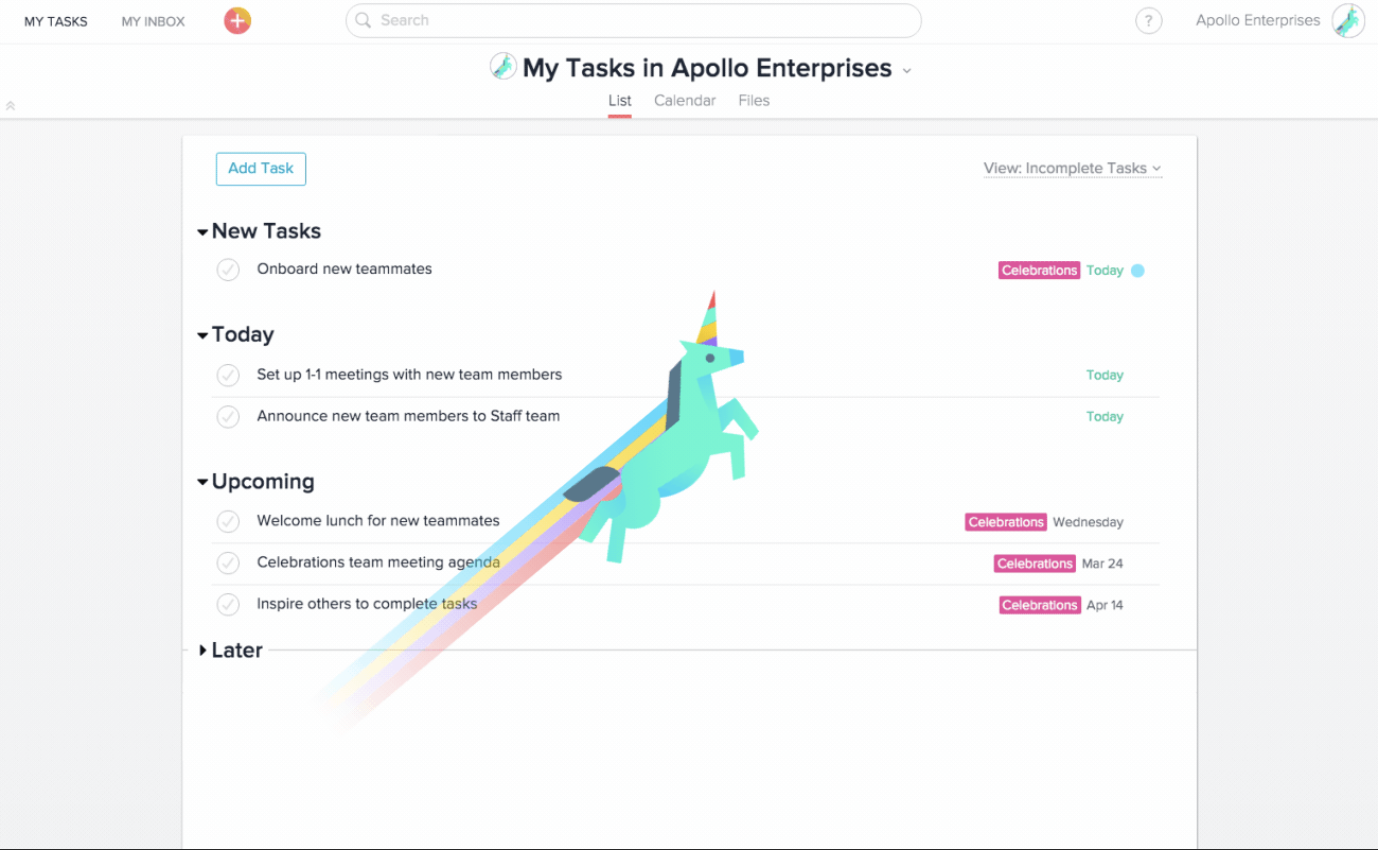
Asana's celebratory unicorn is a perfect illustration of how a simple, fun reward can increase task completion and overall app engagement.
#13 Use in-app communities to promote new features
In-app communities foster peer-to-peer learning. User growth experiments that leverage communities, like Intercom’s forum, allow you to collect feedback and identify power users. By featuring a leaderboard of top contributors, you use social status to drive deeper app engagement and feature discovery.
Our score:
- Impact - 8
- Confidence - 7
- Ease - 4
- ICE score - 63%
Want to calculate your own ICE score? Get our Free Growth Experiment Planning Tool!
Get activating with gamification! Book a custom workshop & go home with an actionable roadmap!
6 User growth experiments that boost trial to paid conversions
#14 Leverage “stored value” to keep users coming back
The more data a user puts into your platform, the higher their switching costs. User growth experiments at Salesforce and Notion focus on "stored value." When a user builds their workflow inside your tool, the product becomes exponentially more valuable, making the transition to a paid plan feel like a natural investment.
Our score:
- Impact - 9
- Confidence - 8
- Ease - 4
- ICE score - 70%
Want to calculate your own ICE score? Get our Free Growth Experiment Planning Tool!
#15 Offer the opportunity to extend free trials
Don't let a trial end just because the clock ran out. Instead, use gamified trial extensions as part of your user growth experiments. Offer a 7-day extension in exchange for completing a specific milestone, such as inviting a teammate or integrating an API. This ensures the user is actually getting value before the paywall hits.
Our score:
- Impact - 8
- Confidence - 9
- Ease - 7
- ICE score - 80%
Want to calculate your own ICE score? Get our Free Growth Experiment Planning Tool!

This example from Navexa shows how offering a trial extension in exchange for profile completion is a smart, gamified growth experiment.
#16 Use social proof to build credibility
Social proof is more vital than ever; current studies show that 92% of users trust reviews and testimonials. Nudge your users toward conversion by showcasing case studies from peers in their specific industry. In our experience, targeted social proof during the final days of a trial can increase conversion rates by 12%.
Our score:
- Impact - 8
- Confidence - 9
- Ease - 8
- ICE score - 83%
Want to calculate your own ICE score? Get our Free Growth Experiment Planning Tool!
#17 Keep some features locked during trial
Try a user growth experiment around gated access. Offering a gamified "unlock" for advanced features can drive deeper exploration. For instance, allow users to "earn" a premium feature for 24 hors by reaching a certain usage milestone, which provides a risk-free taste of the paid experience.
Our score:
- Impact - 8
- Confidence - 7
- Ease - 6
- ICE score - 70%
Want to calculate your own ICE score? Get our Free Growth Experiment Planning Tool!
#18 Trigger a sense of urgency by sending follow up emails
Urgency is a powerful psychological trigger. In our experience, sending a "24 hors remaining" email that highlights the specific progress a user stands to lose (Loss Aversion) is one of the most effective user growth experiments to drive last-minute conversions.
Our score:
- Impact - 6
- Confidence - 8
- Ease - 9
- ICE score - 77%
Want to calculate your own ICE score? Get our Free Growth Experiment Planning Tool!
#19 Use scarcity & exclusivity to power up demand
Scarcity remains a potent motivator for user activation rate. Whether it’s an exclusive beta invite or a limited-time bonus for early adopters, people are highly motivated by loss avoidance. Superhuman’s invite-only strategy is a prime example of how exclusivity can build a massive, highly engaged waiting list.
Our score:
- Impact - 8
- Confidence - 8
- Ease - 4
- ICE score - 67%
Want to calculate your own ICE score? Get our Free Growth Experiment Planning Tool!
6 user growth experiments to enhance personalization
#20 Personalized notifications provide unparalleled customer value
The future of user growth experiments lies in hyper-personalization. Notifications should be based on real-time behavior, not generic schedules. If a user hasn't finished a project, a personalized nudge mentioning that specific project name will always outperform a generic "Come back" message.
Our score:
- Impact - 10
- Confidence - 9
- Ease - 6
- ICE score - 83%
Want to calculate your own ICE score? Get our Free Growth Experiment Planning Tool!
#21 Greet existing customers with a personalized message
Relationship-driven user growth experiments focus on retention. Simple gestures like Gusto’s "Welcome back, [Name]" create a sense of belonging. In our experience, tailoring the dashboard to show a user's most-used features upon login can decrease session abandonment by 15%.
Our score:
- Impact - 5
- Confidence - 6
- Ease - 10
- ICE score - 70%
Want to calculate your own ICE score? Get our Free Growth Experiment Planning Tool!

Gusto's personalized greeting is a simple yet effective technique that helps build a stronger customer relationship and improves user retention.
#22 Retargeting campaigns can catch lapsing users
Personalized retargeting ads are significantly more effective than standard displays. Use data from the onboarding phase to show ads that solve the specific hurdle the user encountered. This targeted approach can lift app engagement among dormant users by addressing their unique friction points directly.
Our score:
- Impact - 7
- Confidence - 9
- Ease - 7
- ICE score - 77%
Want to calculate your own ICE score? Get our Free Growth Experiment Planning Tool!
#23 Give product recommendations based on user activity
Make the experience feel unique to every user. Recommend features based on previous clicks if a user uses your reporting tool, suggest the automated scheduling feature next. In our experience, relevant recommendations are the foundation of 2026 user growth experiments, driving both retention and expansion revenue.
Our score:
- Impact - 9
- Confidence - 9
- Ease - 6
- ICE score - 80%
Want to calculate your own ICE score? Get our Free Growth Experiment Planning Tool!
#24 Leverage user engagement for progressive profiling
Avoid overstimulating users with a 20-field form. Instead, use progressive profiling to collect data over time. This approach can improve conversion in every stage by as much as 20%. By only asking for what you need at that moment, you keep the friction low and the user activation rate high.
Our score:
- Impact - 9
- Confidence - 10
- Ease - 6
- ICE score - 83%
Want to calculate your own ICE score? Get our Free Growth Experiment Planning Tool!
#25 Webinars can answer a customer’s burning questions
In 2026, interactive webinars are vital for B2B SaaS. They offer a human touch in an automated world. Use these as user growth experiments to address common churn reasons. In our experience, users who attend a live demo or Q&A during their first week have a 40% higher activation rate than those who don't.
Our score:
- Impact - 8
- Confidence - 7
- Ease - 7
- ICE score - 73%
Want to calculate your own ICE score? Get our Free Growth Experiment Planning Tool!
FAQ
TL;DR: In 2026, a high SaaS user activation rate is driven by immediate time-to-value and interactive onboarding. Recent data shows that optimizing copy can lead to a 29% increase in activation, while switching from passive tours to interactive walkthroughs can boost rates by up to 47%.
How to define the activation point?
In reality, the ultimate activation point for your SaaS user activation rate is the specific milestone where a user realizes the core value of your product (the "Aha! Moment"). Identifying this requires conducting rigorous user growth experiments focused on different user actions. In our experience, the most successful companies define this point not just by a login, but by the completion of a "key functional event" such as a first successful data export or team invite that correlates directly with long-term retention.
What is user activation rate?
You can calculate the SaaS user activation rate by dividing the number of users who reach your predefined activation point by the total number of registered users during a specific period, then multiplying by 100. For example, if 1,000 users sign up and 250 complete their first project, your activation rate is 25%. Modern benchmarks suggest that top-tier SaaS platforms aim for activation rates above 35%, though this varies by industry and product complexity.
Why do I need to do user growth experiments?
Achieving sustainable growth requires constant iteration to reduce friction in the user journey. To maximize your SaaS user activation rate, you must test variables like email cadence, UI layout, and messaging clarity. According to a 2025 SaaSFactor analysis of A/B tests, onboarding copy and flow optimizations resulted in a 29% increase in activation rates for B2B platforms. These user growth experiments allow you to move beyond guesswork and deploy strategies backed by proprietary behavioral data.
How can gamification drive user growth for SaaS?
Gamification drives your SaaS user activation rate by transforming mundane setup tasks into rewarding experiences. By using progress bars, achievement badges, or interactive checklists, you incentivize users to reach the "Aha! Moment" faster. A 2025 case study on heatmap analytics software found a 47% boost in activation rates when passive product tours were replaced with interactive, gamified guided walkthroughs. This high level of engagement ensures users stay focused on the product’s value proposition rather than getting lost in technical complexity.
Keep reading
.avif)
Related Posts
The Two Greatest Gamification Tools Out There - Which One to Pick?
There are millions of apps out there competing over the attention of their users. The average user however only tends to engage with 30 apps per month. Exclude the bare essentials like social media weather apps and banking apps and it gets even harder to keep people engaged. Gamification for apps can boost usage by up to 58%. However, finding the right tool to help you here is crucial. Find out how StriveCloud compares to Captain Up in the full post!

How to Boost App Engagement: Give Your App a Central Place in a Captivating Experience
If you want app engagement rates up now Gen Z is entering the market, it’s time to enhance your user experience. The StriveCloud team can help you develop a gamified app that will be at the heart of the user's experience.